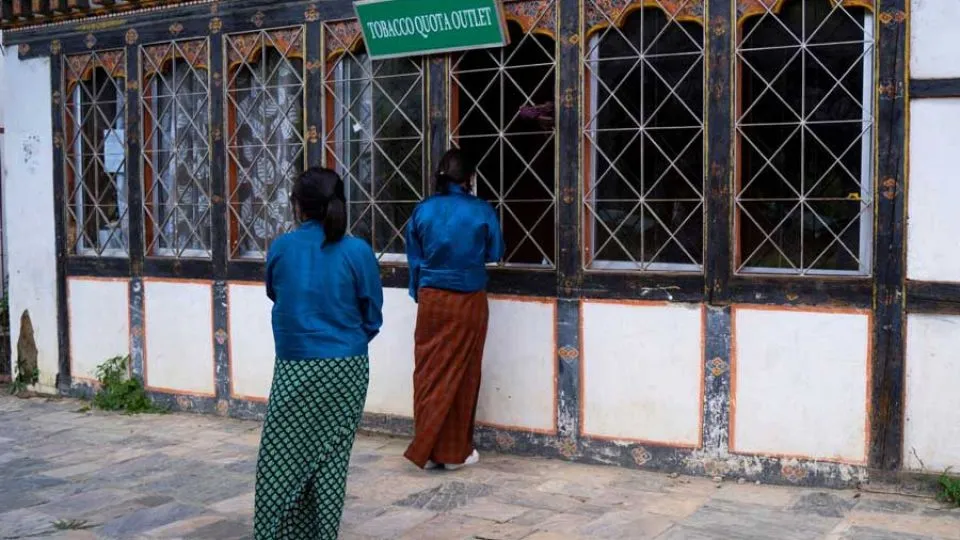
Arya News - A recent policy brief suggests risk-based taxes, tighter product rules, and wider quitting support, after Bhutan`s tobacco sales ban was lifted in 2021.
THIMPHU – Bhutan’s tobacco policy needs to move beyond treating different nicotine products in largely the same way, according to a 2026 policy brief that identifies gaps in taxation, regulation and cessation support.
The policy brief titled “A Harm Reduction and Fiscal Strategy for the Post-Liberalization Era: A Policy Framework for Regulating Alternative Tobacco Products in Bhutan”, was co-authored by Karma Choden, an economics lecturer at JSW School of Law, Sonam Tshering, an associate professor at JSW School of Law, and Carmelo Ferlito, CEO of the Malaysia-based Center for Market Education.
The paper examines Bhutan’s shift from prohibition to controlled liberalisation following the 2021 amendment to the Tobacco Control Act.
According to the policy brief, the removal of the sales ban addressed enforcement failures and reduced dependence on illicit channels, but also exposed a regulatory gap around alternative nicotine products.
It states that while Bhutan’s current tobacco legislation regulates combustible tobacco, it is ambiguous about products such as heated tobacco products, nicotine pouches, and some synthetic nicotine products.
The brief identifies “insufficient differentiation” between products with different risk profiles, patterns of use and cessation potential as the main weakness of the legislation.
The researchers also point to taxation as a major issue. From January 2026, cigarettes have been subject to excise, Goods and Service Tax (GST) and customs duty, while e-cigarettes face a 100 percent excise tax, along with GST and customs duty.
The brief estimates that e-cigarettes and heated tobacco products can face a cumulative fiscal burden of about 115 percent.
The authors argue that taxing lower-risk alternatives at levels close to combustible tobacco can reduce the price difference that could encourage smokers to switch. They also warn that high prices could push some consumers towards informal or illicit markets.
Sonam Tshering said Bhutan’s experience shows the limits of relying on bans and punishment to control tobacco.
He said that prohibition did not eliminate demand for tobacco in Bhutan and that similar approaches have struggled elsewhere to stop people from accessing tobacco through informal markets. “The fundamental reason for tobacco control is to reduce harm, not to punish.”
According to co-author Karma Choden, higher tobacco taxes are important but cannot by themselves make people quit. “Very high taxes can put a heavier burden on highly dependent and lower-income smokers and may also push some consumers towards informal markets.”
The policy brief recommends a risk-proportionate tax system, with combustible tobacco remaining heavily taxed while lower-risk alternatives are subject to different fiscal treatment. This would preserve a clear price difference between combustible tobacco and lower-risk alternatives and could encourage existing smokers to switch.
Karma Choden said Bhutan is also missing much of the support and regulation needed to make such a system work, pointing to limited access to nicotine-replacement products such as patches and gum, weak data on alternative nicotine use and quitting outcomes, and gaps in the law covering newer products such as synthetic nicotine, heated tobacco and vapes.
The brief also recommends stronger controls on alternative nicotine products, rather than leaving them in a regulatory grey area. It calls for product registration, ingredient disclosure, toxicity reporting, nicotine concentration limits and product-specific packaging and safety standards.
For youth protection, the authors recommend strict age verification, retail licensing, controls on online sales and restrictions on youth-oriented product characteristics.
The policy brief also recommends better monitoring of tobacco and nicotine use, calling for tobacco-use data to distinguish between combustible smoking, smokeless tobacco and non-combustible alternatives, so that policymakers can track how consumption patterns change rather than treating all nicotine use as one category.
More than eight in 10 tobacco users surveyed in the 2020 Global Youth Tobacco Survey expressed a desire to quit. However, the policy brief states that cessation services in the country have limited access to evidence-based tools such as nicotine replacement therapy, while formal data on cessation outcomes remains limited.
The authors recommend expanding access to nicotine replacement therapy and other cessation support and integrating regulated alternatives into a broader cessation strategy.
The brief also recommends setting a clear long-term target for reducing smoking prevalence and strengthening monitoring to assess whether tobacco-control measures are achieving that target.
Bhutan’s tobacco policy has changed significantly since the Tobacco Control Act 2010. The 2021 amendment removed restrictions on commercial sales and distribution after the prohibitionist system faced persistent illicit trade. The policy brief notes that seizures of smuggled cigarettes rose from 3.7 million sticks in 2018 to 11.9 million in the first half of 2021.