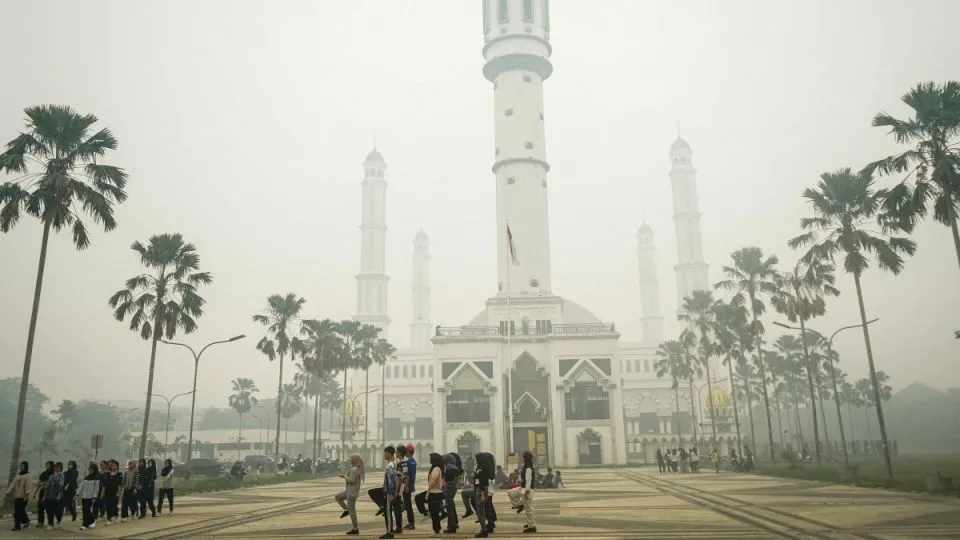
Arya News - More than two months into haze crisis, worsening air quality and mounting health concerns are fueling frustration among residents and renewed calls for authorities to hold those responsible for the fires accountable.
JAKARTA – More than two months into a haze crisis that has blanketed parts of Southeast Asia, worsening air quality and mounting health concerns are fueling frustration among residents and renewed calls for authorities to hold those responsible for the fires accountable.
On Monday morning, Kartika Lestari woke up to the worst air quality she had experienced since the beginning of the year in her hometown of Palembang, the capital of South Sumatra.
“The haze has turned the skies dark and yellowish. Even wearing a mask won’t really protect us, as the residue will stick to our clothes,” Kartika said during a virtual press conference hosted by Greenpeace Indonesia on Monday.
The concentration of microscopic toxic particles known as PM2.5 in the riverine city reached 1,702 micrograms per cubic meter (μg/m3) that day, making Palembang the most polluted city in Indonesia, according to the Environment Ministry’s Air Pollutant Standard Index (ISPU).
The figure was more than five times the threshold for the index’s highest, “dangerous” category, which begins at 300 μg/m3, indicating a severe public health risk.
“This is something that should not be tolerated any longer,” Kartika said.
Palembang recorded a significant increase in acute respiratory infection cases, from 13,480 in July to 17,434 in September, with the highest number of cases reported in fire-prone districts bordering areas affected by the fires, including Kertapati and Gandus, according to local officials.
South Sumatra is among six provinces prioritized for aerial firefighting and weather modification operations, alongside Riau, Jambi, West Kalimantan, Central Kalimantan and South Kalimantan.
Months of widespread wildfires in forest and peatland areas across the archipelago have also sent haze beyond Indonesia’s borders, reaching as far as the Philippines.
In Malaysia’s capital Kuala Lumpur, resident Muhammad Syahir said he had to take his young daughter to hospital after she experienced chest congestion and breathing difficulties amid the worsening haze.
“She was admitted for five days and the cost was almost 10,000 Malaysian ringgit [US$2,444],” Syahir told the press conference.
Air quality in several parts of Malaysia and neighboring Singapore also remained at unhealthy levels on Tuesday.
Accountability needed
As of late August, nearly 900,000 hectares had burned across Indonesia, an area roughly four times the size of Tokyo, according to independent forest monitoring platform Nusantara Atlas.
Reports of deliberate land burning and fires inside palm oil, pulpwood, mining and other concessions have further complicated the crisis, which has been exacerbated by prolonged drought linked to the El Niño climate pattern.
Southeast Asian environmental groups have renewed calls for Jakarta to disclose the companies suspected of being behind the fires, including those linked to Malaysian and Singaporean businesses.
Heng Kiah Chun of Greenpeace Malaysia said several Malaysian and Singaporean agriculture companies operating in Indonesia were among those contributing significantly to the haze crisis.
“We cannot just point fingers at Indonesia because we also have a responsibility to ensure that the companies in our countries do not contribute to forest fires and transboundary haze,” Chun said.
In late September, the Environment Ministry said it had seized the assets of and imposed sanctions on 57 unnamed companies suspected of burning a total of 34,636 ha across Kalimantan and Sumatra. The Forestry Ministry and National Police have also taken action against additional companies and individuals.
The Environment Ministry did not respond to a request for comment.
Denny Bhatara, a senior campaigner at environmental watchdog Kaoem Telapak, recently told The Jakarta Post that although authorities appeared to have launched a crackdown on suspected companies, stronger enforcement and greater transparency were still needed.
“It’s still hard for civil society groups to keep track of legal enforcement progress, as some updates are rarely shared with the public,” he said.
On Sept. 17, Indigenous and civil society groups in West Kalimantan sued President Prabowo Subianto and his administration, accusing them of negligence for allegedly failing to prevent and properly handle wildfires that have paralyzed parts of the province.
Discontent over the government’s handling of the fires has also spilled onto the streets of Palembang.
On Monday, hundreds of students from Sriwijaya University (Unsri) staged a protest outside the South Sumatra gubernatorial complex, demanding that local authorities strengthen peatland governance and wildfire prevention measures.
They also accused the provincial administration of failing to prevent and respond to the fires, handing Governor Herman Deru a “red card” to signal their frustration.
–Yulia Savitri contributes to the story from Palembang
Read More:
Severe haze forces closure of 200 schools and childcare centres in Southern Malaysia
Southeast Asia cross-border haze expected to clear from Oct 9 as inter-monsoon period begins
Malaysia haze: 31 areas record unhealthy API readings as of 6pm