Arya News - President Prabowo Subianto’s expansion of the military’s command structure has raised fresh concerns over the widening military presence in civilian affairs, with critics fearing it would sidestep defence functions and only further weaken civilian supremacy across the regions.
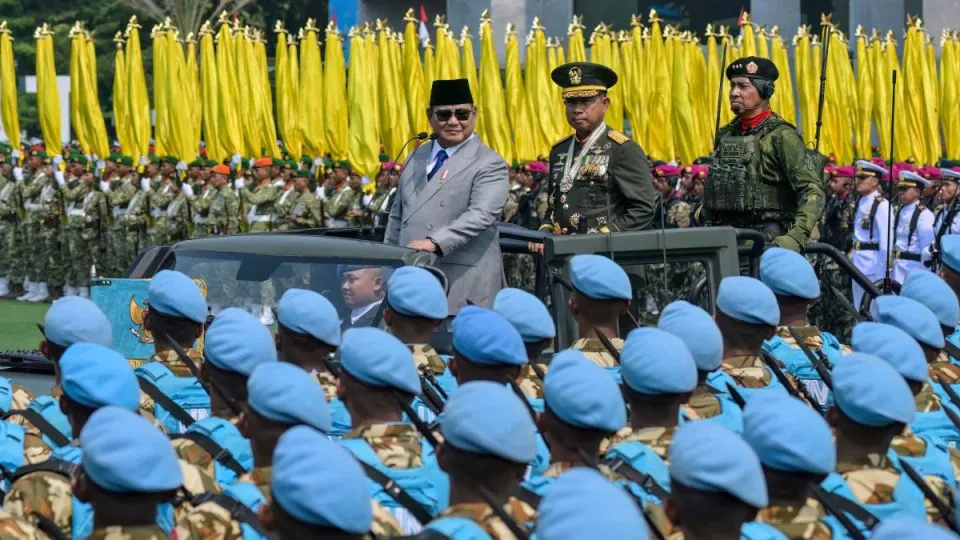
JAKARTA – President Prabowo Subianto marked the anniversary of the Indonesian Military (TNI) on Monday with the expansion of its command structure, as critics raise fresh concern of growing militarization in civic spaces.
In the event at the TNI headquarters in East Jakarta, Prabowo inaugurated over 200 new military units, which include six new regional military commands (Kodam) that serve to boost the Army’s territorial defense.
The new military commands will cover Yogyakarta, Riau Islands, East Nusa Tenggara, North Maluku, Central Papua and West Nusa Tenggara, areas which were previously covered by neighboring military commands.
The addition of new Kodam, now totaling to 27 across the country, was hailed by the Army as an integral restructuring plan for its territorial command to strengthen defense in the country’s border areas and outer islands.
The Navy and Air Force also received a handful of new combat battalions during the inauguration, although contrasting in quantity to that of the Army.
Prabowo described the expansion as a necessary preparation for potential threats and an effort to strengthen the military’s ability to respond to them.
“Peacetime is the period to prepare [ourselves] against threats. Even the worst ones,” Prabowo said in his speech on Monday.
The Monday ceremony also formalized the expansion of territorial development battalions tasked with food security programs and infrastructure projects, with Prabowo inaugurating 30 new brigades and 150 new battalions months after the Army said it had established them in April.
The government previously planned to build a total of 514 territorial development battalions for every regency and city nationwide.
Such expansion has since raised concerns over the military’s growing role in activities unrelated to defense responsibilities, with critics pointing to the military’s presence in initiatives ranging from food estate development to the flagship free nutritious meal program.
Erosion of civic spaces?
Monday’s inauguration has further exacerbated such fears among experts and activists, who said the latest expansion reflected the military’s ever-increasing role in civilian affairs.
“The inauguration of additional Kodam and hundreds of new TNI units is increasingly eroding the civilian sphere and forming the militarization of government as a command state,” Muhamad Isnur, chairman of the Indonesian Legal Aid Foundation (YLBHI), said in a press briefing on Monday.
While defense analyst Rizal Darma Putra of the Indonesia Institute for Defense and Strategic Studies (Lesperssi) said a Kodam unit could strengthen the country’s defense, he questioned the lack of apparent immediate threats in these new regions.
“In my view, this new Kodam lands as a militarization attempt because their territorial structures correspond with civilian administrative areas and could allow the military to ‘shadow’ civilian bureaucracies,” Rizal told The Jakarta Post on Monday.
The Commission for Missing Persons and Victims of Violence (Kontras) shared a similar sentiment, saying that the military’s growing involvement beyond national defense “reflected a similar trend of militarism” found during the New Order era under late president Soeharto, Prabowo’s former father-in-law.
The concern has grown since the controversial 2025 revision of the TNI law, which drew widespread criticism for expanding the range of civilian positions that active-duty soldiers may occupy and triggered a wave of legal pushback challenging the law at the Constitutional Court.
In response to the criticism, the government said it “respects the opinions” surrounding the military and that it remains committed to civilian authority and the military’s role in accordance with the law.
“Indonesia will continue to strengthen and modernize its defense capabilities based on national security needs, operational priorities and available resources,” the Government Communications Agency (GCA) told the Post on Monday.