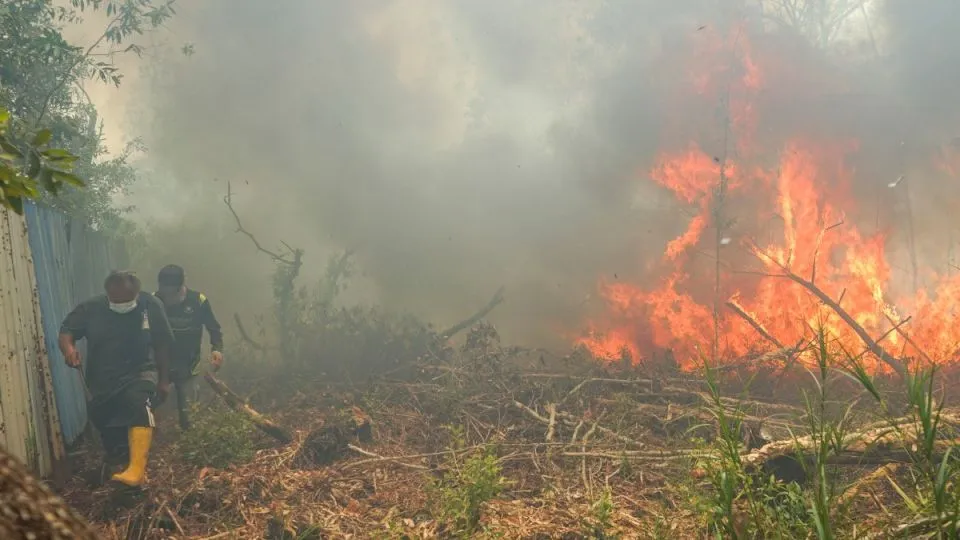
Arya News - Indonesia`s National Disaster Mitigation Agency (BNPB) is still mulling over the technical assistance on offer from Singapore and Malaysia to put out the fires, with cooperation to be focused on closing gaps from existing efforts.
JAKARTA – The government is standing firm in refusing to declare the raging forest and peatland fires a national disaster, asserting that it has launched extensive efforts to contain the blazes and curb the haze despite critics questioning the claim.
Indonesia has been dealing with months of wildfires reportedly caused by deliberate slash-and-burn practices for agricultural purposes and is exacerbated by a prolonged El Niño-induced drought.
At least 1.9 million hectares of land burned in nine months since January, according to figures from forest monitoring platform Nusantara Atlas.
Throughout the week of Oct. 19, the National Disaster Mitigation Agency (BNPB) recorded more than 21,400 ha of land burned in six worst-hit provinces, namely Central, West and South Kalimantan as well as South Sumatra, Jambi and Riau. Fires were also detected engulfing around 2,000 ha of land across Java, Sulawesi and Papua.
To tackle the impact, Indonesia has deployed “massive and integrated efforts” in the worst-hit regions, said Coordinating Human Development and Culture Minister Sugiono at a press briefing on Thursday, asserting that President Prabowo Subianto had instructed his administration to “do everything possible”.
The efforts included joint firefighting, water bombing and weather modification operations involving 71,000 personnel from the BNPB, the Indonesian Military (TNI), the National Police and local volunteers.
The government has also allocated Rp 1.24 trillion (US$68.5 million) for firefighting equipment as well as disbursements of masks, health services and other facilities for people suffering respiratory infections from the toxic haze.
“Regardless of a [national disaster] status, our response is national in nature,” Sugiono said, rejecting criticism that the government has been slow to respond.
Haze from the wildfires has disrupted flights and choked millions of people in neighboring countries such as Malaysia and Singapore. The two countries had offered assistance to help put out the fire, but none has yet to materialize.
While thanking the countries for the help offer, Sugiono said Jakarta had been maintaining communication through diplomatic ways and direct contact between state leaders.
The BNPB is currently discussing technical aspects for potential cooperation on putting out the wildfires. The agency’s spokesperson Berton Panjaitan said officials were still identifying types of assistance needed to ensure any foreign support was effective.
“Foreign assistance will be directed more toward procuring equipment and technology that Indonesia doesn’t currently have,” Berton said on Thursday.
Calls to declare the widespread fires a national disaster have come from communities affected by the fire and choking haze, environmentalists and lawmakers of the House of Representatives.
Disaster management expert Eko Teguh Paripurno said indicators of a national disaster, including socioeconomic impact, geographic coverage and damage, were already “clearly evident” in this year’s forest fires season, which is projected to be worse since 2015.
The fires, he argued, had exceeded the scale of routine seasonal blazes, requiring extraordinary measures especially in areas not usually affected. While appreciating authorities’ response so far, Eko noted a national disaster status could unify response commands across sectors with greater budget flexibility.
“If [the government] has sufficient empathy and the status would make the response more effective, then it should be done,” said the National Development University (UPN) Yogyakarta professor on Friday
Under Indonesia’s disaster management framework, national disaster status typically follows regional administrations declaring they cannot cope with the disaster with their own sources.
But regional declarations can be bypassed by the central government to push for more intensive efforts against the fire, according to public policy expert Trubus Rahadiansyah.
“With the fires spreading this widely, the central government doesn’t need to wait. It can take over if it has the political will,” Trubus said on Friday.
Public frustration over the government’s handling of the fires has spilled over into the streets with protests in Jakarta and other cities urging the government for more intense wildfire containment.
But rather than addressing people’s demands and grievances, the state has resorted to repressive crowd control against the rallies, according to rights group Amnesty International Indonesia.
“The government has failed to protect citizens’ rights to life and physical health in its handling of the forest fires,” Amnesty International Indonesia executive director Usman Hamid said in a statement on Friday.
“It has also openly suppressed the rights to freedom of expression and assembly when people speak out about it,” he continued.
Read More:
Indonesia defends gas export cuts; says existing contracts have not been breached