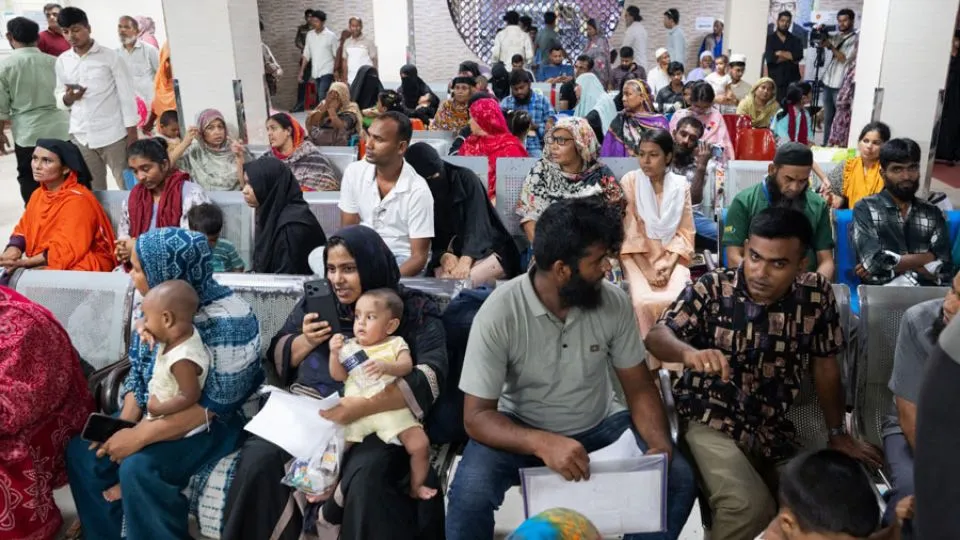
Arya News - A latest government study finds that out-of-pocket (OOP) healthcare expenditure has pushed more than 10.8 million Bangladeshis – more than 6% of the country`s population – below the poverty line in 2022.
DHAKA – Out-of-pocket (OOP) healthcare expenditure pushed more than 1.08 crore Bangladeshis, or 6.4 percent of the population, below the poverty line in 2022, a new government study has found.
The figure is almost double the 56 lakh people, or 3.9 percent of the population, pushed below the poverty line by OOP expenditure in 2005, according to the study.
The rise came even though the national poverty rate more than halved, from 40 percent in 2005 to 18.7 percent in 2022.
The share of the population facing financial hardship due to healthcare spending also rose, from 28.2 percent in 2005 to 41.7 percent in 2022, well above the global estimate of 26 percent in 2022.
“The poorest households were the worst sufferers,” said Subrata Paul, focal point for Universal Health Coverage and National Health Accounts at the Health Economics Unit (HEU).
The HEU conducted the study with support from the World Health Organization (WHO) and the Swedish Embassy. The findings of the study, “Financial Risk Associated with Out-of-Pocket Healthcare Payments and Benefit Incidence in Bangladesh”, were presented at a hotel in Dhaka yesterday.
OOP payments are the money households pay directly for healthcare, including medicines, diagnostic tests and treatment, rather than having the costs covered by the government or others.
A person faces financial hardship when OOP healthcare payments exceed 40 percent of the money remaining after meeting basic needs, while impoverishing OOP payments are those that push a household below the poverty line.
The study analysed four rounds of the Household Income and Expenditure Survey (HIES), conducted in 2005, 2010, 2016 and 2022, to assess trends in healthcare spending, its impact on poverty and inequalities in access to publicly funded health services.
The incidence of catastrophic health expenditure climbed from 12.5 percent in 2005 to 32.1 percent in 2022, the study found.
“This indicates a sharp deterioration in households’ ability to afford healthcare without facing financial strain,” Subrata said.
Catastrophic health expenditure (CHE) occurs when OOP healthcare payments exceed 10 percent of a household’s total consumption expenditure. The WHO replaced the indicator with financial hardship last year, as CHE does not reflect the actual situation.
Average monthly household OOP payments (inflation adjusted) rose from Tk 1,241 in 2005 to Tk 3,238 in 2022, and the proportion of households reporting any OOP payment rose from 52.5 percent to 92.7 percent during this time, Subrata said.
The study identified medicines, diagnostic tests, hospitalisation and consultation fees as major contributors to household healthcare expenses. It also found growing reliance on pharmacies for outpatient care, with their share rising from 32.5 percent in 2016 to 55.4 percent in 2022.
In 2022, 90.8 percent of people in the poorest consumption quintile faced financial hardship due to healthcare spending, compared with only 13.6 percent in the richest quintile, he added.
Rural people bore the brunt, although financial hardship increased in both rural and urban areas. The study found that 47.9 percent of people in rural areas faced financial hardship in 2022, compared with 28.2 percent in urban areas.
Barishal division showed a striking reversal, he said. In 2005, it had the lowest rate of financial hardship among all divisions, at 22.5 percent. By 2022, it had the highest, with 59.1 percent of people facing financial hardship.
Public facilities remained the main provider of inpatient care, but their share fell from 61.3 percent in 2016 to 56 percent in 2022, while the private share rose from 36.9 percent to 42.5 percent during this time, he said.
The report also raised concerns over the distribution of public healthcare benefits, finding that public health spending no longer clearly favoured poorer households despite their greater needs.
“Compared with 2016, the findings suggest a loss of the previously observed pro-poor distribution of inpatient public health benefits, raising concerns about whether public resources are adequately reaching populations with the greatest health and financial needs,” the study says.
To reduce financial hardship, the study recommended increasing public financing, improving spending efficiency and equity, restoring the pro-poor distribution of public healthcare benefits, ensuring free and reliable access to essential medicines and diagnostics, and providing continuous and affordable care for chronic conditions.
Speaking at the programme, State Minister for Health MA Muhit said the findings reflected the dire straits of the health sector under the Awami League government.
Expressing deep concern over the alarming rise in OOP healthcare expenditure, Muhit said the government was committed at the highest level to curbing irregularities and corruption in the health sector.
Touhidul Islam and Sayem Ahmed of WHO Bangladesh gave separate presentations on the study. Rajesh Narwal, acting WHO representative to Bangladesh, was present at the programme, which was chaired by Enamul Haque, director general of the HEU.