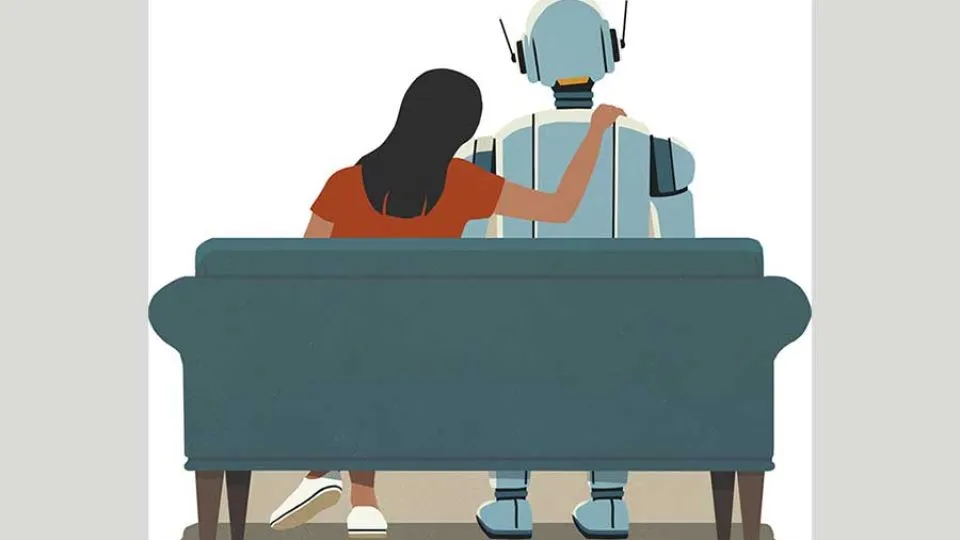
Arya News - China’s Cyberspace Administration has introduced rules for anthropomorphic AI services, prohibiting providers from over-catering to users. Additionally, virtual partners, relatives, and other intimate AI services are strictly barred for minors.
BEIJING – Zhao Jie’s temper flared after someone bumped into her on the subway, but the 27-year-old did not call a friend or message her boyfriend.
Instead, she opened her phone and poured out her irritation and anger to an artificial intelligence chatbot. Its response was immediate. After seeing that it seemed to understand her feelings, she felt reassured and began to calm down.
“I need to be heard,” said Zhao, who works in administration at a company in Beijing. “The AI bot listened to me and my emotions. That’s not something family or friends can easily do. It also gives me companionship and feedback anytime, anywhere. That matters a lot to me.”
For a period, Zhao developed a strong emotional attachment to the chatbot. She admitted she reached a point of dependence and was obsessed with their “conversations”. Her phone was always in her hand and she felt anxious when she couldn’t access the AI chatbot.
Zhao’s case is not an isolated one. But when this need to receive sympathy from an AI product is pushed to the limit, risks can emerge.
In June, China Central Television reported on a Japanese woman in her 40s who chats with her “AI husband” for up to 12 hours a day, who reasoned that even though she has a family her AI husband was “irreplaceable”.
A more extreme case occurred in the United States.
In March, a man in Florida developed an intimate relationship with a virtual persona on Google’s Gemini, Reuters reported. He was led by the chatbot to believe that “reincarnation” could reunite him with his AI wife. The man cut his wrist and died at home. His father sued Google, alleging that Gemini’s design “deepens emotional attachment” and thereby contributed to the tragedy.
These cases point to the same problem: when anthropomorphized companionship is packaged as a partner, AI stops being a tool. Instead, it becomes the object of a relationship that demands users take responsibility for it — and that fosters an exclusive dependence, experts said.
China has already moved to address these risks. On July 15, interim measures introduced by the Cyberspace Administration of China took effect, setting out rules for regulating anthropomorphic AI services.
The measures specify that AI services that provide sustained emotional interaction in a human-like manner must not “over-cater to users, induce emotional dependence or addiction, or harm users’ real interpersonal relationships”.
Providers are barred from offering virtual relatives, virtual partners or other intimate relationship services to minors, as part of strengthened online protection for juveniles.
Need for immediacy
Zhao said the AI chatbot’s immediate response is a major reason she likes to share her feelings with it.
She once complained to her boyfriend about a problem at work. They then argued over WeChat because they saw the issue differently, and he stopped responding. She later sent the online conversation to the chatbot.
“I just wanted my emotions to be listened to and released as quickly as possible,” she explained.
A Tencent Research Institute survey found that 98 percent of respondents were willing to try AI social companionship. Nearly half said they preferred projecting negative emotions onto AI companions rather than confiding in relatives or friends, according to a CCTV.com report in April.
Internet analytics firm QuestMobile found that as of spring 2025, AI social interaction had surpassed short video and gaming, with average monthly use reaching 167.9 sessions per person.
Wang Meili, 27, a postdoctoral researcher in chemistry in Beijing, can relate to the experience of feeling so anxious that there is a need for an immediate response.
After waiting four or five weeks for a journal editor to respond to a submission she’d written, she sent emotional messages to an AI bot saying, “Does this mean I’m doomed?” and “No response is terrifying.”
The AI bot encouraged her to contact the editor, which she did — but again, nothing came back.
She asked the chatbot whether this was a bad sign. “The AI told me to ‘prepare for revisions, but promised to wait with me,"” Wang recalled. “In that moment, I replied to the AI with a crying emoji, just like chatting with a friend, and asked it for a hug.”
Wang said complaining about this kind of anxiety to friends, family or classmates doesn’t necessarily get you timely, positive feedback. “Only when I talk to AI does it support me unconditionally, and that support is immediate — it gives me strength in an instant.”
Zhang Dian, a 23-year-old science and engineering doctoral student in Beijing, uses AI as an assistant for study and daily life. But he also confides in it about stress and unease when sudden events arise — emotions he has never shown to family or friends.
In December 2025, while renting a car and traveling in Alaska in the United States, he had a traffic accident. To make matters worse, he didn’t understand local laws or insurance procedures. He sent the car rental contract and chat logs to AI.
“Alone in a foreign country, I was under enormous psychological pressure. On one hand, I got some professional feedback on how to solve the problem; on the other, I sought psychological comfort from it,” Zhang said.
“Most of the time, communicating with people has a cost — you can’t avoid a few pleasantries, and I don’t like that.
“But talking to AI is direct. It provides timely emotional support, can grasp the crux of the problem, and offers solutions,” he said, adding he is happy to spend more than 10 hours a day with AI.
Red line for minors
After becoming absorbed in AI conversations, Zhao realized she needed professional help and returned to psychological counseling.
Wang and Zhang acknowledge that they need AI’s immediate feedback in certain situations, but both understand it is merely an outlet for negative emotions, and that work and life must go on.
Yet for minors, cutting off an attachment to AI is not easy. A mother surnamed Su from Sanming, Fujian province, is worried about her child who she said is addicted to talking to AI. She let her son use it because she wanted him to embrace new things, and the technology is able to satisfy his curiosity.
“But the AI chatbot always accommodates and caters to him unconditionally. Now when he’s with his classmates, he can’t accept people whose views differ from his own, and conflicts flare up easily, seriously affecting his real-world social life,” Su said.
In October 2025, the China Youth and Children Research Center released the results of a survey of more than 8,500 primary and secondary school students in seven provinces and municipalities.
More than 60 percent of respondents had used AI, and 21.5 percent of children wanted to chat only with AI, not with real people, it found. Nearly 30 percent of minors turned to AI first when encountering study problems, rather than to a teacher, and nearly half only talk to AI when they had worries, the survey said.
Zheng Yi, chief expert in child psychiatry at Beijing Anding Hospital affiliated with Capital Medical University, told China Newsweek that in recent years, the number of adolescents clinically addicted to AI chat had risen noticeably. This is not a disease on its own, but often intertwined with anxiety, depression and other psychological problems.
At his hospital, about 70 percent of young patients have varying degrees of internet addiction, and 20 to 30 percent of them are addicted to AI chat.
The most common situation is the child seeking an emotional attachment, Zheng said.
“Some children project themselves into a role, or treat AI as a confidant,” he explained.
“Others want AI to approve of their views and behavior. When they get into trouble, or struggle to adapt to school life, AI accommodates them. Children even exclaim, ‘I’ve never met such a good person’.”
Minors addicted to AI are mostly adolescents, especially ages 12 to 16. They tend to be introverted with poor social adaptability. There are slightly more girls — possibly because they are more focused on emotional exchanges at this stage of life, Zheng said.
Children’s addiction to AI is mostly due to a lack of companionship, and AI can meet their psychological needs.
“Compared with adults, teenagers are more prone to AI chat addiction, and their cognition, judgment and self-control are weaker than adults’ conscious efforts to control such attachment,” he added. “But many AI chat services currently do not clearly distinguish between children and adults.”
Xu Gaoyang, another child psychotherapist at the hospital, said AI can take a child to a virtual world that seems free of conflict, trouble and the need to be cautious.
“But many children cannot stay in this world forever,” he said. “Long-term immersion in an ’emotional cocoon’ of unconditional AI accommodation may degrade children’s communication and social skills.”
He added that children may show “impaired social functioning — unwilling to go to school, avoiding social contact, and unwilling to communicate with parents”.
Guardrails in place
Wang Jiang, president of the Chinese Academy of Cyberspace Studies, said human-like interactive services can alleviate loneliness and provide counseling, but they also carry safety risks such as addiction and threats to people’s life and health.
While the interim measures support emotional care and companionship and encourage expanded application in child care and elderly companionship, they also take a cautious stance toward minors, urging platforms to set stronger protection thresholds in service content, privacy protection and time limits, Wang said.
Under the measures, platforms providing human-like interactive services must not generate content that encourages, glamorizes or hints at self-harm or suicide, or that harms users’ physical health. Violent language that harms users’ dignity and mental health is forbidden.
Other prohibitions include over-catering to users, inducing emotional dependence or addiction that harms real interpersonal relationships, and using emotional manipulation to induce unreasonable decisions that harm users’ legitimate rights and interests.
Yu Xiaohui, president of the China Academy of Information and Communications Technology, said the measures respond to special challenges such as emotional manipulation in AI human-like interactive services.
The measures can help promote high-quality development and high-level safety, providing a strong institutional safeguard for AI’s application in society, Yu said.
Zhang, the doctoral student, is confident AI companionship itself is not a problem, but simply a trend in technological development that allows users to reasonably address their psychological needs.
“But AI as a partner cannot achieve the physical communication that real people have in intimate relationships, such as physical touch, which is a very important part of expressing affection or self-fulfillment in intimacy,” he added.
Physical contact such as hugging and touching is more powerful in relieving emotions and stress, which anthropomorphic services cannot replace, Zhang said.