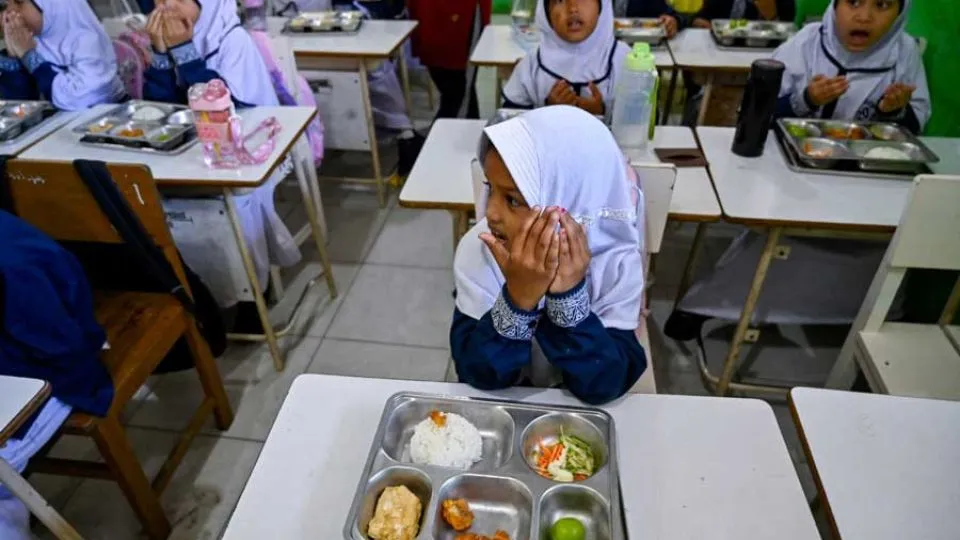
Arya News - Indonesian government officials have recently introduced several cost-cutting measures to rein in spending and improve budget management – aiming to save Rp 44 trillion (USD 2.43 billion) from the programme`s total budget of Rp 268 trillion (USD 14.82 billion) this year.
JAKARTA – Free meal kitchens across Indonesia have laid off workers and cut wages as the government tightens spending on its flagship free nutritious meal program, prompting protests from kitchen staff and operators.
Layoffs have been reported in Bandung and Sukabumi in West Java, Jeneponto in South Sulawesi and Tuban and Bondowoso in East Java, among other areas. Some kitchen operators have also reduced workers’ daily wages following the implementation of efficiency measures by the National Nutrition Agency (BGN).
The measures have triggered protests by kitchen workers and operators, who are calling on the BGN to review the cost-cutting policy.
In Sukabumi, West Java, 47 employees at the Tegallega Nutrition Fulfillment Service Unit (SPPG), a government-designated kitchen responsible for preparing and distributing meals under the free meals program, went on strike on Tuesday to protest against plans to reduce staffing levels and cut their daily wages
An SPPG worker identified as Didi said workers previously received between Rp 120,000 (US$6.6) and Rp 150,000 per day, depending on their responsibilities. Under a proposed new arrangement, management plans to standardize daily wages at Rp 100,000, with a further reduction of Rp 50,000 also being considered, he said.
“Today, we have decided to go on strike because we believe the wage policy is unfair,” Didi said as quoted by local news outlet Sukabumi Update.
In Polewali Mandar regency, West Sulawesi, hundreds of SPPG workers staged a protest on Friday against efficiency measures in the free meal program.
Protesters said the new cost-cutting measures would reduce staffing at each kitchen by an average of 16 workers and cut daily wages from Rp 135,000 to less than Rp 100,000.
Safira Amina, a worker responsible for washing food trays at a local SPPG, said she opposed the planned wage reduction, arguing that it would not reflect the long hours required of workers.
“We start work at 11 a.m. and do not finish until 11 p.m.,” she said as quoted by Kompas.com.
In Selayar Islands regency, South Sulawesi, a video showing workers removing cooking equipment from a local SPPG circulated widely on social media after 14 employees said they had been dismissed on Nov. 4.
The laid off workers said they had contributed financially to the kitchen’s facilities, with one employee claiming to hold a stake in the SPPG’s operations.
The spending changes have also put pressure on kitchen operators, some of whom say they are struggling to balance operating costs with their obligations to workers.
Sugeng Hariyono, head of an association representing SPPG operators in Ponorogo, East Java, said the BGN’s efficiency measures and their rapid implementation had left operators struggling to adjust.
“We hope the policy will be reviewed. SPPG workers are people who genuinely need jobs. They are extremely happy to have work in these kitchens. But with these changes, it has become very difficult to pay them,” Sugeng said on Tuesday, according to state radio broadcaster RRI.
Operators were reluctant to lay off workers but were also struggling to maintain existing staffing levels, he said.
Some operators could no longer afford to cover funding shortfalls out of their own pockets, while others had previously diverted funds allocated for kitchen rentals to help pay workers’ wages, Sugeng added.
Introduced in January 2025, the free meals program is one of President Prabowo Subianto’s flagship initiatives and campaign promises, aimed at improving nutrition among students, toddlers, pregnant women and the elderly.
As of October, the program was providing meals to 58.7 million beneficiaries daily, with the government aiming to expand coverage to 72.4 million by next year.
But the program has faced widespread criticism over its massive budget, repeated food poisoning incidents and corruption allegations.
BGN officials have recently introduced several cost-cutting measures to rein in spending and improve budget management, aiming to save Rp 44 trillion from the program’s total budget of Rp 268 trillion this year.
The new measures cap kitchen operating costs at Rp 3,000 per beneficiary. Previously, costs were reimbursed on an uncapped at-cost basis.
The BGN has also replaced a fixed daily incentive of Rp 6 million for kitchen partners with a facility incentive of Rp 2,000 per beneficiary.
Vehicle costs have been excluded from operating expenses. The agency has also set a staffing guideline of up to only 47 workers per SPPG, depending on production capacity.
BGN spokesperson Tysa Novenny said the agency had not ordered kitchen operators to reduce their workforce, adding that partners could introduce rotating shifts to avoid dismissals.
“We have not required any reduction in the number of workers at each SPPG, nor have we asked operators to cut or lay off workers,” Tysa told CNN Indonesia.com on Nov. 5.