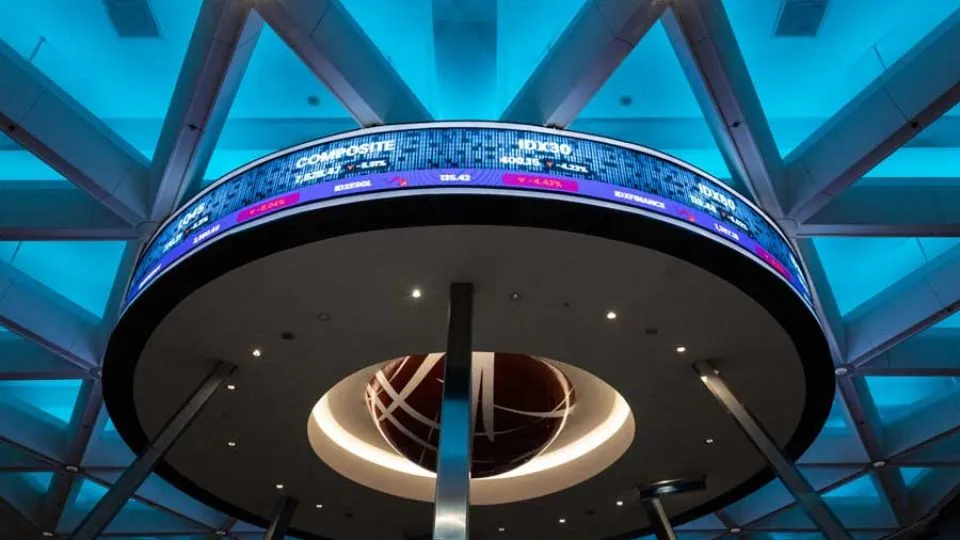
Arya News - The Indonesia Stock Exchange (IDX) has tightened its screening mechanism to identify stocks with high shareholding concentration (HSC) in its latest push to improve market transparency, raising the number of stocks classified under the category to 383.
JAKARTA – The Indonesia Stock Exchange (IDX) has tightened its screening mechanism to identify stocks with high shareholding concentration (HSC) in its latest push to improve market transparency, sharply raising the number of stocks classified under the category to 383.
That marks an increase from the initial 83 listed firms identified earlier this month, when the IDX rolled out the measure to exclude HSC stocks from its benchmark Composite index.
The expanded list follows an overhaul of the IDX’s screening mechanism, which previously limited screening to listed firms with a market capitalization above Rp 5 trillion (US$276.8 million).
“HSC screening is now conducted across the entire market, covering all listed shares,” IDX president director Jeffrey Hendrik announced on Tuesday, as quoted by CNBC Indonesia.
The additional HSC stocks, accounting for 6.16 percent of the total IDX Composite’s weighting, would be excluded from the index Jeffrey said.
The exchange also announced that it had scrapped the price impact ratio (PIR) metric for identifying HSC stocks. PIR measures how much a stock’s price changes relative to its trading activity.
Under the new mechanism, Jeffrey said the bourse would no longer depend on price movement in its screening, noting that a stock would be added to the HSC category if 10 or fewer shareholders collectively held 92.5 percent or more of the company’s total shares.
He added that the HSC committee would soon publish the updated list of HSC stocks and conduct a regular review to identify potential new additions.
To be removed from the watchlist, Jeffrey explained, a stock must prove an improvement in its public share distribution through transactions on the regular market.
He went on to say that the Self-Regulatory Organization (SRO), which includes the IDX, the Indonesia Central Securities Depository (KSEI) and the Indonesian Central Securities Depository (KSEI), would continue monitoring and conduct surveillance using existing technology.
“If we find any inaccurate reports, we will apply all the relevant regulatory provisions to impose sanctions on those responsible for spreading information to the public,” he asserted.
The screening overhaul comes as the local market braces for the upcoming index review announcement from MSCI, which is scheduled to be published on Thursday Jakarta time. But no final decision on Indonesia’s market status by MSCI will be made until June 2027.
The IDX unveiled its plans to exclude HSC stocks from its benchmark index in October, following MSCI’s proposal to downgrade Indonesia’s market status from emerging market to standalone market.
These HSC stocks, however, remain tradable despite being removed from the index.
Jeffrey has said that such a measure would provide a “fairer reflection” of the benchmark index’s movement, given the “potential risks” carried by shares with concentrated ownership.
Among the HSC stocks are issuers with large capitalization, including PT Bayan Resources (BYAN) and PT Barito Renewable Energy (BREN), which have a market capitalization of Rp 305 trillion and Rp 240 trillion, respectively.
Indonesia’s stock market has performed dismally this year amid looming concerns over a potential downgrade from its emerging market status by MSCI. The IDX Composite index has plummeted by more than 40 percent since the beginning of the year, making it the worst major index worldwide.