Arya News - Despite the EU’s large economy, Indonesia’s exports to the bloc stand at just $18.7 billion, well below those of neighboring countries such as Vietnam, Malaysia and Thailand.
JAKARTA – The government expects the Indonesia-European Union Comprehensive Economic Partnership Agreement (IEU-CEPA), which was signed on Saturday, to boost the country’s exports to the EU by 14.4 percent, or around 2.6 billion euros (US$2.85 billion). However, analysts noted that the benefits will depend on the timely implementation of the deal.
Coordinating Economy Minister Airlangga Hartarto claimed that businesses on both sides should begin feeling the benefits by Jan. 1, 2027, at the latest.
In Indonesia, garments are expected to record the largest export gains at 779 million euro, followed by leather and footwear at 652 million euro and vegetable oils at 512 million euro. The deal is also hoped to add 26.8 billion euro to the country’s gross domestic product by 2042.
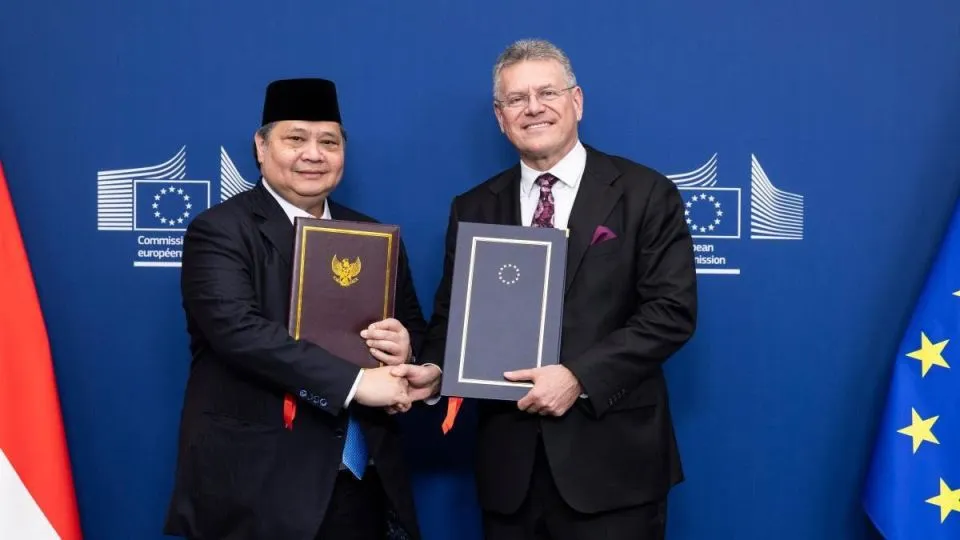
“[The signing] is an important milestone, not an end goal. Today, we enter the implementation stage, which demands harder work than the negotiation process itself,” Coordinating Economy Minister Airlangga Hartarto said after the signing on Saturday.
Trade Minister Budi Santoso said the agreement will immediately eliminate import duties on 90.4 percent, or 8,820, of the EU’s 9,754 tariff lines for Indonesian products, with a further 7.92 percent to be phased out over three to 15 years, bringing total coverage to 98.35 percent.
“More than 98 percent of EU tariff lines will provide preferential market access for Indonesia’s leading export products, such as palm oil and its derivatives, footwear, textiles, fisheries products, rubber, furniture and various other manufactured goods,” Budi said on the same event.
The agreement will immediately eliminate duties on 1,143 tariff lines for Indonesian textiles and garments, 78 for footwear and all 14 for palm oil and palm kernel oil, alongside selected downstream products such as oleochemicals, margarine and glycerol.
Frozen shrimp and whole tuna for industrial processing will also receive zero-tariff access, while other fisheries products, including processed tuna, surimi and sardines, will benefit from tariff cuts or duty-free quotas.
The deal is also expected to boost European investment in electric vehicles, batteries, critical minerals, renewable energy, pharmaceuticals and electronics in Indonesia. It will give Indonesian industries duty-free access from the outset to 86.2 percent of machinery tariff lines, 83.5 percent of chemicals and 73.9 percent of pharmaceuticals from the EU.
The investment agreements aim to strengthen legal certainty and investor confidence, while supporting technology transfers, domestic value-added industries and integration into global supply chains.
The deal also protects 72 Indonesian geographical indications in the EU, including Gayo Arabica, Toraja and Java Preanger coffee, Banda nutmeg, Lampung black pepper, Amed Bali salt and Alor vanilla.
For micro, small and medium enterprises (MSMEs), it offers simplified export procedures through self-declaration of origin and dedicated information channels on tariffs and export requirements.
On the other hand, EU exports to Indonesia are also projected to rise by nearly 40 percent over 15 years, particularly in machinery, motor vehicles and metals.
European Commission President Ursula von der Leyen said the agreements signed with Indonesia provided businesses with certainty through clear rules, open market access and a stable trade and investment climate over the long term, creating prosperity for 730 million people.
“EU-Indonesia trade and investment has vast untapped potential. With these deals in place, we will make rapid progress on delivering real benefits for our peoples and businesses,” she said on Saturday.
Meanwhile, Commissioner for Trade and Economic Security Maroš Šefčovič said the agreements’ success would instead depend on how effectively they were promoted and implemented.
“We are once again turning shared ambitions into tangible benefits. This is an important step towards a more prosperous economic future in the EU and Indonesia, opening new doors for businesses and giving momentum to our cooperation in key sectors such as agri-food and advanced manufacturing,” he said.
However, realizing the projected gains will depend partly on timely ratification, as Indonesia faces the expiration of tariff incentives under the EU’s Generalized Scheme of Preferences (GSP). Without the CEPA in force before the incentives expire, Indonesian exports could face higher duties, undermining their price competitiveness in the European market.
Paramadina University economist Wijayanto Samirin said the IEU-CEPA offered significant opportunities for Indonesia, but the government should establish an ad hoc team to ensure the agreement delivers tangible benefits.
“Agreements are often signed, then everything goes on as business as usual. Various obstacles that emerge are not addressed with quick solutions, marketing of our products to the EU is not well coordinated, and so on. As a result, various important agreements fail to deliver benefits,” he told The Jakarta Post on Sunday.
Despite the EU’s large economy, Indonesia’s exports to the bloc stood at just $18.7 billion, well below those of neighboring countries such as Vietnam at $63.9 billion, Malaysia at $30.3 billion and Thailand at $29.9 billion, he noted.
Wijayanto said that while CPO, footwear, garments, electronics, automotive components, coffee and cocoa had significant export potential under the agreement, environmental and deforestation concerns remained key barriers. He urged the government to step up lobbying and advocacy to address these issues.
Meanwhile, even after the agreement takes effect, businesses say it could take six to 18 months for exporters to enter the EU market and benefit from the deal.
Apindo chairwoman Shinta Kamdani said to the Post earlier this month that export-ready firms were better positioned to take advantage of the tariff cuts, while MSMEs faced constraints in production capacity, quality consistency, compliance with EU standards, financing and supply-chain access.