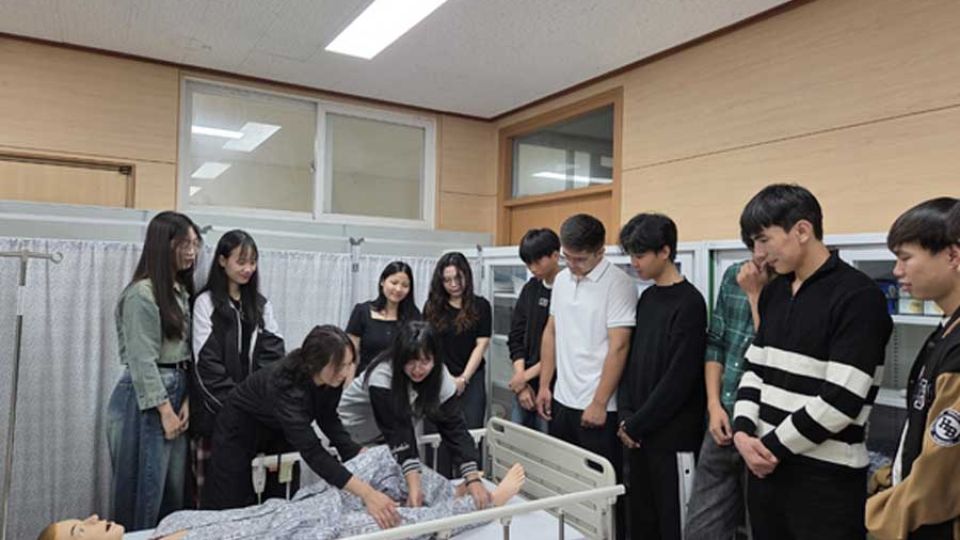
Arya News - As South Korea turns to foreign students to fill a shortage of caregivers, experts warn that bringing in new workers without first improving pay, conditions and career prospects could leave the underlying crisis unresolved.
SEOUL – South Korea’s rapidly aging population has created an issue that is at once demographic and deeply personal: Who will care for the growing number of older people?
The arithmetic appears daunting. Korea is projected to face a shortfall of roughly 116,000 eldercare workers by 2028, according to government data. The Health Ministry estimates the country will need 990,000 additional caregivers by 2043.
Yet beneath that headline shortage lies a contradiction.
Nearly 2.3 million people have obtained caregiver qualifications but are not working in the field, according to the care workers’ union affiliated with the Korean Confederation of Trade Unions.
That has led workers and labor experts to question whether Korea simply lacks people capable of providing care — or whether it lacks care jobs attractive enough for people to enter and remain in.
As policymakers search for ways to expand the care workforce, one increasingly prominent part of their strategy is to open new pathways for foreign residents and international students.
With Korea firmly a super-aged society and demand for elderly care rising, the government has begun creating routes for international students to train as caregivers and remain in the country for work.
But if poor pay and working conditions are part of what keeps qualified Koreans out of the sector, another question follows: Will those same jobs prove attractive enough for the foreign students now being recruited to fill them?
A shortage of workers — or of good jobs?
Care work occupies a paradoxical place in Korea’s labor market. Society increasingly depends on it, yet the work remains relatively poorly compensated and socially undervalued.
Workers assist with some of the most intimate parts of daily life — bathing, toileting, feeding and mobility — while also performing emotional labor for elderly people suffering from loneliness, dementia and declining health.
Yet the occupation offers little career progression, and workloads can be severe.
“Although stereotypes against caregivers have subsided, the job remains difficult compared with other careers,” Jeon Hyun-wook, head of the KCTU-affiliated care workers’ union, told The Korea Herald.
Caregivers are generally paid around the minimum wage, with pay rising largely in line with increases in the statutory minimum. There is no wage system recognizing seniority or accumulated experience, while night shifts and overtime are difficult to avoid at nursing homes that operate around the clock.
Jeon said those conditions help explain why many qualified workers stay away from the field. “We keep telling authorities that there needs to be better treatment,” he said.
Lee Kyu-yong, a senior researcher at the Korea Labor Institute, said the large pool of inactive certificate holders suggests Korea’s shortage cannot be explained simply by a lack of qualified people.
“There are a great many Koreans who hold caregiver qualifications,” Lee told The Korea Herald. “They are not going into the field because the wages and working conditions are poor.”
For Lee, the problem is one of sequencing. “Improving caregivers’ working conditions should come first,” he said, questioning whether bringing in foreign workers should precede efforts to make the existing jobs more sustainable.
Kim Ok-nyu, a Sookmyung Women’s University professor who studies migration and care work, put the problem more bluntly.
“The care sector is already one of the occupations Koreans avoid,” Kim said. “If Koreans don’t want to do the work, migrants won’t necessarily want to do it either.”
That is the central risk facing Korea’s new strategy. Migration may expand the pool of potential workers, but it does not by itself make care work more attractive.
Looking abroad for caregivers
To address the looming shortage, the Justice Ministry and the Health Ministry announced in March 2025 that 24 universities nationwide would be allowed to operate degree programs for foreign students seeking caregiver qualifications from 2026.
Under the two-year pilot program, designated universities can establish departments for international students and offer degree courses leading to caregiver certification. The curriculum must follow government guidelines and include customized Korean-language training.
The government has also introduced visa-related incentives aimed at recruitment and settlement.
“With a shortage of caregivers expected going forward, the foreign caregiver training university program could serve as a way to secure a stable workforce,” Health Minister Jeong Eun-kyeong said when the program was announced.
For policymakers, international students offer a potential source of long-term workers. They are younger than much of the existing caregiver population, can build Korean-language skills while studying and may remain in Korea after graduation.
For students themselves, the program can also create opportunities that did not previously exist.
For 37-year-old Uyanga, a Mongolian student studying global nursing at Sahmyook Health University, the new track has offered a chance to pursue both a new career and long-term settlement in Korea.
“I heard it is difficult to obtain a D-2 visa past your late 20s,” Uyanga told local media. “I am now able to study what I enjoy in Korea, a country I was always interested in.”
Uyanga majored in veterinary medicine in Mongolia and later worked at a processed-food factory testing chemical treatments. She said she had long wanted to work in social welfare, particularly elderly care.
“I am confident that I can provide care and support services to elderly people better than anyone,” she said. “I had a strong desire to work in social welfare, especially in elderly care.”
For students like Uyanga, the program offers something tangible. It provides a degree, a profession and a possible path to staying in Korea. But the same conditions that deter Koreans will still be waiting for them after graduation.
Can migration work without reform?
Both Kim and Lee questioned whether the government has sufficiently prepared for what happens after those students graduate.
Kim said students entering the new tracks may not have been given a realistic picture of the wages and working conditions awaiting them.
“They aren’t necessarily studying with an accurate understanding of the working conditions or wages they will face as caregivers,” she said.
Kim said some students could arrive expecting wages in Korea to translate into greater purchasing power than they actually provide once housing, food and other living costs are taken into account.
The program also contains a built-in mismatch. Foreign students are being asked to complete college-level programs to enter an occupation whose Korean certification system currently has no requirement for academic qualifications.
Kim questioned whether the sector has created a wage and career structure capable of recognizing that additional education.
“If someone has earned at least an associate degree, are they going to receive the same pay as someone with no educational requirement?” Kim said. “The wage system itself has not been properly established.”
Without better pay or meaningful career advancement, Kim warned, the caregiver track risks becoming a stepping stone into other industries rather than a lasting occupation, cutting directly against the policy’s goal of securing a stable care workforce.
“The students need to be given accurate information and asked whether they still want to come,” she said. “Only when they come with clear information can both the foreign students and Korea reduce the risk of harm.”
Lee likewise questioned whether policymakers had adequately worked through the realities of the existing caregiver market before launching the foreign-student pathway.
“The sequence is somewhat wrong,” he said. “To put it strongly, I think the people who designed this system may not sufficiently understand the reality of the caregiver market.”
Lee also warned against assuming foreign workers can simply be substituted one-for-one for experienced Korean caregivers under existing staffing arrangements. Facilities operate with set staffing levels, he said, and newly arrived caregivers may need time to adapt to language and workplace barriers. Without additional staffing support, that adjustment period could increase existing workers’ workloads rather than relieve them.
Migration is part of the answer, not the whole answer
Despite those concerns, even labor representatives acknowledge that migration will likely form part of Korea’s response to its shrinking workforce.
“The union had held a lot of debates and there were a lot of opinions on whether we should oppose the government policy to host more foreign caregivers,” Jeon said. “In the end, the union decided we would not oppose it because we are ultimately in a shortage.”
The debate, then, is less about whether foreign caregivers should enter Korea than about the conditions under which they do — and whether migration supplements reform of the care industry or becomes a substitute for it.
For Kim, making that strategy sustainable starts with recognizing caregiving as skilled work. Caregivers frequently work with elderly people with serious medical conditions, requiring them to recognize emergencies and make rapid judgments. Language difficulties can have consequences beyond inconvenience if workers cannot immediately understand a resident or communicate during a medical emergency.
“This is work with highly vulnerable people, often people with serious conditions, so the service has to be provided professionally,” Kim said.
High turnover can also affect the quality and continuity of care. If foreign students use caregiving merely as a temporary route into Korea before moving elsewhere, elderly recipients could repeatedly see their caregivers replaced.
For foreign recruitment to become sustainable, Kim said, the sector needs better working conditions and a career structure that recognizes skills and experience. Prospective recruits must also understand what the job offers before committing to study and work in Korea.
Korea can broaden the pool of people willing to enter care. The harder task is giving them a reason to stay.