• Arya News AgencyEnglish
    • خبرگزاری آریافارسی
    • وکالة آریا للأنباءالعربیه
Tuesday, August 18, 2026
  • Home
  • Iran
    • World
      • Economy
        • Sports
          • Technology
            • Archive
            World

            The vanishing trade of Bhutan’s Drukor

            Tuesday, August 18, 2026 - 06:25:49
            The vanishing trade of Bhutan’s Drukor
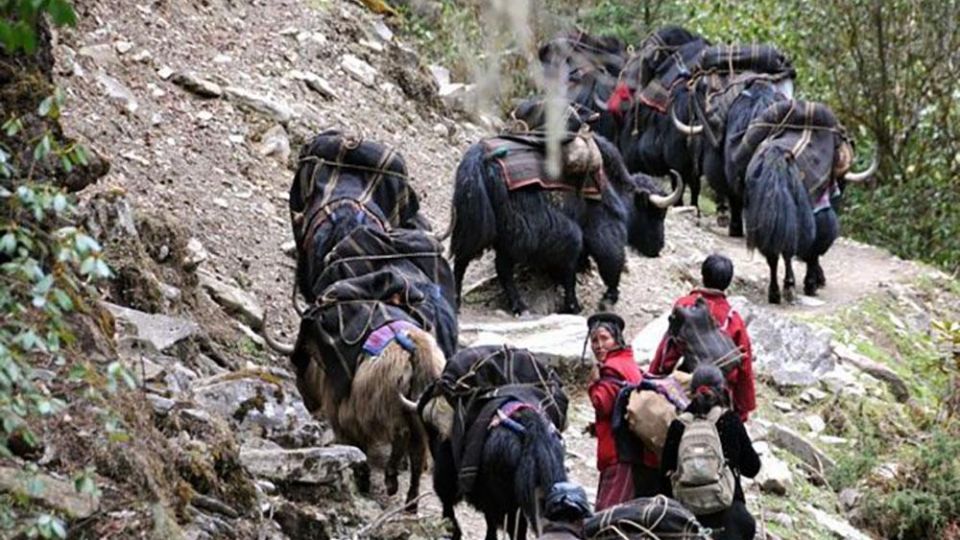
            Arya News - Drukor usually began by late October and continued for four months. As they moved from village to village collecting grain, highlanders took about a week in each place to gather grain and exchange dairy products.

            THIMPHU – “Merak Sakteng cee Sakteng, Waaktsa beeley cee mala. Radhi Phongmey toh Phongmey, Waaktsa beeley toh mala.”
            It is a local saying in Trashigang that loosely translates to, “Merak and Sakteng have butter, but no butter to feed the children; Radhi and Phongmey have rice, but no rice to feed the children.”
            It began as a joke among children, but it also captured an economic reality that connected the highlanders with the inhabitants of the lower valleys of Trashigang through the exchange of grain.
            The highlanders (Brokpas) had butter and cheese. The people of Radhi, Phongmey and other lower valleys had rice and maize.
            For 67-year-old Dorji Wangdi, the saying brings back memories of a time when this exchange was not simply an economic transaction, but a way of life. “Even as a child in the village, I remember this saying,” he said.
            At the heart of this relationship was Drukor , the traditional practice of Brokpas travelling to the lower valleys to exchange their dairy products for grain.
            Drukor was more than a journey for food. It created a bond between communities separated by geography and different ways of life.
            In the summer, when the Brokpas migrated south with their cattle, they moved from village to village, collecting maize and other grains they had bartered for butter and cheese.
            “We used to give dairy products to our Nepos (village hosts) in villages such as Radhi, Phongmey, Bidung, Khaling and Samkhar, and collect grains from them in winter,” said Lobzang Tashi, 60, from Merak. “Whenever we came down, which was not very often, we used to bring around 200 to 300 kilograms (kg) of butter and cheese.”
            In return, the Nepos brought grain and vegetables to trade for butter and cheese, often adding gifts of liquor and extra grain for their host families in Merak and Sakteng.
            Through his network of three to five Nepos, Lobzang Tashi said he trades roughly 300kg of butter and some 600kg of cheese and yosha, a traditional fermented cheese.
            In exchange, many highlanders took back around 30 bags of unhusked rice and 30 bags of maize, each weighing 100kg. The highlanders were constantly on the move during Drukor , transporting the grain home before setting out again.
            A journey measured in grain
            Drukor usually began by late October and continued for four months. As they moved from village to village collecting grain, highlanders took about a week in each place to gather grain and exchange dairy products.
            During the harvest season, highlanders received 13 to 14 changdeys of rice (one changdey is about two kilograms) from Radhi and Phongmey in exchange for 1kg of butter. For 1kg of fermented cheese, they received about 12 changdeys of rice.
            Highlanders also exchanged two hand-woven woollen blankets for 280 changdeys of maize and dried chillies from a single household in Thrimshing. “There was a difference between what we bartered before the grain harvest and what we bartered during the harvest,” said Lobzang Choden.
            Her other Nepos in Changmey, Radhi, Phongmey and Bidung gewogs gave her unhusked rice and maize in exchange for butter and cheese.
            Former Sakteng Mangmi Lhendrup explained that every Brokpa family had its own specific areas to visit for Drukor . “About 50 families from Merak go to Shingkhar Lauri in Samdrupjongkhar, 48 to Khaling, about 30 to Kangpara, and so on,” he said. “But some never go beyond Tashigang.”
            The Brokpas from Sakteng and Merak also traded with Tawang and Bomdila in Arunachal Pradesh, India.
            Before roads changed everything
            Lobzang Dorji recalled that in the past, before road connectivity, the Brokpas traveled to Trashigang and Rangjung towns to buy salt and cooking oil. “Now we don’t go that far. Almost everything is available in the village shops,” he said.
            Brokpas are no longer seen in Trashigang, Rangjung and Khaling towns carrying leather bags of fermented cheese. The availability of shops and road connectivity in the gewogs has reduced the Brokpas’ dependence on local inhabitants for grain.
            The Brokpas themselves admit that they no longer move around as much as they did in the past, and now spend weeks at their host houses instead.
            “In the past, there was a constant exchange between the Brokpas and the local communities here. The relationship still exists, but it is not as strong or as frequent as it once was,” said Pema Dorji of Radhi.
            Merak Gup Nima said that brokpas now rely on Bolero trucks instead of horses, allowing them to complete Drukor in a single day. “We still need to do Drukor because nothing grows in the village and, more importantly, we need maize to feed our herds,” he said. “But the way of doing Drukor has changed.”

            Short Link:
            News Code:
            Member Code:

            More News
            Seoul mayor faces 18-month prison request over campaign polls
            Seoul mayor faces 18-month prison request over campaign polls
            Pressure mounts to halt, review Indonesia President Prabowo’s free meals programme
            Pressure mounts to halt, review Indonesia President Prabowo’s free meals programme
            Young dancers seek freedom in Korea’s growing street dance scene
            Young dancers seek freedom in Korea’s growing street dance scene
            Over 1,000 Malaysians in 2km queue for jobs with starting pay of $1.1k
            Over 1,000 Malaysians in 2km queue for jobs with starting pay of $1.1k
            After detention reform, migrants in South Korea still face locked doors and long waits
            After detention reform, migrants in South Korea still face locked doors and long waits
            Steeped in culture: Chinese tea wins over Moscow
            Steeped in culture: Chinese tea wins over Moscow
            New faces coming for polls in Malaysia’s Johor
            New faces coming for polls in Malaysia’s Johor
            15 bodies recovered in Bangladesh in 21 days, sparking public concern
            15 bodies recovered in Bangladesh in 21 days, sparking public concern
            Tropical storms, heat and drought putting millions of Vietnamese children at risk: UNICEF
            Tropical storms, heat and drought putting millions of Vietnamese children at risk: UNICEF
            • More News
            • In four years, Generation Alpha begins coming of age. What will it mean for South Korea?
            • Why cash refuses to die in Pakistan
            • Singapore’s key exports rise 24.2% due to strong AI demand, but miss forecasts
            • Why cash refuses to die in Pakistan
            • Singapore’s key exports rise 24.2% due to strong AI demand, but miss forecasts
            • Iraq-Syria Pipeline Bypassing Hormuz Will Take Years, Billions to Rebuild
            • Singapore’s key exports rise 24.2% due to strong AI demand, but miss forecasts
            • Brunei’s durian season survival guide
            • Two reported dead in school shooting in southern Philippine city of Zamboanga
            • Captive-bred ibis released into wild in world first in Cambodia
            • Bangladesh’s China-bound brides: Deceived, drugged and trafficked
            • Former Malaysian PM Mahathir welcomes first great-grandchild
            • Royal Thai Army regrets Chong An Ma blast near Cambodia border, warns site remains dangerous
            • South Korean tech giant SK rally rewrites group chair Chey’s US$668mil divorce settlement calculus
            • Official ‘kidnapped, tortured’ for culling dogs in Pakistan
            • Pakistan’s cosmetic boom outpaces oversight
            • Pakistan’s cosmetic boom outpaces oversight
            • Two killed as student opens fire at Philippines high school, official says
            • Linen weaving keeps Vietnam’s traditions alive
            • The vanishing trade of Bhutan’s Drukor
            • Will BTS reconsider Grammy boycott as entry deadline looms?
            • Mongolia’s fuel supply returns to normal, restrictions on licence plates and purchase limits lifted
            • Thai dentists face legal action for re-signing cannabis prescriptions
            • Mongolia’s fuel supply returns to normal, restrictions on licence plates and purchase limits lifted
            • Chinese scientists develop new approach for diabetes treatment


              خبرگزاری آریا

              "Arya News Agency" is an official and independent Iranian news agency with the slogan "Transparent, honest and professional movement in information dissemination."

              Join with Us:

              Tuesday, August 18, 2026
              News Groups:
              • Iran
              • World
              • Economy
              • Sports
              • Technology
              Arya Group:
              • مرکز مطالعات استراتژیک آریا
              • شرکت سرزمین هوشمند آریا
              • انتشارات پیشگامان اندیشه آریا
              © - Arya News Agency
              About us| Contact us| RSS| Links| Advanced search