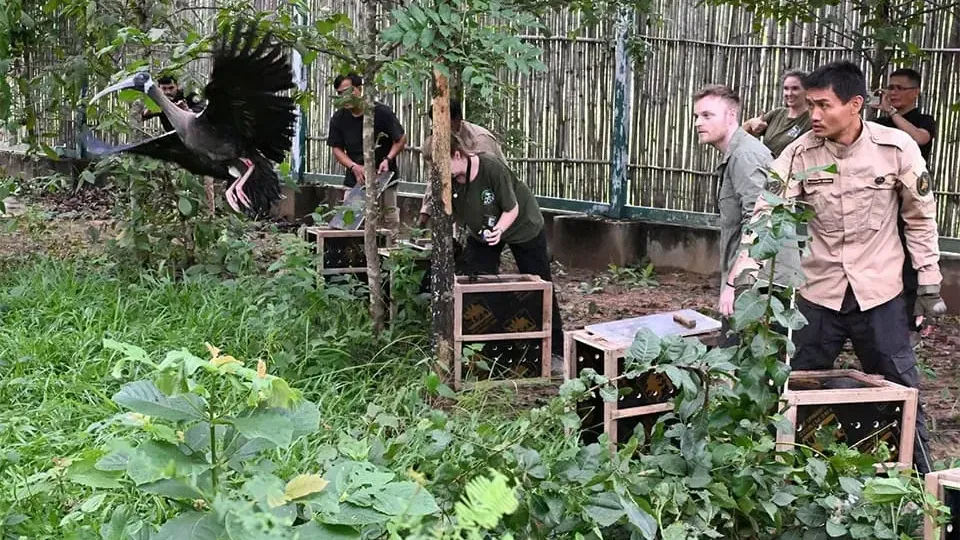
Arya News - The six birds were bred and raised at the Angkor Centre for Conservation of Biodiversity (ACCB) in Siem Reap, the only facility in the world that is raising a population of the critically endangered species, as part of efforts to help prevent its extinction.
PHNOM PENH – Six white-shouldered ibis, one of the world’s most critically endangered bird species, were released into the wild in Stung Treng province’s Siem Pang Wildlife Sanctuary last week in what conservationists described as the world’s first release of captive-bred and human-raised giant ibis.
The six birds were bred and raised at the Angkor Centre for Conservation of Biodiversity (ACCB) in Siem Reap province, the only facility in the world which is raising a population of the critically endangered species, as part of efforts to help prevent its extinction.
The ACCB said the release marked a major milestone in white-shouldered ibis conservation, with fewer than 1,000 birds estimated to remain in the wild worldwide.
Northeastern Cambodia is believed to support about 95 per cent of the species’ global population, making Siem Pang Wildlife Sanctuary one of the last key strongholds for the ibis.
Four of the six birds were fitted with GPS tracking devices before their release, allowing conservation teams to monitor their movements and behaviour in the wild.
Conservationists hope the released birds will strengthen the wild population and eventually reproduce, helping to increase the species’ numbers in the years ahead.
The six birds comprise three males and three females. They were all bred at ACCB and hatched between 2023 and 2025.
ACCB currently has 18 ibis at its facility. Eight were rescued from the wild after suffering injuries or being recovered from wildlife traffickers.
The centre also has two breeding pairs that have recently produced offspring, with their chicks expected to be released into the wild in the near future.
The species has been severely affected by habitat loss and hunting, making protected areas in northeastern Cambodia particularly important for their survival.
ACCB has worked with its partner Rising Phoenix, which has constructed breeding facilities and manages more than 130,000 hectares of wildlife sanctuary that provides a safe habitat for the birds.
The latest release represents an important step in efforts to restore the species in the wild, while demonstrating the potential for captive breeding programmes to support the recovery of critically endangered wildlife.