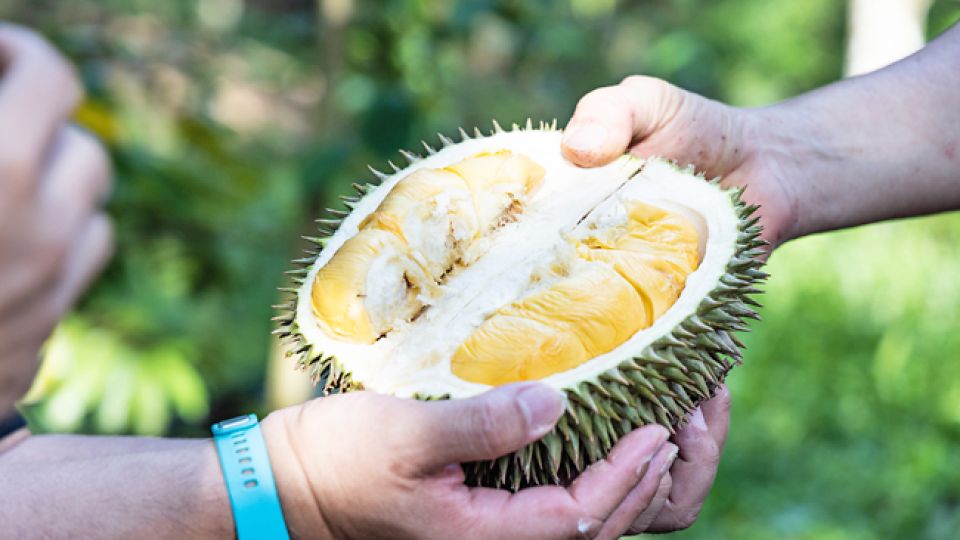
Arya News - Whether packed neatly into plastic containers or still wearing its formidable suit of thorns, the king of fruits has returned alongside mangosteens, rambutans and kembayau – Borneo’s glossy, purple-black answer to the olive.
BANDAR SERI BEGAWAN – Visit any of Brunei’s major open-air markets now and you will probably smell it before you see it.
Durian season is here. Whether packed neatly into plastic containers or still wearing its formidable suit of thorns, the king of fruits has returned alongside mangosteens, rambutans and kembayau – Borneo’s glossy, purple-black answer to the olive.
These seasonal delicacies can deliver quite a punch, not only to the nose and taste buds but also, according to local wisdom, to the body.
Durian, in particular, has long been described as “heaty”: the sort of food blamed for scratchy throats, mouth ulcers, constipation and the uncomfortable warmth that follows an overly ambitious sitting.
My mother and siblings recently returned from a durian shopping spree across the border sounding as though they had spent the journey home shouting over a concert.
Their voices were barely there and their throats painfully scratchy – the apparent consequences of embracing durian season with rather too much enthusiasm.
In Brunei, the intensely flavoured durian putih is often regarded as especially heaty. Its thick, creamy flesh can leave a distinctive tingling or stinging sensation on the tongue.
By comparison, many people find that the yellow, orange and red varieties do not leave them feeling quite as worn out.
Science has not directly compared how Brunei’s durian varieties affect the body, but there may be a physical basis for part of this familiar experience.
A randomised clinical study involving 16 healthy adults found that durian produced a higher and longer-lasting thermic effect than an equal-calorie portion of banana.
The thermic effect of food is the temporary increase in energy the body uses – and heat it produces – while digesting, absorbing and processing a meal.
Simply put, the body works harder after eating, which may help explain that warm or flushed feeling.
FAST FACTS: NOT ALL DURIANS ARE CREATED EQUAL
– Colour may mean a different species: Durian putih, kuning, orange and merah are not necessarily different colours of the same fruit. Many coloured Bornean durians belong to species such as Durio graveolens or Durio kutejensis, while creamy white varieties may belong to Durio zibethinus or other local types.
– Creaminess may offer a clue: Thick flesh generally contains less water and a greater concentration of sugars, fats and other solids. A rich durian putih may therefore give the digestive system a heavier workload than a smaller or less dense fruit.
– The sting may be chemical: Different durians contain different mixtures of volatile compounds, including the sulphur-containing compounds behind their unmistakable aromas. Research suggests Durio kutejensis generally has a milder sulphurous profile than Durio zibethinus.
– Red does not mean dangerous: A 2024 study of indigenous Sarawak durians found that yellow-, orange- and red-fleshed fruits contained vitamin C, carotenoids and antioxidant compounds.
Researchers have compared the nutrients and aromas of different durians, but no human trial has established whether durian putih produces greater heatiness or throat discomfort. For now, local experience remains a few steps ahead of clinical research.
DO NOT TREAT THE FIRST DURIAN LIKE THE LAST ON EARTH
Fruit season creates a strange urgency. Someone opens a durian, the family gathers and suddenly everybody is racing for the best ulas as if the trees will stop fruiting tomorrow.
Slow down. Durian contains fibre and useful nutrients, but it is also rich in carbohydrates, natural sugars and fat. Eating too much may leave you bloated, uncomfortably full or nursing heartburn.
Begin with two or three ulas, eat slowly and wait before reaching for another. Those managing diabetes should be particularly mindful: depending on their size, three seeds may contain between 20 and 30 grammes of carbohydrates, according to Raffles Medical Group.
People with kidney disease may also need to watch their intake because durian contains potassium.
Remember, fruit is not a competitive sport. You do not receive a trophy for finishing an entire durian alone.
DO DRINK WATER – EVEN IF IT COMES WITH A HUSK
Many Bruneian households practise the same post-durian ritual: pour drinking water into one of the empty chambers, or locules, inside the husk, swirl it around and drink from it. Some add a pinch of salt. Elders may insist that this cools the body or neutralises the fruit’s heatiness.
There has, surprisingly, been some scientific investigation into the custom. A small preliminary study by Universiti Kebangsaan Malaysia tested five people after they ate durian. Water drunk from the husk appeared to have a mild short-term effect on oral temperature, possibly due to pectin from its inner surface.
However, its effect was broadly similar to drinking the same amount of plain water. The study was too small to prove that the husk offers special cooling powers.
Provided the chamber and water are clean, there is no need to abandon the custom. Think of the husk as ceremonial crockery rather than a miracle cure, then follow it with a proper glass of water. Sugary drinks are unnecessary; the durian has already handled that department.
An evening durian session can easily become a second dinner.
WATCH THE TIMING
Eating a large quantity on top of an already heavy meal may invite indigestion.
For people susceptible to acid reflux, lying down soon afterwards may allow stomach acid to irritate the throat and voice box. This can cause a raw throat, bitter taste, coughing or hoarseness – sometimes without the usual burning sensation of heartburn.
Remain upright after eating and give yourself time to digest before bed. Mangosteen may traditionally be paired with durian for its supposed cooling qualities, but there is no firm evidence that one cancels out the other. Enjoy it because it is delicious, not as a licence to keep eating indefinitely.
RESPECT THE FRUIT AND ITS ARMOUR
Place the durian on a stable surface, protect your hands with a thick glove or folded cloth and cut away from your body. Better yet, ask the vendor to open it.
Once opened, refrigerate the flesh promptly in a tightly sealed container. In Brunei’s heat, cut fruit should not remain outside for hours. A good seal will also prevent everything in the refrigerator from smelling like durian until next season.
Fruit season is brief and deeply woven into life in this part of the world. Enjoy the roadside stops, family debates over varieties and containers exchanged between households. All it takes is a little restraint, enough water and the wisdom to recognise when you have had your share. There will always be another ulas in the refrigerator – and probably another relative arriving with an entire boot full of durians.