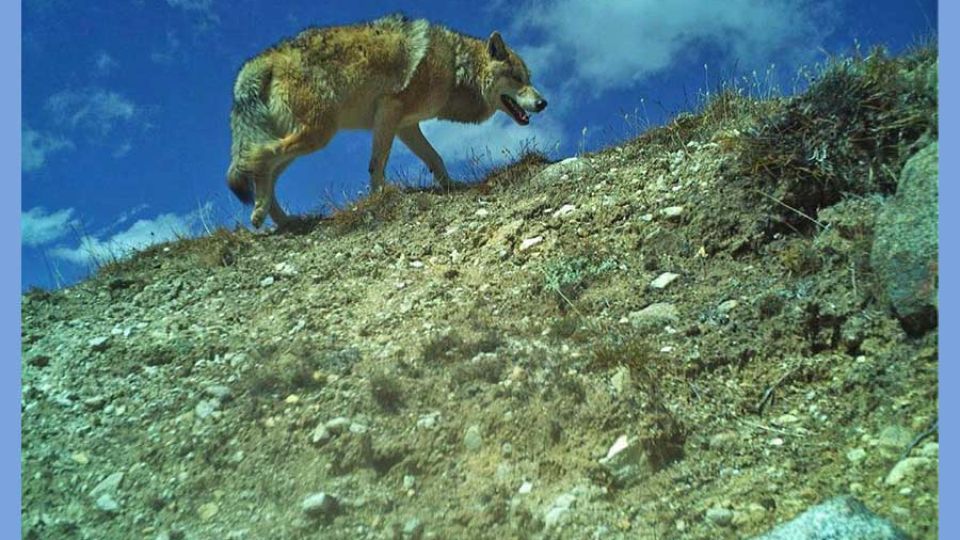
Arya News - Genetic evidence confirms what the country`s first wolf habitat study could only suggest.
THIMPHU – Wolves found in the country’s high-altitude landscapes belong to the ancient Himalayan wolf (Canis lupus chanco) lineage, according to the first genetic study of wolves in Bhutan.
The finding resolves a question left unanswered by the first wolf distribution study, published in 2024. That study found that the animals were likely Himalayan wolves but noted that genetic evidence was needed for confirmation.
The new study, “Wolves in Bhutan are part of the ancient Himalayan wolf (Canis lupus chanco) Lineage”, was published in the international journal Ecology and Evolution on August 19.
The study was carried out by Tashi Dhendup, Antonio Sampedro, Joshua J. Robinson, Jan E. Janečka, and Geraldine Werhahn.
The researchers are affiliated with the Department of Forests and Park Services, the University of Queensland, the Himalayan Wolves Project, the Himalayan Carnivore Foundation, the Biodiversity Research Institute in Spain, Duquesne University in the United States, the University of Oxford, and the IUCN Species Survival Commission’s Canid Specialist Group.
The genetic samples came from the country’s nationwide snow leopard survey conducted in 2022 and 2023. Field teams collected 184 faecal samples thought to belong to snow leopards. Laboratory tests later identified some of them as wolf faeces.
Wolf DNA was successfully obtained from 13 samples—12 from Wangchuck Centennial National Park and one from Jigme Dorji National Park.
The genetic results placed all the tested Bhutanese samples within the Himalayan wolf group and distinguished them from other wolf lineages. The genetic variants detected in Bhutan matched variants previously recorded in north-western Nepal.
This provides evidence that the sampled wolves in Bhutan share maternal ancestry with Himalayan wolves found elsewhere in the region.
The study identified five possible individual wolves among the 13 samples. However, the same animal may have produced more than one sample. The finding, therefore, is not an estimate of the country’s wolf population.
The latest finding builds on an earlier study by Nature Conservation Division officials Tashi Dhendup, Letro, Tandin, and Sonam Wangdi. Published online in the journal Oryx in May 2024, it was the first study to map wolf distribution and potential habitat in Bhutan.
The 2024 study compiled 32 camera-trap records of wolves from nationwide snow leopard and tiger surveys. These were records of wolf presence, not a count of 32 individual wolves.
Of the 32 records, 25 were from Wangchuck Centennial National Park, four from Paro Forest Division, two from Jigme Dorji National Park, and one from Jigme Khesar Strict Nature Reserve.
The wolves were recorded between 4,281 and 5,090 metres above sea level, mostly in alpine meadows. The study estimated that about 2,431 square kilometres, or 6.3 percent of the country, could be suitable wolf habitat.
Based on Bhutan’s proximity to known populations in Nepal and the Tibetan Plateau, the 2024 study considered the animals likely to be Himalayan wolves. Their identity, however, remained unconfirmed in the absence of genetic evidence.
The latest study fills that gap for wolves sampled from Wangchuck Centennial and Jigme Dorji national parks.
However, the samples were limited in number and geographical coverage. Twelve came from Wangchuck Centennial National Park and only one from Jigme Dorji National Park. Wolves previously recorded in Jigme Khesar Strict Nature Reserve and Paro Forest Division were not represented.
The study recommends wider sampling to determine the number of wolves in Bhutan, identify individual animals, and understand whether wolves in different parts of the country are connected.
It recommends expanding genetic sampling to Jigme Khesar Strict Nature Reserve, Paro Forest Division, and areas between known wolf habitats. It also calls for future sampling of neighbouring wolf populations in Arunachal Pradesh, particularly Tawang, and the adjoining Tibetan Plateau.
The confirmation is important because the Himalayan wolf is one of Asia’s most ancient and distinct wolf lineages. It is adapted to the high-altitude, low-oxygen environments of the Himalayas and the Tibetan Plateau.
The Himalayan wolf is listed as Vulnerable on the International Union for Conservation of Nature Red List because of its small global population and declining numbers.
As an apex predator, the wolf also plays an important role in high-altitude ecosystems by regulating prey populations and helping maintain ecological balance.
In Bhutan, wolves remain among the least-studied large carnivores. The study identifies livestock depredation and the resulting human-wildlife conflict as threats in high-altitude areas.
Wolves are protected under Schedule II of the Forest and Nature Conservation Act of Bhutan 2023. However, the study notes that Bhutan does not have a dedicated national programme for wolf research, conflict mitigation, or conservation planning.
The study recommends combining wider genetic sampling with field surveys and assessments of human-wolf conflict to identify important habitats and movement routes and guide national conservation planning.