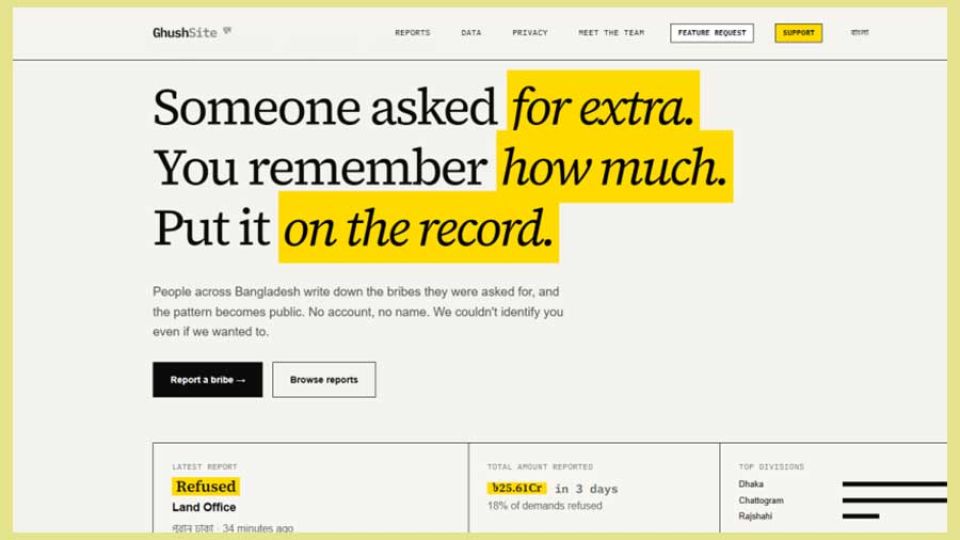
Arya News - GhushSite, a website launched on August 21, describes itself as an anonymous public ledger of alleged bribe demands in public services, allowing users to record what they say they were asked to pay without identifying themselves.
DHAKA – For anyone who has dealt with a government office in Bangladesh, the official fee is usually the easiest cost to establish. It may be listed on a website or stated on an application form. What is considerably harder to know is whether there is another, unofficial cost attached to getting the service done, often described as “speed money”.
If there is, how much might be expected? That information is rarely written down. Instead, it tends to circulate through conversations with people who have already gone through the process, relatives who know someone in an office, or middlemen familiar with the system.
GhushSite, a website launched on August 21, is attempting to bring some of that informal knowledge into the open. The platform describes itself as an anonymous public ledger of alleged bribe demands in public services, allowing users to record what they say they were asked to pay without identifying themselves.
By August 24, the site had published 804 reports from all eight divisions, with alleged demands totalling roughly Tk 13.65 crore, according to its founders.
The figures are striking, but they require substantial qualification. The reports are submitted anonymously and are unverified, and the platform does not claim to establish whether an alleged demand actually took place. It is neither an alternative complaints authority nor an investigative body.
Its proposition is narrower: if people already exchange information about unofficial payments privately, could a public database make those experiences easier to compare?
An experiment
GhushSite was built by Saif Kabeer, 23, and Shahed Sharif, an 18-year-old A-level student and full-stack developer. Saif runs GM Studios and SaaSMotionDesign.com and is completing a double major in computer science and marketing at BRAC University.
Neither has a professional background in anti-corruption work. They describe GhushSite as an independent project that they currently fund themselves, including its hosting costs.
The idea came from an Indian website, bribes.fyi, which Saif discovered and sent to Shahed. Their initial reaction was that someone should create something similar for Bangladesh. Instead of leaving the idea to someone else, they decided to build it themselves. GhushSite went live roughly a day later.
The speed of the launch reflects the relative simplicity of the concept: create a form through which people can report alleged demands, organise those submissions into a database and make the information publicly searchable.
Saif says the aim is not to solve corruption through a website. Instead, he sees GhushSite as an attempt to address an information gap.
Someone applying for a government service for the first time may know the official fee but have little idea what previous applicants say they encountered in practice. Even where unofficial payments are widely discussed, that information is often anecdotal, fragmented and difficult to compare.
Submitting a report takes less than two minutes. Users select a department and service, provide an approximate location, enter the amount allegedly demanded and state whether they paid, refused or are still waiting. They can also add a short description of the incident.
There is no requirement to create an account, and the form does not ask for a name, email address or phone number.
Building anonymity into the product
Privacy is one of the more deliberate elements of GhushSite’s design.
The creators have decided that reports should not identify individual officials, keeping the focus on offices and public services rather than named people. According to Saif, the reports database also does not contain a column for IP addresses, meaning the published information does not provide an obvious route back to the person who submitted it.
Submissions are moderated before publication. The system checks reports for identifying information such as names, phone numbers, national identity card numbers and file numbers, as well as obvious spam or other material that should not be published.
The aim is to maintain a degree of separation between the person submitting a report and the information that eventually appears on the website.
The founders are explicit about the limits of that system.
“We’re a privacy filter, not a truth check,” Saif said.
Every report published on the site is marked “Unverified”, and the platform states that it is neither the Anti-Corruption Commission nor an official complaints mechanism. A report therefore represents what an anonymous user says happened; it should not be treated as an established finding of corruption.
The decision not to allow names is particularly significant. Publishing an identifiable accusation without being able to verify it would raise a different set of ethical and legal concerns.
By limiting published reports to departments, services, locations and alleged amounts, GhushSite is attempting to document patterns without becoming a public accusations board.
What the early data shows
By August 24, the site had published 804 reports. Of those, 430 came from Dhaka and 167 from Chattogram. Rajshahi accounted for 44 reports, Khulna 43, Sylhet 38, Rangpur 37, Mymensingh 30 and Barishal 15.
About 18% of reports stated that the person had refused to pay the alleged demand.
The amounts reported vary substantially. The average amount reportedly paid is about Tk 89,000, but the founders caution against interpreting this as a typical demand faced by an ordinary citizen.
A small number of large allegations involving land, building approvals, customs and tax push up the average considerably. For more routine services, reported amounts are generally in the hundreds or low thousands of taka.
The total of roughly Tk 13.65 crore should likewise be understood as the sum of allegations submitted to the platform, not an estimate of how much Bangladeshis actually pay in bribes.
Nor can the geographical distribution be used to rank divisions by levels of corruption. Higher numbers of reports may simply reflect population, awareness of the website, internet access or differences in willingness to use the platform.
Those limitations do not necessarily make the information useless. Rather, they shape how it can responsibly be interpreted.
The potential value of a crowdsourced database is less likely to lie in any single entry than in recurring reports that appear to describe similar experiences. If independent users repeatedly report similar demands involving the same service or office, those entries could potentially provide leads for further reporting or investigation.
They would not, on their own, prove that corruption had occurred.
When informal knowledge becomes searchable
The behaviour GhushSite is trying to capture is not new.
People have long exchanged information about unofficial payments through personal networks. Someone who has completed a passport application may tell a colleague what happened at the office. A family member may describe their experience dealing with land records. Someone else may recommend a broker who knows how to move a file through a complicated process.
Such exchanges can be useful, but they remain private and fragmented.
What GhushSite changes is the form in which that information exists. An account that might previously have remained part of a conversation can become a searchable entry linked to a service, location, amount and outcome.
Over time, that creates the possibility of comparing experiences that would otherwise have remained separate.
Saif describes the idea simply: “If you’ve been asked for one, write it down, and the next person walks in already knowing.”
The platform therefore occupies an unusual space between a public database and an informal reporting mechanism. It is more structured than a social media post, but far less authoritative than an official complaint or investigative finding.
The experiment beyond the launch
GhushSite’s usefulness will ultimately depend less on how quickly it accumulates reports than on the quality of the dataset it is able to maintain.
A database containing thousands of unverified allegations could quickly become noise if it is poorly moderated or interpreted as fact. Conversely, a carefully managed collection of recurring reports could make visible information that is difficult to obtain through conventional channels.
That is the experiment behind GhushSite.
The project does not claim that technology can replace investigations or that an online ledger can eliminate bribery. Instead, it is testing whether experiences that have traditionally remained informal, private and difficult to compare can be turned into structured public information, aimed at greater transparency.
The website cannot tell users whether the next person they encounter at a government counter will demand an unofficial payment, or how much that demand might be.
What it can do is show what previous users say they encountered.
Whether those accounts eventually amount to meaningful evidence of broader patterns is a question the website itself cannot answer. That would require verification, investigation and evidence beyond anonymous submissions.
For now, GhushSite is doing something more limited, but important nonetheless. It is creating a public record of allegations in an area where much of the information has traditionally circulated only in private.