Arya News - The operation came just days after the government declared that large-scale compounds had been eradicated from the Kingdom. 86 large-scale scam compounds had been raided, with legal proceedings underway to confiscate them as state property.
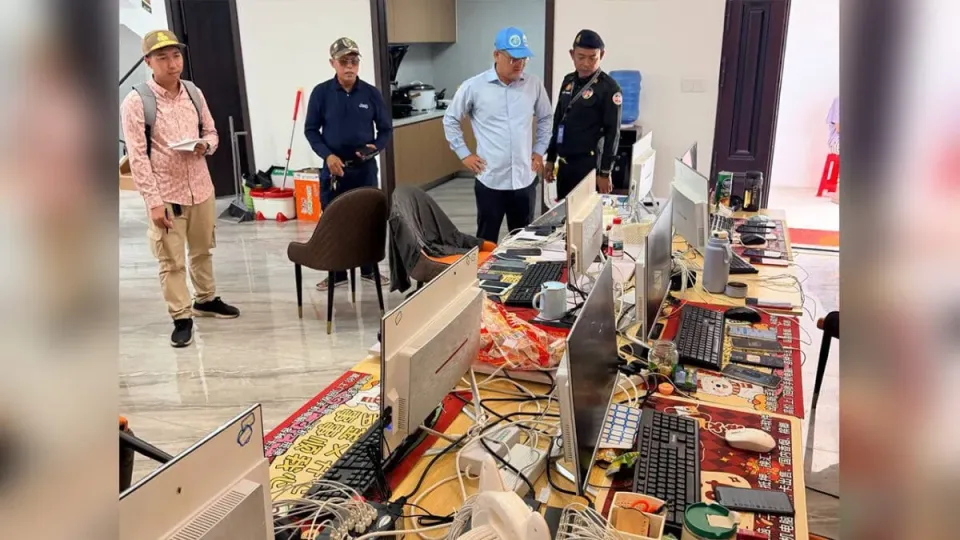
PHNOM PENH – A raid on a suspected online scam operation in a village in Koh Kong province led to the detention of 34 people and the seizure of 746 mobile phones, highlighting a new enforcement challenge as criminal networks reportedly disperse from large compounds into smaller and less conspicuous locations.
The operation in Peam Kay village, Koh Sdach commune, Kiri Sakor district, came just days after the government declared that large-scale compounds have been eradicated from the Kingdom. 86 large-scale scam compounds had been raided, with legal proceedings underway to confiscate them as state property.
However, the government acknowledged that scam activities have not been eliminated completely.
It said criminal groups are changing tactics by dividing their operations among houses, rented rooms, guesthouses, condominiums, coffee shops and even vehicles.
According to a report by the Commission for Combating Technology-enabled Scams (CCTC), specialised Kiri Sakor district authorities inspected the location on August 29 and 30.
Authorities detained 34 suspects, including 33 Chinese nationals – three of them women – and one Cambodian woman.
They seized 746 mobile phones, as well as 33 laptops and more than 30 other computers.
The suspects and evidence were transferred to the Koh Kong Provincial Police Commissariat for further legal proceedings.
The report did not identify the types of scams allegedly being conducted, the countries that may have been targeted, the number of possible victims or the value of any financial losses.
The government said the operation illustrates the changing nature of technology-enabled scam crimes following the dismantling of large compounds.
“These developments demonstrate that technology-enabled scam activities have evolved into smaller and dispersed operations across different locations,” said the CCTC.
It added that the shift requires stronger cooperation between authorities and the public, including timely reporting of suspicious premises.
Thousands of devices found in Phnom Penh
The Koh Kong raid came days after authorities in Phnom Penh discovered thousands of mobile phones and computers at a property in Chamkarmon district.
On August 27, forces from unified district command inspected house 128G10 on Samdech Sothearos Boulevard in Tonle Bassac commune over suspicions that untaxed equipment had been illegally imported.
Authorities seized approximately 3,000 mobile phones packed in 42 boxes, along with 211 all-in-one computers, 16 laptops, 16 CPUs and nine monitors.
However, the Chamkarmon operation concerned suspected smuggling of untaxed goods. The statement did not establish that the equipment had already been used or was intended for use in online scams.
No links to scam operations can be confirmed unless investigators find evidence connecting the devices to such offences.
Nevertheless, CCTC placed the discovery within the broader context of its warning that scam operations are becoming smaller and more dispersed.
The discovery followed August 24 raids at two properties in Phnom Penh’s Russey Keo district, where authorities detained four suspects and seized 585 mobile phones, foreign SIM cards and extensive computer equipment.
At one house in Tuol Sangke I commune, authorities found a Malaysian man with 540 phones and extensive computer equipment, as well as seven passports and a large quantity of foreign SIM cards.
At a rented room in Russey Keo commune, authorities detained one Cambodian man and two Cambodian women who were alleged to be involved in online scams and the distribution of foreign SIM cards. Police seized 45 phones and 154 SIM cards from the room.
Taken together, the Koh Kong and Russey Keo operations – as well as the discovery of the thousands of devices in Chamkarmon – have increased enforcement attention on houses, rented rooms and smaller buildings, although the three cases remain at different stages of investigation and do not carry the same legal status.
Large compounds cleared, smaller operations persist
Chhay Sinarith, senior minister in charge of special missions and head of the CCTC Secretariat, announced on August 27 that large-scale scam compounds were no longer operating in Cambodia.
He said the 86 large compounds previously identified by Cambodian authorities had been raided and brought under control.
The alleged ringleaders, accomplices and any other people involved would face legal action without exception, he added.
The claim that no large scam compounds remain does not mean that all technology-enabled scam activity has ended.
CCOS said continuing operations were changing form and moving into smaller, concealed premises.
Such premises may be more difficult to detect than large compounds because they can be embedded in communities or hidden behind the doors of apparently ordinary homes and businesses.
Dividing personnel and equipment among several smaller locations may also make investigations more complex, even when a single address contains hundreds of phones or computers.
The CCTC renewed its call for residents, foreign diplomatic missions, international organisations and other stakeholders to report suspected online scam locations so authorities can act quickly.
The government said it would intensify legal measures and regular investigations, increase public awareness of evolving scam tactics and strengthen cooperation with international partners.
It also warned the public to remain vigilant against technology-enabled scams, which continue to change form and become more complex.
He urged foreign missions and international organisations to share information about suspected clandestine scam operations with CCOS and relevant ministries and law enforcement bodies.