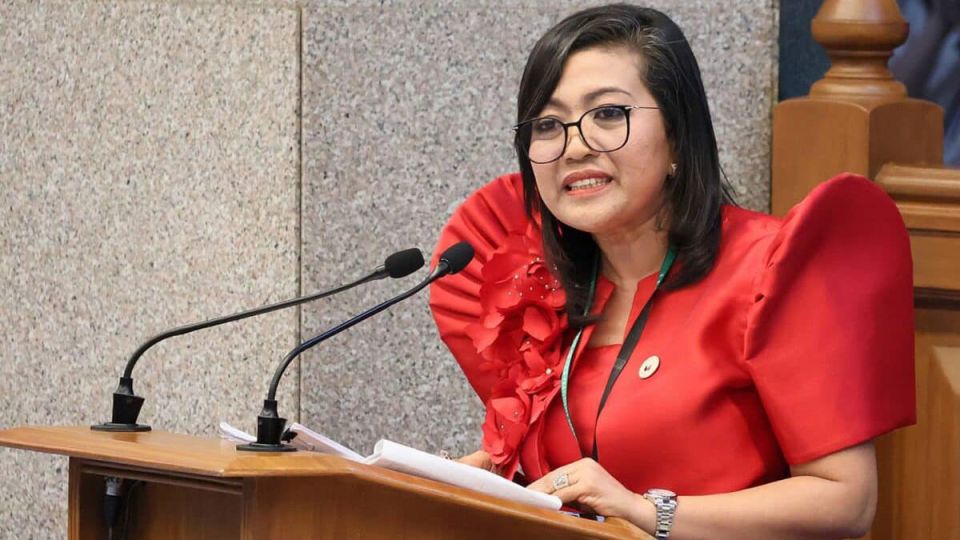
Arya News - Batangas Rep. Gerville Luistro, lead public prosecutor, stressed that no decision had been made, but said abandoning the bribery article was being considered partly to give the Senate impeachment court “some breathing room” and prevent the trial from dragging on.
MANILA – The House prosecution panel is considering dropping the bribery case against Vice President Sara Duterte and moving straight to the unexplained wealth allegations, a tactical shift that could narrow its battlefield and speed up the long-running impeachment trial.
Batangas Rep. Gerville Luistro, lead public prosecutor, said on Thursday the panel was weighing whether to skip Article 3, which accuses Duterte of bribing Department of Education (DepEd) procurement officials, and instead proceed to Article 2, which deals with alleged unexplained wealth involving Duterte and her husband, lawyer Manases Carpio.
Luistro stressed that no decision had been made, but said abandoning the bribery article was being considered partly to give the Senate impeachment court “some breathing room” and prevent the trial from dragging on.
“We do not want to drag this impeachment trial too much,” Luistro told reporters after a House hearing, citing the impact of the proceedings on Filipinos and the Senate’s competing responsibilities.
The timing of the proposal came as the Senate impeachment court announced a temporary change in its trial calendar before Wednesday’s session was adjourned, laying out a schedule that would extend hearing hours in October before a nearly monthlong suspension to make way for intensive budget deliberations.
Squeezed by the calendar
Presiding Officer Francis Escudero said the impeachment court would tentatively sit from 10 a.m. until early evening on Oct. 1 and 2, Oct. 5 to 9, and Oct. 12 to 15.
There would then be no impeachment hearings from Oct. 16 to Nov. 8.
The trial would resume on Nov. 9 and 16, from 10 a.m. to 2:30 p.m., before returning to its regular schedule beginning Nov. 23.
The proposed calendar underscores the prosecution’s calculation that time is becoming a factor, and that presenting another lengthy set of witnesses for Article 3 could further stretch proceedings.
The panel’s possible decision to drop the bribery article would allow it to move sooner to Article 2, whose evidence can draw heavily on financial records already obtained by the Senate impeachment court.
Not a weak case
Luistro was careful not to portray Article 3 as the weak link in the prosecution’s case.
She said prosecutors remained confident in the bribery allegations but noted that they, like Article 1, center on DepEd and alleged irregularities involving the agency.
“I’m not saying that it is the weakest,” Luistro said, referring to Article 3.
The bribery allegations involve so-called “payola envelopes” that were also investigated by the House. But because the prosecution has already presented the alleged misuse of confidential funds involving both the Office of the Vice President (OVP) and DepEd, prosecutors are considering whether another DepEd-centered case is worth the additional trial time.
“All of them are strong,” Luistro said of the impeachment articles. “But we have this confidential fund already pertaining to both the OVP and DepEd. Perhaps, we focus on something else.”
That “something else” appears to be Article 2.
Luistro said the prosecution’s willingness to drop one article, if it does so, would reflect its confidence in the evidence supporting the remaining charges.
“We are confident about the grave threat, confident about the confidential fund misuse, and as a matter of fact, we are equally confident when it comes to unexplained wealth,” she said.
Manila Rep. Joel Chua, another public prosecutor, confirmed on Wednesday that the panel was considering not presenting Article 3.
He later clarified that the bribery case remained strong and that the only reason it was being considered expendable was the prosecution’s priority of expediting the trial.
A case built on records
The shift could give prosecutors a more focused and potentially more efficient way to present their remaining evidence.
Unlike the bribery allegations, which would require the prosecution to present another set of witnesses and evidence tied largely to DepEd, the unexplained wealth case can draw heavily on financial records already obtained by the impeachment court.
Bicol Saro Rep. Terry Ridon, the public prosecutor leading the Article 2 team, said his group was already preparing to present its case if the prosecution decides to drop Article 3.
Ridon said the team could be called as early as the middle of September.
The prosecution has received copies of subpoenaed bank information involving Duterte, Carpio and 19 of their businesses, as well as tax records covering the couple and their companies.
The documents, Ridon said, would form the “last important pillar” of the evidence for Article 2.
The prosecution now faces the task of scrutinizing those records and matching them against Duterte’s declared assets, liabilities and net worth.
Article 2 alleges that Duterte and Carpio had unexplained wealth that was not properly declared in her statements of assets, liabilities and net worth (SALNs).
Wealth jumped 1,120 percent
Ridon has previously pointed to the sharp increase in Duterte’s declared net worth over the years.
Her net worth stood at P18.49 million in her 2008 SALN and rose to P77.50 million in 2023 and P88.51 million in 2024, according to figures cited by Ridon.
Using Duterte’s 2007 SALN, when she first entered politics as vice mayor of Davao City, as the baseline, Ridon said her net worth increased from P7.2 million to P88.51 million by 2024, a 1,120-percent jump.
The prosecution has also cited billions of pesos in transactions involving Duterte and Carpio.
Ridon earlier said prosecutors had identified covered and suspicious transactions involving the couple, with total transactions from their bank accounts reaching P6.7 billion, including P4.4 billion in inflows and P1.5 billion in outflows.
Anti-Money Laundering Council Executive Director Ronel Buenaventura separately confirmed suspicious transactions involving Duterte and her relatives during a House committee on justice hearing last April.
Buenaventura testified that bank accounts linked to the Vice President and her husband were flagged for covered and suspicious transactions totaling P6.77 billion between 2006 and 2025.
The records included a combined total of 630 covered transaction reports and 33 suspicious transaction reports across both accounts.
The bank and tax records now in the prosecution’s possession could allow prosecutors to build their unexplained wealth case around documentary evidence rather than spend more trial days developing another witness-heavy narrative involving DepEd.
Less overlap, faster trial
The prosecution has completed its presentation for Article 4, which accuses Duterte of betraying public trust through grave threats against President Marcos, first lady Liza Araneta Marcos and former Speaker Martin Romualdez.
It is also on track to finish presenting Article 1, involving the alleged misuse of confidential funds, by Sept. 9.
Ten witnesses have so far testified for Article 1, including Land Bank of the Philippines officials, state auditors, former OVP special disbursing officer Gina Acosta and two Philippine Army officials.
Former Education Undersecretary and Chief of Staff Michael Poa, who is also a member of Duterte’s defense panel, was the prosecution’s latest witness on Wednesday.
Dropping Article 3 would allow the prosecution to avoid opening another major evidentiary track at a time when the Senate is preparing to compress and then temporarily suspend impeachment hearings because of its budget work.
Chua said the move, if pursued, would resemble the strategy used by prosecutors in the impeachment trial of former Chief Justice Renato Corona in 2012, when an article was dropped to focus on the remaining charges.
The prosecution has previously said it could abandon one article once it became satisfied with the evidence and testimonies it had presented.
The possible withdrawal of Article 3 therefore appears less a retreat than a calculation over where the prosecution can make its strongest and most efficient presentation within a tightening calendar.
By concentrating on the alleged confidential fund misuse, grave threats and unexplained wealth—and leaving the DepEd bribery allegations aside—the panel could reduce duplication, sharpen its case and move the proceedings toward the defense stage sooner.
For now, however, Article 3 remains part of the articles of impeachment.