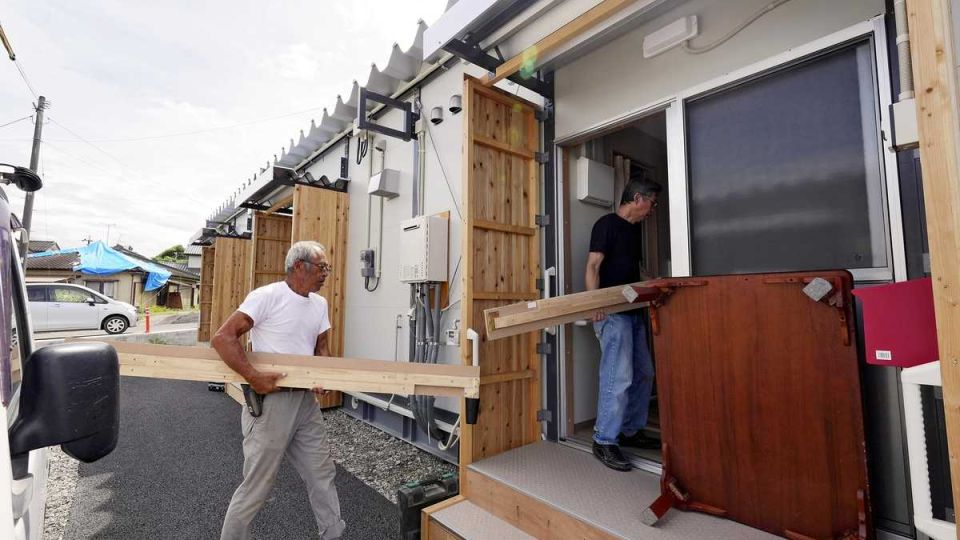
Arya News - According to Japan`s Kumamoto prefecture authorities, plans had been finalised on August 29 to build a total of 503 temporary housing units in 18 locations across six municipalities.
HIKAWA, KUMAMOTO – The first handover of temporary housing for evacuees was made on Saturday morning in Hikawa, Kumamoto Prefecture, but approximately 60% of the 503 planned units will be built in areas expected to be inundated if flooding occurs.
The prefecture, struck by an earthquake with an intensity of 7 on the Japanese seismic intensity scale in late July, has had difficulties in finding appropriate locations for temporary housing. Since the devastated areas are located in low-lying coastal regions, the prefecture is implementing certain countermeasures, such as constructing two-story buildings that allow for vertical evacuation and raising the foundation of the land.
“I’m sad to leave my home that I’ve lived in for so long. However, I want to live my best new life [here],” Aiko Takase, 89, who moved into the Yoshimoto temporary housing compound in Hikawa, said on Saturday morning.
The compound which she moved into is composed of eight single-story buildings, the norm for temporary housing, since it is located outside of any expected inundation areas. However, the other three compounds scheduled to be built in Hikawa are located within those risky areas and will be two-story buildings.
“We had no choice but to use the expected inundation areas since infrastructure is not developed in the mountainside,” a municipal official said.
According to the prefecture, plans had been finalized as of Aug. 29 to build a total of 503 temporary housing units at 18 locations in six municipalities, including Yatsushiro, Uki and Hikawa. A total of 311 planned units at 12 locations are located within the expected inundation areas, equivalent to approximately 60% of the total number of units.
“The devastated areas are coastal, and the elevation is low, which makes it difficult to secure substantial lands outside of the expected inundation areas. We will inform residents of the need for early evacuation in the event of flooding and have them move in with that understanding in mind,” a prefectural official said.
Based on the Disaster Relief Law, the Cabinet Office calls for avoiding the establishment of temporary housing in high disaster risk areas. Following the January 2024 Noto Peninsula Earthquake, temporary housing was built in some expected inundation areas in order to ease the lives of evacuees as soon as possible in the Okunoto region of Ishikawa Prefecture. However, these units suffered flooding above floor level during heavy rains in September 2024.
It was previously confirmed that certain instances of land selection did not meet the criteria for construction sites in surveys done by Kumamoto Prefecture in 2024. The prefecture had planned to request a review from each municipality in 2025, but this was postponed due to the need to respond to record-breaking heavy rains in August 2025.
“If locating temporary housing outside of the expected inundation areas is difficult, it is necessary to assess the depth of potential flooding and the availability of evacuation sites before construction and to establish a system that allows for rapid evacuation in the event of a flood,” said Norio Maki, a professor at Disaster Prevention Research Institute, Kyoto University.