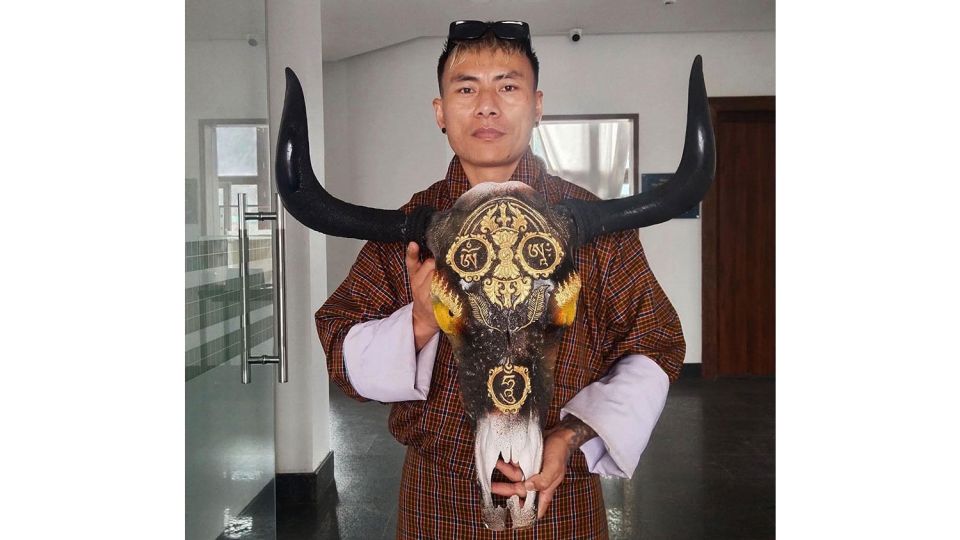
Arya News - Lobzang Nima discovered art while serving a prison sentence, a period he describes as one of the hardest times of his life. For him, a yak skull is more than what remains of an animal. It carries strength, impermanence, and compassion – while reminding him that life can begin again.
THIMPHU – For Lobzang Nima, a yak skull is more than what remains of an animal. It carries strength, impermanence and compassion, while reminding him that life can begin again.
The skull sits quietly, its empty sockets looking out from beneath layers of carved patterns and sacred mantras. Once, it belonged to a living animal. Now, under Nima’s hands, it has become something else.
For the 37-year-old artist from Punakha, the skull is a reminder of what ends, what endures and what can be transformed. It also carries something of his own story.
“I went from a dark cell to carving and painting prayers on yak skulls, and in doing that, I found my freedom,” he says.
Lobzang Nima discovered art while serving a prison sentence, a period he describes as one of the hardest times of his life. “I did not have any help, direction or purpose in life.”
His sense of being lost began early. His parents divorced when he was three, and his grandmother took care of him. His father later remarried and, while serving in the Royal Bodyguard, Nima lived with his stepmother.
As a child in Dechencholing, he often wondered why his life seemed different from that of other children. He would spend time alone in an attic, carrying questions he could not answer.
“I wondered most of the time in the attic why my life was always different from some other kids my age,” he says.
While he does not want to dwell on his parents’ choices or shortcomings, he has come to understand that life is not always made up of sunshine and happy endings.
Then came 2016.
Lobzang Nima says his own naivety led him to break the law. He lost his freedom and spent 10 years and four months in prison. “I wish to be a better man, a son and a citizen of our country.”
Behind bars, however, something unexpected began to happen. There was time, and there was the question of what he could do with it.
At some point during his imprisonment, someone helped him obtain a machine and tools he needed to begin working. Without any formal training, he began carving and painting. His own prayers drew him towards Buddhist symbols and sacred mantras.
“As I crafted and painted, I felt calm for the first time,” he says.
The work gave shape to hours that might otherwise have been spent waiting. In prison, his body was confined, but his imagination was not. “The body was in prison, but the mind could travel and imagine.”
The first skull he completed remains the most meaningful to him, not necessarily because it was his best work, but because of what finishing it represented.
“That was the moment I believed I could have a second chance in life,” he says.
Since then, the yak skull has become central to his work.
For him, the yak represents strength. It carries heavy loads and helps sustain people, particularly in nomadic communities. He sees something familiar in that burden.
“The yak represents strength,” he says. “The weight they carry to feed the people in the nomadic areas is too strong. The willpower is strong.”
The skull, meanwhile, speaks to him of impermanence.
Lobzang Nima carves and paints sacred mantras onto the skulls of dead animals, transforming what remains of death into an expression of blessing and prayer.
“I am giving protection and prayer to something that once carried life,” he says.
Art did not erase his past. Instead, it gave him a different way of looking at it.
Before discovering art, he says, he was often angry, struggled with himself and questioned the purpose of his life. Through his work, he learned patience and compassion for himself as well as for others.
“You need to have a lot of patience. If not, how are you going to survive another day?” he says.
That patience continues to shape his work. Each skull takes weeks or even months to carve and paint, turning the process itself into an exercise in endurance.
After experiencing a time when freedom could be measured by walls and chains, even breathing fresh air became something worth noticing.
“When I wake up, what I do is always wake up and try to refresh myself. ‘Thank you. I still have this life. I have good, fresh air in my lungs and I am able to breathe. Thank you.’”
Life, he says, has humbled him.