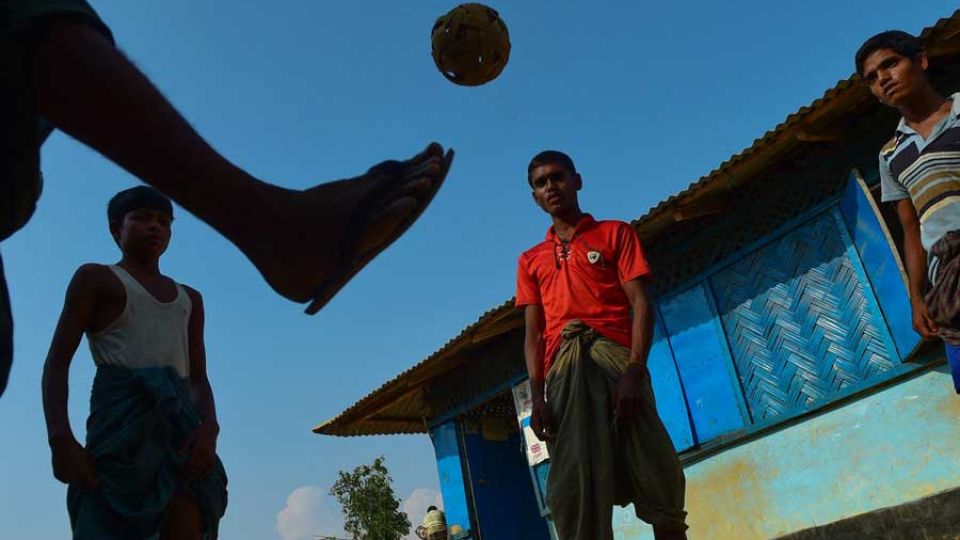
Arya News - From refugee camps in Bangladesh and Malaysia to diaspora communities in Australia, Europe and North America, young Rohingya are using social media not simply to communicate, but also to document, organise, advocate and imagine a future beyond displacement.
DHAKA – The Rohingya crisis can easily be reduced to numbers: refugees, camps, deaths, displacement and decades without citizenship. But behind these numbers is a generation that has grown up amid statelessness and exile, yet is increasingly finding ways to speak for itself rather than being spoken for.
From refugee camps in Bangladesh and Malaysia to diaspora communities in Australia, Europe and North America, young Rohingya are using social media not simply to communicate, but also to document, organise, advocate and imagine a future beyond displacement.
Their activities reveal an important transformation. The Rohingya are not simply a displaced population living in camps and waiting for repatriation. They are also a transnational community actively producing their own narratives, networks and identities while asserting claims to belonging, citizenship and political recognition.
From statelessness to a digital diaspora
The exodus of 2017 fragmented Rohingya families and communities across countries and continents. Yet digital technologies have created new ways of maintaining connections across these distances. Facebook, YouTube, WhatsApp, X and other platforms allow young Rohingya to maintain relationships, exchange information and participate in community discussions despite physical separation. These connections extend beyond family and friends, bringing together old and new relationships, community organisations, activists and supporters across borders.
In this sense, social media has contributed to the emergence of a “Rohingya diaspora online”—a dispersed community connected through mediated communication and shared political and cultural concerns. For Rohingya youth, these networks are particularly significant. Many have spent their formative years in exile, with limited opportunities to participate in formal political institutions. Digital spaces provide an alternative arena in which they can speak, organise and build relationships. They also help create an “imagined community of resistance”—one whose members may never meet physically but see themselves as connected through shared histories, experiences and aspirations. The purpose is not simply to maintain a sense of identity and community. It is also to sustain collective claims for justice, citizenship and the right to return home.
Social media and transnational advocacy
Social media has also contributed to the growth of transnational Rohingya advocacy networks. For decades, Rohingya voices were often marginalised in international representations of the crisis, with their experiences narrated primarily by governments, humanitarian organisations, journalists and researchers.
Digital platforms have begun to shift this dynamic. Young Rohingya activists can communicate directly with audiences far beyond refugee camps and diaspora communities. They share testimonies, photographs, videos and personal stories, respond to misinformation and draw the attention of journalists, policymakers and international organisations to issues affecting their community. Hashtags such as #SaveRohingya, #RohingyaGenocide, #StopRohingyaGenocide and #JusticeForRohingya have become more than labels attached to social media posts. They function as digital rallying points, connecting dispersed communities, activists and supporters around demands for justice, recognition and citizenship.
Yet social media is not inherently democratic. The same platforms that enable Rohingya voices to reach global audiences have also been used to spread hatred and dehumanising narratives. During the 2017 genocide, social media helped amplify anti-Rohingya propaganda. Rohingya activists continue to navigate harassment, hate speech, misinformation and the risks associated with speaking publicly about politically sensitive issues. Even so, these platforms have expanded opportunities for political participation. Young Rohingya are no longer simply recipients of information about their community’s crisis; they are increasingly producers, curators and distributors of that information.
Telling their own stories
This has contributed to the emergence of Rohingya diasporic media production. The internet has created opportunities for Rohingya-led media initiatives and information platforms to challenge dominant narratives and create spaces for Rohingya perspectives, histories and experiences. Platforms such as Zita TV, R Vision, Rohingya Khobor and The Arakan Times are part of this expanding media landscape.
This is particularly important given the propaganda and anti-Rohingya hatred that circulated online before and during the 2017 genocide. Countering such narratives requires more than fact-checking. It requires producing alternative narratives and giving Rohingya people the means to tell their own stories. Young Rohingya are contributing to this effort by documenting displacement, discrimination and loss, while also highlighting resilience, education, community life and hope. Through online media, video platforms and independent photographic initiatives, they document everyday life in refugee camps and across the diaspora.
These practices challenge the tendency to portray the Rohingya solely as victims. They show that the community has its own storytellers, journalists, photographers and media producers who are actively shaping how Rohingya lives and experiences are represented.
Representation, after all, is not simply about visibility. It is also about who has the power to define a community and tell its story. The aspiration is not merely to be seen as refugees, but to be recognised as a people with a history, rights and political agency.
Women and new forms of youth leadership
The growing visibility of Rohingya women in digital advocacy further demonstrates the changing nature of community leadership. Women-led initiatives and networks, including the Rohingya-Maiyafuinor Collaborative Network, Refugee Women for Peace and Justice and the Rohingya Women Development Network, have created spaces to address justice, gender equality and education, as well as to amplify Rohingya voices.
Their emergence is significant because displacement and humanitarian responses can reproduce existing gender inequalities. Digital spaces can provide women with opportunities to participate in public conversations and community leadership that may otherwise be difficult to access. These initiatives also remind us that Rohingya youth are not a homogeneous group. Their experiences and priorities differ according to gender, generation, location, education and migration status. The future of Rohingya advocacy will therefore depend partly on creating spaces where these diverse voices can be heard.
Beyond the refugee camp
Perhaps the most important contribution of Rohingya youth is that they are expanding the meaning of community itself.
A Rohingya person in Cox’s Bazar can communicate with someone in Kuala Lumpur, Brisbane or London. A community event in one country can become a shared moment of remembrance across several continents. These connections do not erase geographical distance or political exclusion. Nor can social media substitute for citizenship, safety, education or a durable political solution. Digital connections alone cannot end statelessness. But they can help a dispersed community maintain its collective identity and political voice across borders.
Almost a decade after the genocide, this matters deeply. The story of the Rohingya should not be told only through the lens of humanitarian crisis. It is also a story of community-making, political imagination, agency and resilience. Rohingya youth are at the centre of that story. They are using the tools available to them to preserve memory, challenge misinformation, build networks and demand recognition. Their activities demonstrate that exile does not necessarily mean political silence.
Finally, Rohingya youth should be meaningfully included in community dialogues and policy processes, ensuring that their lived experiences and perspectives inform decisions rather than allowing those decisions to rely predominantly on the views of external policy experts.
Dr Abdul Aziz is a lecturer in media and communication studies at the School of Arts and Social Sciences, Monash University Malaysia. His research focuses on media, migration, and intercultural studies.