Arya News - The validation recognises Bhutan`s achievement in preventing human deaths from dog-mediated rabies through sustained dog vaccination, population management, surveillance, rapid response, and universal access to post-exposure prophylaxis (PEP).
THIMPHU – Bhutan has become the second country in the world, after Mexico, to receive WHO validation for eliminating dog-transmitted human rabies as a public-health problem, and the first country in the WHO South-East Asia Region to achieve this milestone.
The validation recognises Bhutan’s achievement in preventing human deaths from dog-mediated rabies through sustained dog vaccination, population management, surveillance, rapid response, and universal access to post-exposure prophylaxis (PEP).
According to the Ministry of Health, Bhutan recorded its last human rabies death in June 2023 at Tareythang in Sarpang.
Between 2006 and 2025, 19 people died from dog-mediated rabies in the country, with most cases concentrated in southern border districts.
Chhukha, Samtse, and Sarpang each recorded six deaths, while Trashigang recorded one.
According to the health ministry, rabies was historically a major public-health, animal-health and livelihood threat. Until the early 1990s, rabies in dogs and other domestic animals was reported from many parts of Bhutan.
The highest concentration of human cases occurred between 2008 and 2013, when 13 human cases were recorded. Three cases were reported between 2006 and 2007, while only three cases were recorded during the most recent decade.
The elimination of dog-mediated human rabies, however, does not mean rabies risk or dog bites have disappeared.
Bhutan recorded 62,906 dog-bite cases between 2016 and 2025, an average of about 6,400 cases a year. The highest annual number was 7,915 in 2016.
In 2025, health facilities recorded 4,808 dog-bite cases and 7,432 total animal exposures.
Despite the continuing exposure to dog bites, almost all reported dog-bite cases presenting to health facilities received PEP between 2019 and 2023. The proportion ranged from 99.8 percent in 2019 to 100 percent from 2020 to 2023.
PEP remains free through Bhutan’s public health system.
According to the ministry, rabies vaccine is available at 59 hospitals and 193 primary health centres, while rabies immunoglobulin is available at hospitals. Rabies biologicals, including anti-rabies vaccine and rabies immunoglobulin, are financed through the Bhutan Health Trust Fund.
From culling to nationwide dog management
According to the Department of Livestock, Ministry of Agriculture and Livestock, Bhutan’s organised rabies-control efforts began in 1985 under a United Nations-supported project, when rabies was widespread across the country.
Early efforts relied heavily on shooting and poisoning stray dogs, but these approaches were unsuccessful and faced strong public opposition.
The country gradually shifted towards mass dog vaccination and more humane dog-population management.
A national rabies-control programme involving mass vaccination of owned and free-roaming dogs was implemented in 1992. This significantly reduced dog-mediated rabies in the interior parts of the country, with the disease becoming concentrated mainly in the southern border areas.
The approach was accelerated following His Majesty The King’s Royal Command in July 2021, when the Department of Livestock, in partnership with De-suung, implemented the Nationwide Accelerated Dog Population Management and Rabies Control Programme (NADPM&RCP).
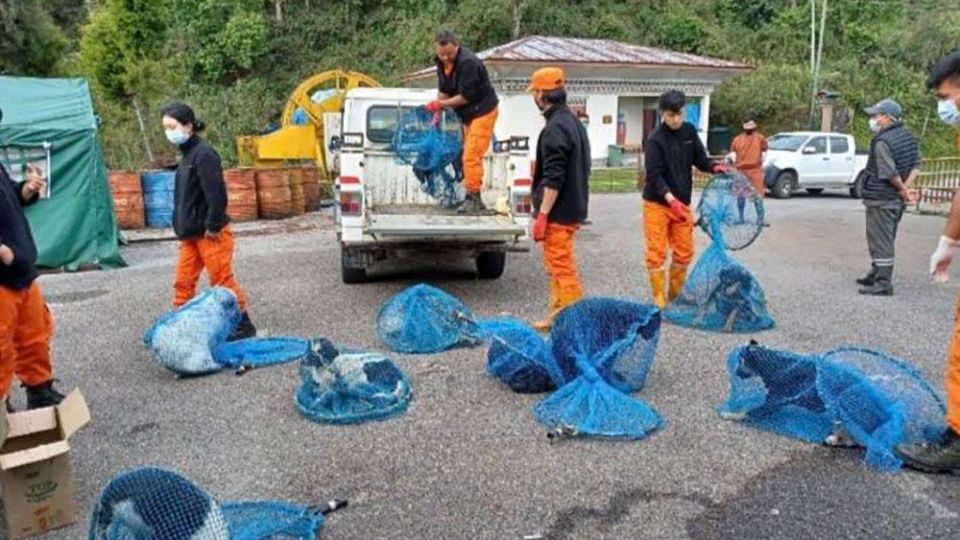
The programme, implemented from March 2022 to October 2023, adopted a whole-of-nation approach, with targets including 100 percent sterilisation of free-roaming dogs, mass rabies vaccination, pet dog registration and microchipping, and management of the feral dog population.
Under NADPM&RCP 1.0, 61,680 dogs were sterilised, while 61,311 free-roaming dogs were vaccinated against rabies through the Catch, Sterilise, Vaccinate, Withhold and Release approach.
The vaccination covered more than 90 percent of the estimated free-roaming dog population.
A further 495 dogs were sterilised under NADPM&RCP 2.0 in Gelephu Mindfulness City. Another 1,125 dogs were vaccinated, while 1,092 were vaccinated through coordinated cross-border mass vaccination campaigns with the Bhutan-India Friendship Association.
In total, the reported programme interventions directly sterilised at least 62,175 dogs and vaccinated at least 63,528 dogs, excluding dogs reached through other routine and annual vaccination activities.
The programme also registered and microchipped 32,544 pet dogs.
Rabies still persists in animals
The Department of Livestock stated Bhutan continues to report animal rabies, particularly in the southern border areas, underlining the country’s vulnerability to transboundary incursions.
On average, about 16 animal rabies outbreaks were reported annually in recent years. The number declined to an average of about 10 outbreaks annually after 2024, coinciding with intensified dog population management, mass vaccination and surveillance.
Between 2006 and 2025, rabies affected 475 cattle, 496 dogs and 79 other domestic animals, including horses, cats, goats, sheep and pigs.
The Department stated that high vaccination coverage and strengthened surveillance remain necessary to prevent re-establishment and further transmission.
A sustained investment
Bhutan’s progress has involved significant government investment over several decades.
The first phase of NADPM&RCP had a budget of about Nu 295 million. The programme covered dog sterilisation, vaccination, registration and identification, surveillance, field operations, equipment, logistics, capacity building and coordination.
A further Nu 45 million was invested under NADPM&RCP 2.0, bringing the combined allocation for the two phases to about Nu 340 million.
Earlier interventions included Nu 27 million for a dog shelter established in 2008, Nu 71.61 million for a cost-sharing project with Humane Society International between 2009 and 2018, and Nu 115 million for the National Waste Management and Stray Dog Population Control Flagship Programme in 2020.
Annual procurement of dog vaccines costs approximately Nu 1 million, while PEP procurement costs about Nu 2 million annually.
The Department cautioned that the Nu 340 million figure represents overall programme allocations and should not be interpreted as expenditure solely on rabies vaccination or surveillance.
Validation does not end the fight
According to the Ministry of Health, Bhutan’s validation process began in December 2025, when the Ministry requested WHO technical assistance to develop a national dossier.
The dossier was developed from March 2026 and submitted to WHO’s South-East Asia Regional Office in July 2026.
An external expert mission conducted a field validation from August 18 to 21, 2026. The mission independently assessed the evidence presented by Bhutan, including epidemiological evidence and systems established to sustain elimination.
The assessment confirmed that Bhutan had demonstrated the key epidemiological criterion and established systems required to sustain elimination.
However, the ministry said the expert mission also provided recommendations to prevent reintroduction of dog-mediated human rabies.
These include maintaining universal free PEP, strengthening human and animal surveillance and laboratory capacity, formalising One Health coordination, strengthening cross-border cooperation with neighbouring Indian states, and maintaining high dog vaccination and sterilisation coverage.
For people bitten by dogs, the response will remain unchanged. They will continue to receive clinical assessment, wound management and PEP according to national guidelines.
The health ministry said Bhutan remains exposed to the risk of rabies reintroduction, particularly through its southern border areas and the cross-border movement of infected animals.