Arya News - The results reveal issues that cannot be overlooked amid rapid changes in children’s environment, including digitalisation and reading fewer books.
TOKYO – The average scores for Japanese students declined in all three categories for the 2025 Program for International Student Assessment (PISA) test, revealing issues that cannot be overlooked amid rapid changes in children’s environment, including digitalization and reading fewer books.
According to the results released Tuesday by the Organization for Economic Cooperation and Development, Japanese students ranked fourth in reading and fifth in science and mathematics among all participating countries and regions. The Education, Culture, Sports, Science and Technology Ministry described Japan’s performance as at a “top global level.”
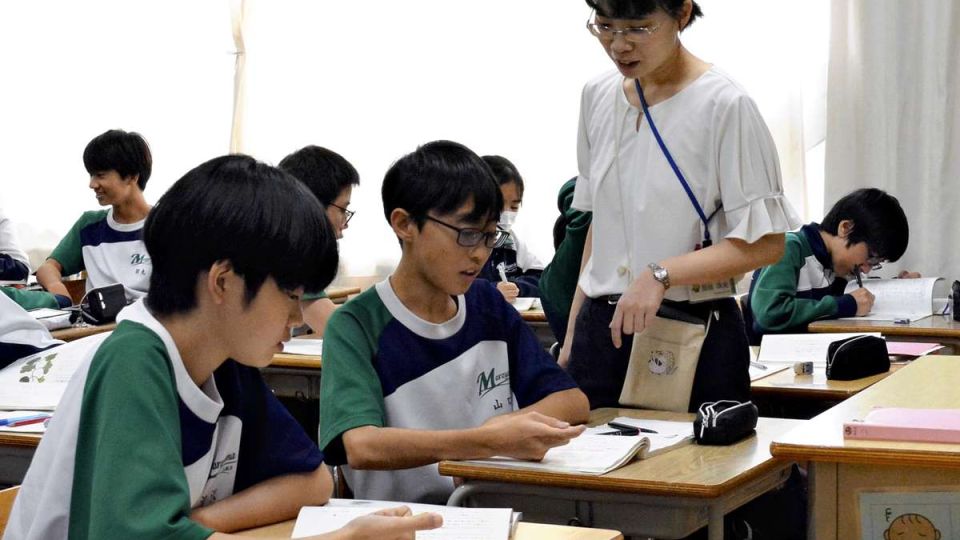
During a Japanese class on Friday at a junior high school in Moroyama, Saitama Prefecture, second-year students were given an essay written by Kuniko Mukoda. The students focused on the characters’ actions in an effort to interpret their emotions and personalities.
“Try to underline parts that describe the characters’ actions in 30 seconds,” a teacher said to the students. “It’s important to have the ability to analyze the text within a time limit.”
A senior education ministry official expressed relief over the latest PISA results, describing them as “the fruits of the steady, day-to-day efforts that schools have made.”
Reading has been Japan’s weak spot on the PISA, with the nation’s rankings fluctuating wildly in this category. Japan dropped to 14th in reading in 2003 and to 15th three years later, triggering what was called a “PISA shock.”
Hiroyuki Miyagi, president of a nationwide council studying Japanese methodology at the junior high school level, welcomed the latest PISA ranking.
“This appears to be the result of Japan’s efforts over the past 20-plus years to improve reading comprehension,” sad Miyagi, who is also the principal of Daiichi Junior High School in Mitaka, Tokyo,
At the same time, however, Miyagi said he was concerned about the overall results, as they might indicate that “gaps are widening in academic achievements” among children.
Reading fluency fluctuates
One of the concerning signs in the latest PISA results is that Japan’s average scores declined in all three domains. The percentage of the highest-scoring students was roughly the same as in 2022 but that of the weakest students increased.
Japan’s average score in reading declined by 13 points from three years earlier, with issues seen in reading fluency. In this section, test-takers are required to read short sentences — such as “Airplanes are made of dogs” — and chose “yes” or “no” depending on whether they think the sentences make sense.
Test-takers are given about 20 sentences to read in three minutes. While Japan’s correct answer rates were 92% to 93% in 2018 and 2022, the latest figure stood at 89.9%. The OECD itself said that Japan fluctuated in reading “in particular.”
Education ministry officials and experts believe that this trend may stem from the fact that more and more children do not pay much attention when scrolling through the flood of short posts on social media.
First-year high school students who took the 2025 PISA assessment went though the COVID-19 pandemic from their fifth-grade elementary school year to the first half of their junior high school years. Schools were temporarily closed, and events were suspended or scaled back, so it is believed that children in this demographic have developed the habit of spending a lot of screentime on smartphones and other digital devices.
According to a 2025 survey by the School Library Association, about 56% of high school students said they read at a rate of less than one book a month.
When analyzing the results of this year’s national assessment of academic ability, the education ministry compared correct answer rates on the math test for third-year junior high school students. The correct answer rate stood at 48.7% among children who said they spent at least four hours on a weekday watching social media posts and videos, while the figure climbed to 69.6% among the students who said they did so for less than 30 minutes.
The ministry will work to revise curriculum guidelines, a set of standards for school education whose introduction will start in the 2030 academic year. Meanwhile, the digitization of education has gained momentum, as the ministry has decided that digital textbooks will be used as official textbooks. It has also started deliberations to revise guidelines on the use of artificial intelligence in schools.
Prof. Noriko Arai at the National Institute of Informatics said the increase in lower-scoring students is a “clear warning for Japan’s education system.”
“People need to have the ability to read text accurately and understand the logic behind it to determine whether information generated by AI is accurate,” she said. “Rather than rushing headlong into digitization, it is necessary to help children thoroughly cultivate fundamental skills that form the basis of learning, including reading comprehension and mathematical skills.”
Read More:
Japan tops OECD in reading, science and math, but average reading score declines on PISA assessment results
OECD survey shows 7% of Japanese students use AI for schoolwork everyday
Editorial: Japan’s high global ranking in international academic achievement survey is no reason to let its guard down