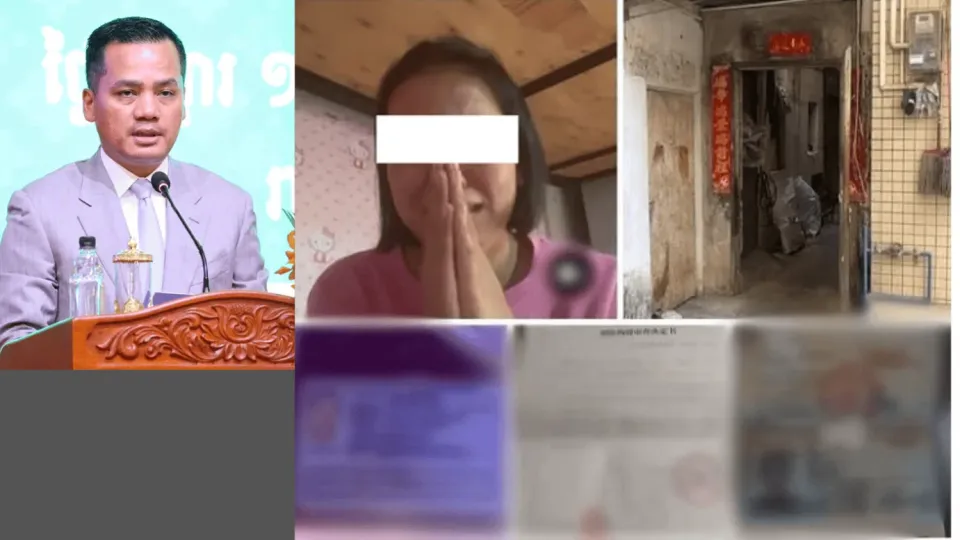
Arya News - The minister instructed authorities to share information about human trafficking, with particular emphasis on people seeking overseas employment without proper employment documents from legitimate recruiting companies.
PHNOM PENH – Minister of Interior Sar Sokha has urged authorities and law enforcement officials to step up public education measures to prevent Cambodian citizens from falling victim to scams and human trafficking schemes that lure them abroad for work or marriage, particularly to countries such as China.
Speaking at the September 8 closing ceremony of the generale assembly of commune and sangkat councils, Sokha called on commune and sangkat officials to actively participate in preventing and combating technology-facilitated scams, human trafficking and fraudulent recruitment for overseas employment.
He said such schemes commonly involve promises of high-paying jobs abroad, with traffickers and scammers often preparing fake documents or arranging sham marriages.
In recent days, the General Department of Immigration (GDI) has taken a series of measures to prevent some Cambodian citizens from travelling to China after identifying potential risks of human trafficking, he said.
“An observation we have made is that when one family goes, many people in the surrounding villages and communes tend to follow. This is because brokers have already found clients in the area and then continue spreading deceptive information to persuade others to go as well,” he warned.
“This problem does not discriminate by province. It even occurs in Phnom Penh, including cases where people are deceived into going to China to marry Chinese husbands,” he added.
According to Sokha, Cambodians who are deceived or trafficked abroad often travel on tourist visas, claiming that they are going overseas for tourism.
“But in reality, some do not even have $10 in their bags. We know that if you travel for tourism in another country, even $10 would not be enough to pay for a car or taxi. Therefore, it is clearly not genuine tourism,” he said.
Sokha said Chinese authorities are cooperating with Cambodia’s National Police, and Cambodia has repatriated several citizens who were deceived into travelling to China for marriage or illegal employment via Vietnam.
“Some people are currently stranded in Hanoi, and we are looking for ways to transport them from Hanoi back to the Kingdom. The Cambodian embassy in Vietnam has greatly assisted in facilitating this process,” he noted.
The minister also raised concerns over Cambodians being trafficked to Laos, saying Laos’ Minister of Public Security had recently confirmed a significant increase in the number of Cambodian citizens travelling to the country.
He called on provincial governors in areas bordering Laos to pay ensure thorough checks at international border crossings to determine the genuine purpose of travellers’ trips.
Regarding trafficking to Malaysia, the minister noted that some Cambodian citizens had been trafficked to work on fishing boats and were forced to remain at sea for several months.
Recently, Malaysian authorities repatriated more than 40 Cambodian citizens for illegal stays or overstaying their visas, according Sokha.
“I personally met a young man from Tbong Khmum province who told me that when he arrived in Malaysia, he was taken by boat from one area to another until they reached the middle of the sea, where he was made to work as a fisherman.
“He had to live on the fishing boat for between three and eight months before being allowed back on land. His labour was exploited like that of a slave.
“He told me that when he saw Malaysian marine police approaching, he jumped into the water so they would rescue him because he desperately wanted to return to land. I urge everyone to be extremely cautious about this issue,” he said.
The minister instructed authorities to share information about human trafficking, with particular emphasis on people seeking overseas employment without proper employment documents from legitimate recruiting companies.