Arya News - The decision to place students in a military environment has raised concerns among civil society groups, who described it as part of the growing trend toward the “remilitarization” of civilian space.
JAKARTA – Civil society groups have condemned the government’s decision to send students detained after last month’s Jakarta protest to a so-called state defense program at a military facility in Bogor, West Java, calling the move an act of intimidation and a violation of human rights.
At least 27 students from Jakarta have been sent to the 10-day training program, along with participants from other areas in Greater Jakarta, including Bekasi, Bogor, Depok, South Tangerang and Tangerang, Jakarta Governor Pramono Anung said.
According to its official website, the 2026 National Defense Training Program for the Indonesian Republic Cadet Corps (KKRI) is a youth character-building program focused on nationalism, discipline, leadership and civic responsibility for high school students.
The program was established through a 2026 decision by the Primary and Secondary Education Ministry, with the Defense Ministry involved in providing national defense education, leadership and discipline training and other character-building activities.
“This is a state defense program. In my view, this is a good program because it could encourage students, in particular, to appreciate and care more about their own country,” Pramono said on Thursday, as reported by Kompas.com.
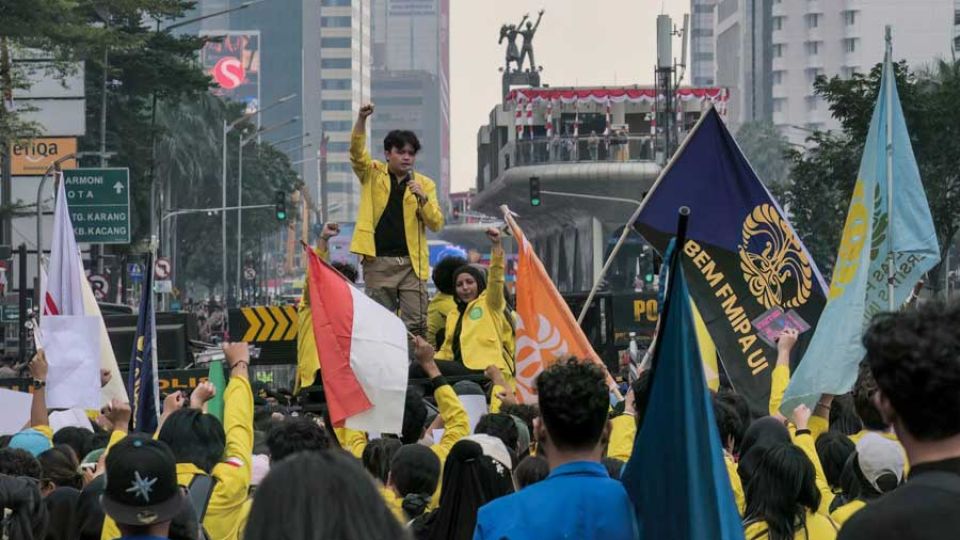
The students had reportedly been taken into custody by the Jakarta Police’s Directorate for the Protection of Women and Children and the Eradication of Trafficking in Persons (PPA-PPO) in connection with the unrest that followed the Aug. 27 protest outside the House of Representatives complex in Central Jakarta.
Their participation followed a Sept. 3 letter from the Jakarta Education Agency to several school principals, requiring the students to take part in the program at the Indonesian Military (TNI) Standby Force facility in Citeureup, Bogor, from Sept. 5 to 14.
The agency’s head Nahdiana said the agency became involved after the Jakarta Police arranged for the students to participate in the program, which she said was intended to provide education, guidance, rehabilitation and character development through a humane and educational approach.
“The approach is more about educating these children first. The police have a good program, so we are taking part,” she said in a statement on Wednesday.
She stressed that the students were participating with their parents’ consent, with their parents accompanying them to the facility before they are picked up by the Education Agency at the end of the program.
Jakarta Police’s spokesperson, Sr. Comr. Budi Hermandto and Defense Ministry’s spokesperson Brig. Gen. Rico Ricardo did not respond to The Jakarta Post’s request for comment on Friday.
The decision to place students in a military environment has raised concerns among civil society groups, who described it as part of the growing trend toward the “remilitarization” of civilian space.
Usman Hamid of Amnesty International Indonesia called on the government to stop subjecting protesters to such programs, questioning the legal basis for requiring civilians, particularly school-age children, to participate.
“We strongly condemn this policy, which violates human rights […] This is not an educational or disciplinary program, but rather a form of intimidation and repression by the state,” Usman said in a statement on Thursday.
He added that sending residents and students to military barracks simply because they had participated in demonstrations sent the wrong message to the public, suggesting that exercising the right to protest was a problem.
“Nationalism and love for the country are not about obedience to orders, but about developing critical awareness of abuses of power and injustice, including criticizing problematic government policies,” he said.