Arya News - Families of those swept away by the August 26 flood are performing funeral rites without bodies. But they cannot secure death certificates or claim relief, compensation, insurance and other entitlements.
KATHMANDU – Purna Ghale, a resident of Khalte in Rasuwa, survived the August 26 floods but many of his family members remain missing since the disaster—his father, eldest son, daughter-in-law, younger brother, two granddaughters and three sons-in-law.
With none of their bodies recovered, they are all but presumed dead. Without a body, there is no death certificate. Without a death certificate he has not been able to even claim relief. Ghale lost his home and everything he owned. He doesn’t have any money to perform the funeral rites of those presumed dead. “At least I want to perform the rites according to our faith and traditions,” he said. “Perhaps their souls would find peace.”
Ghale, who also lost relatives in the 2015 earthquake, said the government had then provided Rs40,000 per victim to help families perform funeral rites, followed by another Rs100,000 in relief. This time, however, Uttargaya Rural Municipality says it cannot certify the deaths of those still missing.
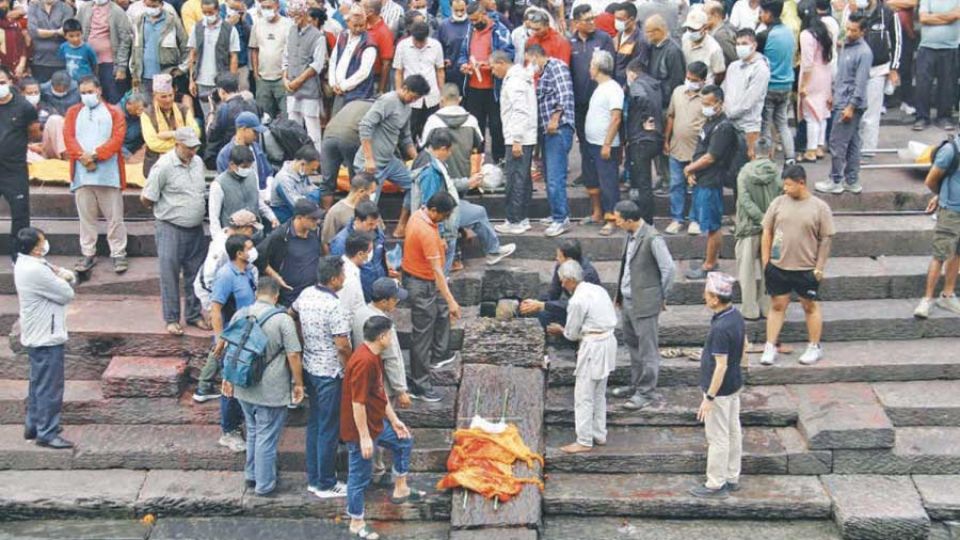
In the days after the devastating flash floods, many families who have given up hope of finding their relatives alive, or even recovering their bodies, have already performed mourning rituals using symbolic bodies made of the kusha holy grass, a traditional practice. Others are preparing to do so. But local governments say they cannot formally register the deaths under the law as it stands. This has put relatives of the missing, especially those who have little left, in a bind.
Section 40 of Nepal’s Civil Code, 2017, sets out when a missing person can legally be presumed dead. It says a person who has been continuously missing for 12 years, or whose whereabouts have been unknown to people who would have information about them for 12 years, shall be presumed dead unless there is evidence that the person is alive. The law also provides for shorter periods in certain specified circumstances.
The provision has created immediate problems for families affected by the flood. Without official death registration, they face difficulties claiming relief and compensation, transferring property and other assets, securing pension entitlements and making insurance claims.
Local units in Rasuwa and Nuwakot have asked the federal government to clear the legal hurdles, while authorities in Dhading and Gorkha have also raised the issue.
As of the latest available figures, 1,397 bodies have been recovered, while 5,130 people remain unaccounted for. Police have collected 3,139 DNA samples, including 1,286 from recovered bodies and remains and 1,853 from relatives of missing people. Many recovered bodies have yet to be identified and handed over to their families.
Thousands of displaced people are also being housed in holding centres, where authorities face concerns over drinking water, sanitation and the risk of disease outbreaks. The government has estimated that rebuilding the disaster-hit areas will cost Rs723 billion.
Uttargaya Rural Municipality chair Madhav Prasad Aryal said local governments have been unable to act on their own because of the existing legal provisions.
“We had already taken a collective decision and written to the home ministry,” he said. “We also raised the issue with the prime minister, home minister and other ministers during Monday’s meetings.”
Representatives from flood-hit local units in Rasuwa told Prime Minister Balendra Shah that registering the deaths of people who disappeared after the disaster had become difficult because of the existing legal and administrative procedures. They asked the government either to take a Cabinet decision or amend the law immediately.
No decision has yet been taken.
For some families, the legal impasse has also become a financial barrier to performing funeral rites.
Sabitri Tamang of Angitar in Nuwakot has decided to perform the rites for relatives who disappeared in the flood. But she cannot afford to do so.
When she asked her ward office whether it could provide financial assistance, officials told her they could not because she did not have a death certificate and the case raised legal complications. “Those who had something left to them have already completed the rites,” Tamang said. “We have nothing.”
Following complaints from victims, a joint meeting involving local units, chief district officers, district disaster management committees, army commanders, police chiefs and district coordination committees in Rasuwa, Nuwakot, Dhading and other affected districts decided to formally ask the government to address the problem.
Local governments in Rasuwa and Nuwakot wrote to the home ministry on September 9, while authorities in Dhading, Gorkha and other districts have also raised the issue.
“Because of the difficulties and cumbersome procedures involved in registering deaths and other records for people who have been missing or out of contact since the flood, problems have arisen in making insurance claims and officially confirming deaths,” the letter said. It called on the home ministry to establish a mechanism allowing such deaths to be registered immediately.
Ananda Kafle, spokesperson for home ministry, said the letters had been received and the issue was under discussion. “The ministry is discussing the legal issues surrounding the recognition of deaths in the case of citizens who have gone missing,” Kafle said. “Local representatives also raised the issue during Monday’s discussion with the prime minister.”
“The prime minister, home minister and the government are serious about the issue,” he said. “The government will decide within a few days.”
Tuku Prasad Subedi, spokesperson for Uttargaya Rural Municipality, said local governments had been overwhelmed by immediate relief and resettlement work and had been unable to do much for people who remained unaccounted for. “We are focused on the immediate response,” he said. “We have made a collective written request to the federal government to remove the legal obstacle. We expect a solution.”
Bidur Mayor Rajan Shrestha said local officials had pushed for action after seeing how the lack of official recognition was preventing victims from accessing state support. “There has been no decision from the federal government to remove the legal hurdles,” he said. “At the very least, local governments should be given the authority to certify the deaths so that the immediate problem can be resolved.”
He said Shah had told local representatives that the federal government would coordinate with them and move forward with a solution.
Buchung Tamang, chair of Aamachhodingmo Rural Municipality, said the issue had been raised both in a written appeal and during Monday’s meeting with the prime minister. “This is something the federal government needs to address through a single decision,” he said. “The law enacted by the federal parliament itself appears to be the obstacle, so there is nothing the local government can do.”
He said most families of those still missing had already performed the funeral rites, while others were preparing to do so.
“Now the Cabinet has to find a way around this, even through a separate decision,” he said. “It is not possible to leave families for years without official recognition of what happened to their loved ones.”
Rasuwa Assistant Chief District Officer Dhurba Prasad Adhikari also said the federal government would have to take the decision.
He said the necessary correspondence had already been sent and expected a decision within days.
“A large number of people are missing,” he said. “Even if not immediately, ward offices will eventually need to be able to issue death certificates.”
He added, “Official recognition is needed for claims, insurance and compensation provided by the government. That is why the issue requires a decision by the federal government, and the request has already been submitted.”