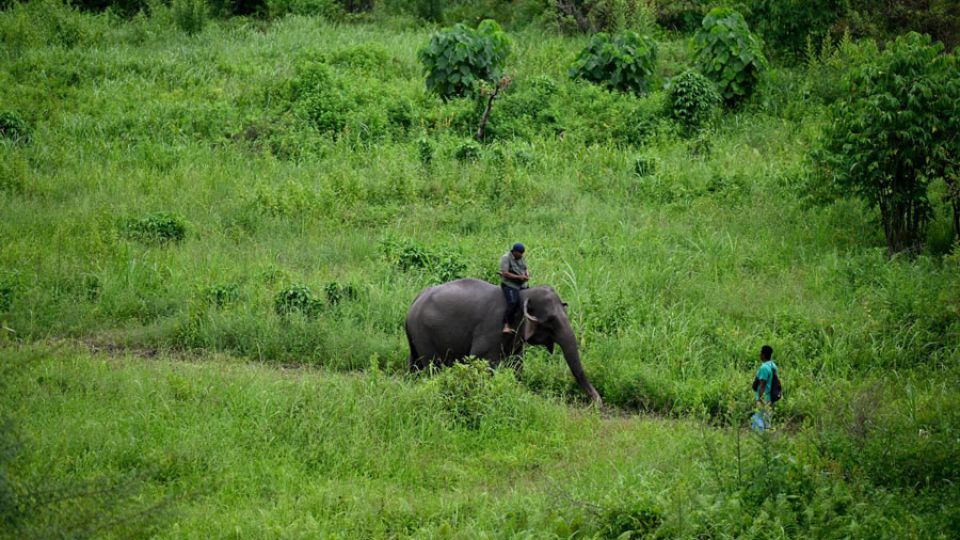
Arya News - A new report by environmental group Geopix found that about 382,778 hectares of elephant habitat were affected by fires throughout August. Further fires affected 147,550 ha between Sept. 1 and 8 across 21 population pockets on Sumatra, which accounted for around 7.06 per cent of the total elephant habitat.
JAKARTA – A surge in wildfires across Sumatra is putting critically endangered Sumatran elephants at greater risk of extinction, with hundreds of thousands of hectares of their habitat now affected by fires.
A new report by environmental group Geopix found that about 382,778 hectares of elephant habitat were affected by fires throughout August. Further fires affected 147,550 ha between Sept. 1 and 8 across 21 population pockets on the island, which accounted for around 7.06 percent of the total elephant habitat.
Between 1,320 and 1,635 Sumatran elephants are estimated to remain in the wild across Sumatra, according to official statistics. Their population has declined by as much as 45 percent over the past two decades.
”Dozens of landscapes with high conservation value are at risk of destruction due to the ongoing wildfire crisis,” Geopix senior wildlife campaigner Annisa Rahmawati said at the report’s launch in Central Jakarta on Tuesday.
Indonesia has been grappling with a surge in forest and peatland fires in recent weeks, with some of Sumatra’s most important biodiversity areas among those affected. Kalimantan and Papua have also reported extensive fires.
Forestry Ministry data showed that about 202,000 ha of land and forest had burned between January and late July, an area roughly three times the size of Jakarta.
Rather than measuring only burned areas, Geopix mapped fires and hotspots across elephant territories to show how fire activity could affect the animals’ wider habitat and movement corridors.
“Extinction risks become higher, particularly where wildfires inside elephant habitats worsen forest fragmentation,” Annisa said.
She said climate change was compounding the threat by prolonging dry seasons and reducing the availability of water, leaving elephants with fewer options as fires spread through their habitats.
The report recorded a sharp increase in fire activity inside 21 known elephant population pockets. The number of hot spots detected in the areas jumped to 2,851 in the first week of September from just 74 in June.
A hot spot is an area detected by satellite as having a higher temperature than its surroundings. While a hot spot does not necessarily indicate an active fire, a high concentration of hot spots can signal increased fire activity.
Most of the hot spots recorded during the first week of September were classified as medium intensity, while 217 were categorized as high intensity and 160 as low intensity.
In several elephant habitats, however, fires were already burning on the ground.
In the Sugihan-Simpang Heran wildlife reserve, home to South Sumatra’s largest elephant population, the provincial Natural Resources Conservation Agency (BKSDA) has spent weeks battling fires that have scorched at least six conservation sites across the 2,300-ha forest.
Firefighters and water-bombing aircraft were deployed late last week to contain fires in an area known as Elephant Conservation Centre Corridor 21 (PKG Jalur 21), a natural route used by about 29 elephants.
The fires have also aggravated long-running human-elephant conflicts in Jambi.
Jambi BKSDA head Himawan Sasongko said the agency had been monitoring growing pressure on elephant habitat around the Tebo-Serangge-West Tanjung Jabung landscape, where fires had restricted the animals’ movements.
”The wildfires have squeezed the movement of these elephants,” Himawan said during Tuesday’s launch, speaking virtually.
The landscape is home to up to 120 elephants and forms part of the wider Bukit Tiga Puluh rainforest, which includes a national park.
Geopix also found numerous hotspots inside palm oil, pulpwood and mining concessions, as well as community plantations, that overlap with elephant corridors, increasing the risk of fires spreading into the animals’ remaining habitat.
Himawan acknowledged the problem, saying many natural routes used by Sumatran elephants were classified as “productive forests”, leaving them vulnerable to development and land-use changes.
Large-scale deforestation has already severed many of the natural corridors used by Sumatran elephants, forcing the endangered animals into villages and plantations and increasing the risk of conflict with communities.