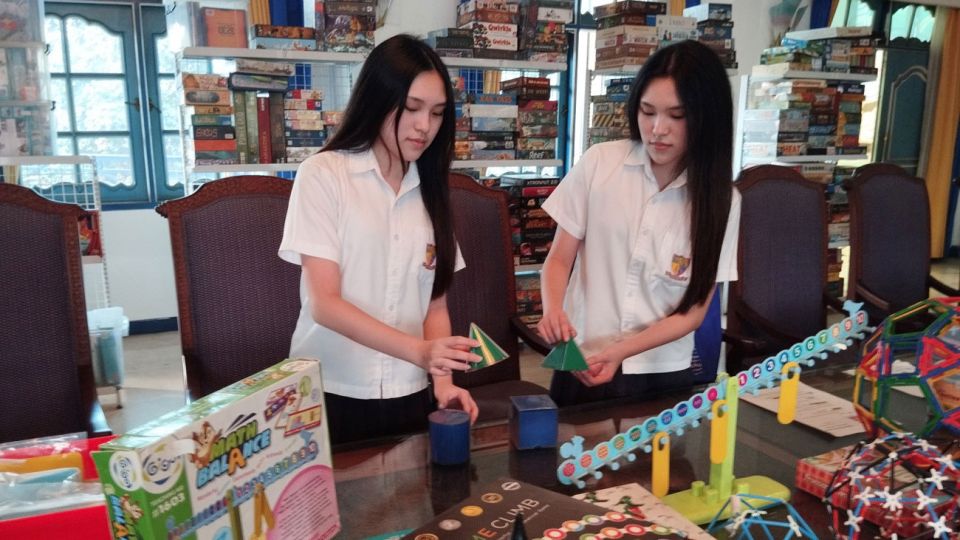
Arya News - A hands-on approach to mathematics is helping Indonesian children move beyond memorising formulas to understand the concepts behind the numbers.
JAKARTA – For young children, the number 10 can be difficult to imagine. The symbol “10” tells them little unless they can connect it to something they can see, touch or count.
This is where the concrete, pictorial and abstract (CPA) approach to mathematics comes in. The method moves through three stages, starting with real objects children can touch and move, followed by visual representations and, finally, symbolic representations using numbers.
The CPA approach draws on American psychologist Jerome Bruner’s idea that children learn through different forms of representation, moving from concrete experiences to visual representations and eventually to abstract symbols.
Singaporean educator Kho Tek Hong later brought this principle into Singapore’s school mathematics curriculum.
In Indonesia, the approach is being introduced to children by 17-year-old twins Kimberly Georgia and Kathleen Victoria, who are currently in their second year of high school. Through their educational program Bermain Matematika, which airs on state-run television TVRI, the twins teach younger children to see mathematics as something fun and worth exploring.
“If I say ‘one’, a child may only have the image of the number one in their head. But if I say ‘one cake’, they can picture a cake,” the twins said.
“If biology, physics and chemistry all have laboratories, why doesn’t mathematics?” — Kathleen Victoria, Bermain Matematika cocreator
From numbers to toy bears
Rather than asking children to immediately work with numbers on paper, the CPA approach encourages them to start with physical objects.
Kimberly and Kathleen use small plastic bears riding toy vehicles with 10 seats as teaching tools. They can show children nine bears on one vehicle and six on another to illustrate 9 plus 6.
Instead of asking children to calculate the answer using their fingers, they move one bear from the group of six to the group of nine. The first vehicle is then filled with 10 bears, while the second has only five.
Once children understand the concept visually, Kimberly and Kathleen introduce the abstract notation: 9 plus 6 equals 15.
Kimberly said the concrete experience helps children understand the picture, while the picture provides a bridge to the abstract symbols used in mathematics.
She added that the way the material is presented also matters. Lessons delivered in a fun and engaging way can capture children’s attention and encourage them to take a greater interest in what they are learning.
The twins’ interest in teaching began at home, where they helped their younger sibling, who is only a year below them. Through the experience, they learned that teaching mathematics was not simply about helping children memorize formulas, but about helping them understand the ideas behind them.
They have also taught children from eastern Indonesia through the Sekolah GenIUS program in Tangerang, Banten. Working with children from different backgrounds has further shaped their view that mathematics can be taught through approaches that are both practical and engaging.
The twins now plan to take their approach beyond television and the classroom through a YouTube program featuring the many teaching aids they have collected. By using social media, they hope to reach children from a wider range of backgrounds and make the lessons accessible beyond the formal classroom.
The videos could also help children prepare for lessons at school. A child who is about to learn a new mathematical concept the following day, for instance, could watch one of their videos beforehand and arrive in class with a basic understanding of the topic.
“So the next day when the teacher taught math in class they already had an idea of the concept,” Kathleen said.
Where math gets its own lab
Although the approach is already used in some Indonesian schools, the twins said it is not yet widely adopted, including at the international school they attend.
They said mathematics lessons still often rely on whiteboards, while subjects such as biology, physics and chemistry have laboratories where students can learn through practice.
“If biology, physics and chemistry all have laboratories, why doesn’t mathematics?” Kathleen said.
“Mathematics is the foundation of so much of what we learn. We think mathematics should also have a laboratory where children can practice directly,” Kimberly said.
The Organisation for Economic Co-operation and Development (OECD) released the 2025 Programme for International Student Assessment (PISA) results on Sept. 8, showing a decline in mathematics scores. PISA is an international assessment that measures how well education systems prepare students to apply their knowledge and skills to real-world challenges.
Indonesia’s mathematics score fell by two points to 364 from the 2022 report, and was below the OECD average of 465.
The mathematics results also showed that only a few Indonesian students had reached basic proficiency. Only 17 percent of the more than 14,000 students assessed reached at least Level 2, compared with an OECD average of 65 percent. At this level, students can interpret straightforward mathematical problems in everyday situations.
At the other end of the scale, almost no Indonesian students reached Level 5 or 6, which require students to model complex situations mathematically. The OECD average was 8 percent, while China and Singapore had the highest shares, at 54 percent of more than 12,000 students assessed and 37 percent of around 6,500 students assessed, respectively.
The findings suggest a need to strengthen mathematics teaching and help students build a stronger understanding of mathematical concepts.
The twins hope their approach can give children more opportunities to explore mathematics through concrete examples, while teaching aids in schools could help them visualize and apply mathematical concepts.