Arya News - What grows wild in Indonesia’s forests is finding a new place on the table, as women from forest communities turn overlooked ingredients into food products, delicacies and new sources of income.
JAKARTA – What grows wild in Indonesia’s forests is finding a new place on the table, as women from forest communities turn overlooked ingrefordients into food products, delicacies and new sources of income.
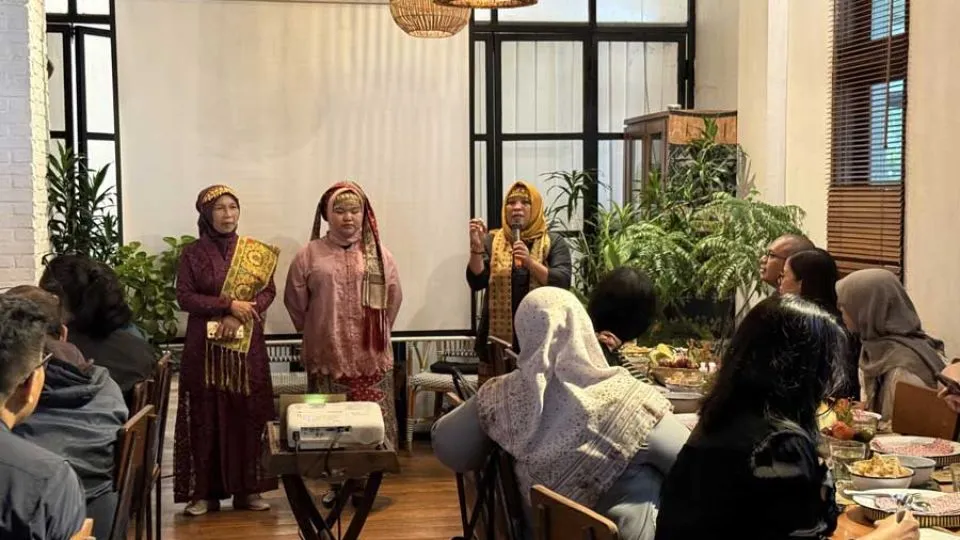
The possibilities were on display at a lunch in South Jakarta last week, where seven women forest defenders from South Sumatra, North Kalimantan and West Nusa Tenggara introduced diners to ingredients that may be unfamiliar to many.
The meal opened with a refreshing ade made from batoko plum, locally called lobi-lobi. It was followed by rattan shoots made into soup, earthy steamed wild splitgill mushrooms, fermented kluwek (black nut) resembling shrimp paste, or terasi, and nutmeg-infused tea.
The main ingredients were brought from their respective regions. Each dish came with a story of where the ingredients grew and what they mean to local communities.
The dining experience was put on by Puan Rimba, a group of women forest defenders seeking to bring undervalued local forest ingredients into the world of gastronomy. They are turning them into specialty products that support their livelihoods while helping protect the forests they depend on.
Tessa Pranisti, from Semende, Muara Enim, South Sumatra, is one of them. She said she found herself enjoying foraging in the forest around her village, which led her to join the women-led social forestry business group (KUPS) Pandan Indah in 2023. The group manages around 141 hectares of village forest.
Her group collected the splitgill mushrooms served at the lunch. They also brought tamarillo jam and local Semende coffee, which they process into ground coffee as well as perfume, body scrubs and aromatherapy candles.
“I never imagined I’d reach this point. Local foods that once had little value have stories behind them and can now be introduced beyond the region. That truly makes me proud,” Tessa said on Sept. 30.
In Longsam village in Bulungan, North Kalimantan, Noviana Liling was looking at the forest in much the same way.
For years, she knew kluwek, or payang as she calls it, simply as a local food found in the forest. The same was true of bekai, a wild plant whose leaves Dayak communities often use as a natural flavor enhancer. The two ingredients were turned into strongly flavored sambal and crispy crackers for the lunch.
“All of these can be easily found in our forests. We didn’t know how to process them so they would last and can be sold,” she said.
That changed in 2025, when Noviana established Femung Himet, the first women-only KUPS in the province, managing some 300 hectares of village forest. The group began turning forest foods into products, including fermented payang powder as a terasi alternative and dried bekai leaves.
As the products gained attention, Noviana began to see that food once taken for granted in her community could also be enjoyed by a much wider audience.
In early 2026, Tessa and Noviana, together with their groups, began working with Sekolah Seniman Pangan (the Food Artisan School), through a program with the Asia Foundation, to develop their products further.
“We want to bring their gastronomic experience beyond the ordinary and encourage them to enter the high-end market,” said Johanna Hehakaja, Sekolah Seniman Pangan business director.
The products have since made their way into some five-star hotels and premium retail stores, promoted as organic foods rooted in local traditions.
The initiative sought to put the role of women at the center of conversations on forest governance, as Asia Foundation program officer Dorta Pardede said such discourse often focused too much on numerical figures: the size of the forest, the number of concessions granted on it and the amount of forest rehabilitated.
“We may have forgotten to ask who is involved in decision-making about forest management in Indonesia. Half of those are women of the communities,” Dorta said.
Under Indonesia’s social forestry program, communities can manage forests for up to 35 years, including through village forest schemes designed to support sustainable forest management and local livelihoods.
As of 2025, the Forestry Ministry had granted access to around 8.32 million hectares of social forests to nearly 16,000 KUPS nationwide.
Over the weekend, the program brought the Puan Rimba women to showcase their products and share their knowledge with an international audience at Bangkok Climate Action Week in Thailand.