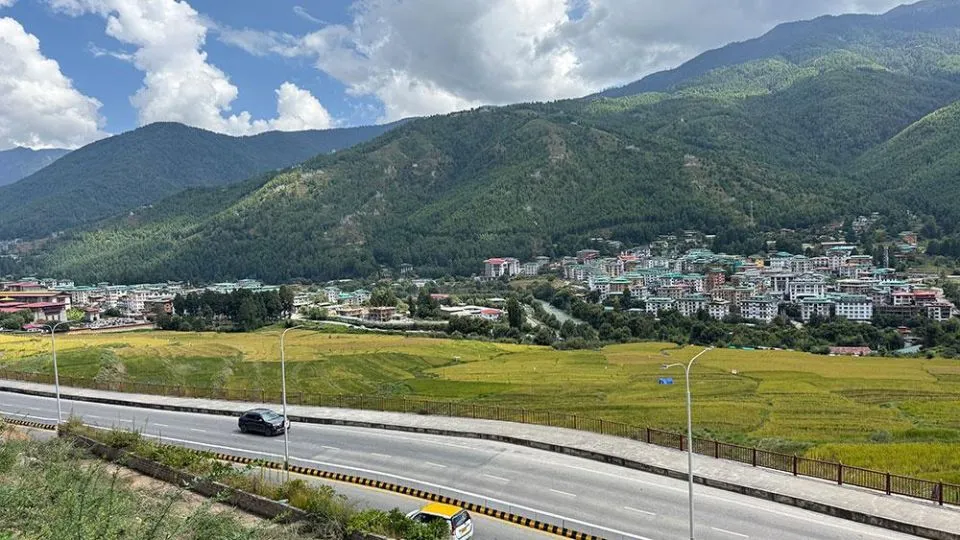
Arya News - Some 868 illegal structures have been built on rice fields in Bhutan, as the country`s self-sufficiency for the commodity falls to 25 percent.
THIMPHU – Bhutan has recorded 868 cases of illegal structures built on paddy land ( chhuzhing ) without official approval, even as rice self-sufficiency has slipped to about 25 percent and the country spends billions of ngultrum importing rice.
Punakha, Wangdue and Paro account for 57 percent of these illegal cases, with 243, 143 and 109 cases respectively. Most of the structure are permanent or semi-permanent structures.
The Officiating Director of the Department of Land Administration and Management at the National Land Commission Secretariat (NLCS), Sonam Tobgay, said illegal constructions are dealt with as per the Land Act of Bhutan 2007. “Majority of the cases pertains to non-compliance (construction on chhuzhing ). These cases are verified and actions are taken for immediate removal.”
The law gives a landowner who has no house, and only inherited chhuzhing on his or her land register (Thram), a narrow right under Sections 167 to 169 to apply to the local authority for one plot of up to 50 decimals in a rural area as residential land.
“A few cases are eligible for conversion to khimsa but await approval,” he said.
Yet paddy land continues to be lost to conversion, illegal building, and neglect. The Act also provides for protected agriculture zones, but the absence of a protection policy has contributed to significant losses.
The NLCS is implementing “Safeguarding Agricultural Land for Food Security through Evidence-based Planning (SAFE)” project, with partner ministries and agencies. Its inception workshop was held on September 29.
Fewer acres, fewer growers
The NLCS’s National Land Use Zoning baseline report of 2023 recorded 72,282 acres of paddy land. Cultivated area fell by 47 percent, from 45,138 acres in 2013 to 23,863 acres in 2022, producing approximately 26,682 metric tonnes (MT) of paddy.
The Integrated Agriculture and Livestock Census (IALC) 2025 puts the figure at 23,588 acres, producing 41,352 metric tonnes (MT). The data show output of 54,088 MT from 31,328 acres in 2020, falling to 41,537 MT from 22,516 acres in 2024-25.
Farmers are leaving too. The number of paddy growers, irrigated and upland, fell from 28,516 in 2020 to 23,327 in 2022 and 21,145 in 2024. The rice self-sufficiency rate dropped from 47 percent in 2017 to 25.17 per cent in 2022.
“Given the global food crisis (for example, the 2008 food crisis) and pandemics (for example, COVID-19), protecting agricultural areas to maintain a certain level of food self-sufficiency is critical,” Sonam Tobgay said.
Under the 13th Plan, the Ministry of Agriculture and Livestock (MoAL) targets a 30 percent rice SSR by plan end. “Achieving this would require the protection of about 43,000 acres of productive paddy land,” he said.
The target is to raise paddy production from 40,804 MT in 2023 (baseline) to 54,040 MT in 2029. With three years left, the country must produce 49,234 MT in 2026, against 41,537 MT in 2024-25. MoAL, with an outlay of Nu 1,279 million, has invested in land development, research, echanization and farmer subsidy schemes.
Rice remains one of Bhutan’s highest imported commodities. In 2020, 90,482.1 MT worth Nu 2,639.3 million was imported, dropping to 89,690.9 MT in 2022. In 2024, rice worth Nu 2,910.2 million was imported, at 61,098.4 MT, the lowest volume in five years.
Conversion before the moratorium
Between 2018 and 2021, when a moratorium took effect, 73.225 acres of chhuzhing were converted to dry land ( kamzhing ). Zhemgang led with 16.192 acres, followed by Samtse (8.669 acres), Punakha (8.479 acres) and Thimphu (8.292 acres).
Nationally, the area converted was 0.168 acres in 2018, about 20.5 acres in 2019, 35.811 acres in 2020 and 16.771 acres in 2021.
Over the same period, 22.055 acres were converted to residential use. Punakha led with 5.465 acres, followed by Paro (3.669 acres) and Thimphu (2.567 acres). In total, 95.28 acres were converted in four years. Punakha is also the highest paddy-producing district, producing 8,027 MT, followed by Paro at 6,382 MT.
About 200 conversion applications, under both categories, are pending with the NLCS.
To enhance public service delivery, the Government has pledged to do away with the need to convert kamzhing to khimsa for house construction, and to revise rules and regulations to relax wetland utilisation and ease conversion as per the Land Act. However, little has been done so far.
Moratorium and its gaps
In December 2021, the 10th Royal Commission on Urban Development (RCUD) halted chhuzhing conversion and land transactions in the Thimphu-Paro valley and the connecting vertical city development areas.
In 2024-25, upon royal command, the NLCS was mandated to lead the national resolution, and field validation began in the National Capital Region (NCR).
In 2025, zoning in four NCR Protected and Regulated Chhuzhing Zones was validated and submitted to the Cabinet for endorsement. This year, the NLCS continues validating and adopting the regulatory framework for zoning in the four dzongkhags with the highest chhuzhing area.
Thimphu, Paro, Wangdue, and Punakha fall under the NCR, where the moratorium is in place. The other 16 dzongkhags have more flexibility, though conversion is regulated per the Land Act.
“There are no agreed criteria to identify and classify protected chhuzhing and no proper policy on land compensation and replacement for landowners having chhuzhing ,” Sonam Tobgay said.
Further, data are scattered and not validated on the ground while planners lack an integrated system, a decision-support tool.
How SAFE responds
Funded with USD 100,000 by the Food and Agriculture Organization of the United Nations (FAO) Bhutan Office, SAFE, a work in progress, runs from June 2026 to June 2028, with plans to complete ahead of the deadline.
“The project’s themes are protecting paddy land, ensuring evidence-based planning, food security, and sustainable rural livelihoods,” Sonam Tobgay said.
SAFE has two outputs. First, a chhuzhing zoning framework with clear, endorsed criteria and parameters, and a proposed land replacement and compensation policy, developed through multisectoral consultation and field validation across four dzongkhags.
It will produce standardised, field-verified GIS datasets targeting eight dzongkhags, available on the National Spatial Data Infrastructure of Bhutan. Second, stronger institutional and regulatory capacity: GIS and multi-criteria decision analysis training for staff, a Spatial Decision Support System and dashboard providing evidence for land-use and protection decisions, and a chhuzhing safeguard policy and implementation guideline.
The NLCS will study four additional dzongkhags with the highest chhuzhing : Trashigang, Dagana, Samtse and Tsirang. This makes eight dzongkhags where conversion of chhuzhing to residential use will be tightened.
“ Chhuzhing is now categorised as protected and regulated,” he said. “In protected chhuzhing , there is no conversion for all times, while regulated chhuzhing allows conversion with proper documentation and review.”
“The project enhances the government’s exercise of Section 302, under which relevant agencies are empowered to declare protected agriculture areas,” he said. It also supports the Food and Nutrition Security Policy of Bhutan 2023, which aims to identify and protect prime chhuzhing , the irrigated land for rice, to maintain the required rice self-sufficiency and preserve the farmscape with appropriate incentives.
The NLCS will produce its first technical report in 2026-27, following the 2023 baseline. The report will help resolve land-use conflicts, advance the Government’s 10X economic vision and enable integrated land use.