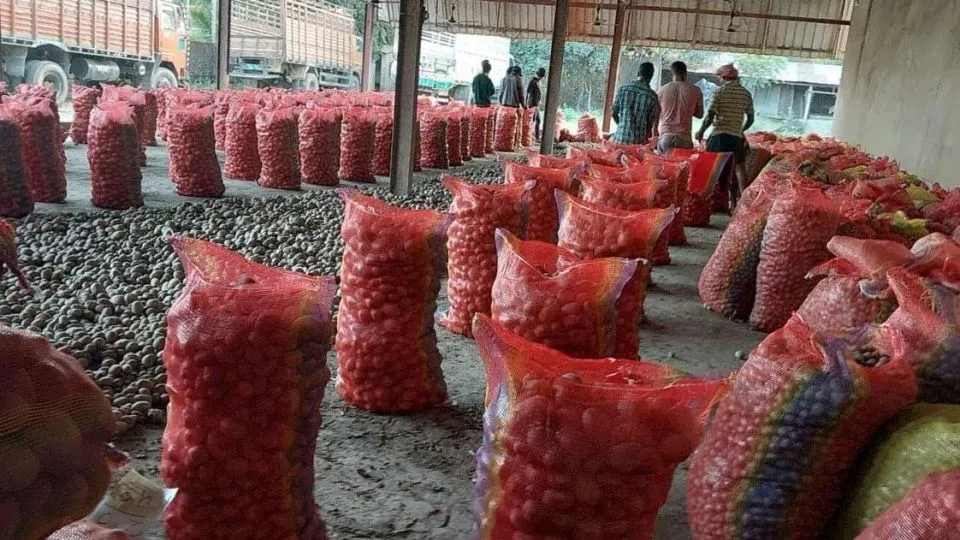
Arya News - Bhutanese potato exporters continue to lose millions to Indian buyers who fail to pay – while prices continue to fall as trucks of supplies remain unsold.
THIMPHU – Bhutanese potato exporters are losing millions of Ngultrum to Indian buyers who fail to pay, while prices continue to fall and about 30 trucks remain unsold.
New trade facilitation centres promise grading and online auctions, but exporters say these do not address their most pressing problems.
Growing potatoes was never the problem for farmers in Wangdue. Selling their harvest is.
Farmers haul their harvests to border towns, mainly Phuentsholing, for auction, with no guarantee of selling the next day and rarely at the price they expect.
Wookpa, a farmer from Phobjikha who has traded since 2020, has scaled back his business due to the lack of a proper market system and value chain.
He exported over 780 metric tonnes (MT) this year.
The Food Corporation of Bhutan Limited (FCBL), once an easier buyer, is no longer accepting his produce because of an overflow from various marketers.
“Selling to Indian bidders is trouble. We cannot get the desired price, the market or the money on time,” he said. “I lost over Nu 7.5 million. After so much effort and legal cases, I have recovered Nu 3.5 million, but I am yet to recover over Nu 4 million.”
He has approached the courts, the Ministry of Agriculture and Livestock (MoAL) and the Indian Embassy.
“They make calls and give updates for some days or weeks, and then the issue is left out. Our efforts so far have all been of no use,” he said.
Another exporter, who has traded since 2021, is yet to recover about Nu 2.5 million from about 15 trucks sold to two Indian parties. He exported only about 15.6MT this year.
“Exporters sell directly to Indian buyers because the price is relatively better than what is offered when routed through FCBL,” he said. “Yet the uncertainties must be understood.”
The government, he said, must tighten the process, strictly enforce trade norms and look to the domestic market. “If not, more Bhutanese will keep losing money to Indian buyers.”
Migma Dorji, who has traded since 2020, said business was fine until 2021, when new parties began deceiving exporters.
“With more supply going to FCBL and Indian markets, the price went down,” he said. “I have lost over Nu 4 million to three Indian buyers.”
Exporters, Migma Dorji said, cannot repay farmers or banks. “Exporters had to sell their vehicles and properties to pay the farmers, while recovering money from the Indian counterparts has been a problem.”
Trade centre falls short
The Potato Trade Facilitation Centre in Gangtey, the country’s first, was meant to change this.
MoAL and FCBL established it with support from the Global Environment Facility’s Least Developed Countries’ Fund (GEF-LDCF), the United Nations Development Programme (UNDP) and the Food and Agriculture Organization (FAO) in Bhutan.
Its online auction and facilities for washing, drying, grading, sorting and packaging are meant to streamline bidding, pricing and payments, help potatoes meet export standards and reduce post-harvest losses.
However, the centre addresses only how potatoes are prepared and sold. It does not resolve what farmers and exporters say hurts most: low prices, a shrinking market and buyers who do not pay.
Phobjikha and Gangtey grow potatoes on about 1,500 acres, which is 53 percent of Wangdue’s potato acreage and 17 percent of the national total. About 90 percent of the produce from more than 1,000 farmers goes through the Phuentsholing auction. Potato farming there earns Nu 133 million, or 29 percent of the national potato export value.
Nationally, potato is among Bhutan’s most valuable cash crops, with more than 60 percent of production earning over Nu 500 million annually. The Integrated Agriculture and Livestock Census (IALC) 2025 recorded over 37,778MT exported to India in 2024, earning over Nu 539.4 million.
In Bumthang, 60 to 65 percent of rural households grew potatoes as a primary or secondary source of income. They produced over 3,220MT in 2024, with an estimated gross income of Nu 54.74 million.
What the ministry says
A senior MoAL official said exports to India, Bhutan’s principal market, now require potatoes to be soil-free, pest-free, properly graded, packed in standard weights and free of plant debris, in line with international protocols.
“The Potato Trade Facilitation Centre in Gangtey is designed to address such needs,” he said.
The domestic market is very limited compared with production, and alternatives have not delivered.
Bangladesh, Nepal, Thailand and Singapore have been explored, but no concrete market has been secured.
“For now, the exploration of markets around the region has not made significant progress,” the official said. “We are streamlining the process towards the market in Gelephu Mindfulness City, which will require naturally grown vegetables and fruits, including potatoes.”
Under the 13th Plan, MoAL is also exploring new international markets.
Farmers, the official said, must not chase attractive prices but move toward a better-systemised process of growing, cleaning, grading and selling under the FCBL system, which would create long-term sales and growth of the potato economy.
Unsold and underpriced
Pema Dorji, head of FCBL’s Agriculture Marketing Division, said increasing production coupled with limited market opportunities necessitates a strategic approach to sustainable solutions.
The Corporation runs potato trade facilitation centres in Gangtey, Wangdue, and Gaytsa, Bumthang.
FCBL has facilitated agricultural exports, particularly potatoes, since 1974 through auction yards in Phuentsholing and Samdrupjongkhar.
Its potato exports were worth Nu 180 million in 2022, Nu 284.1 million in 2023 and Nu 308.2 million in 2024. In 2025, they fell to Nu 217 million, or 10,866.65MT. Potatoes made up about 58 percent of the 18,163MT of agricultural produce FCBL exported in 2025.
Potato exports declined by 2.04 percent from 2024, mainly because of increased participation of private traders and reduced demand for small-sized potatoes in Indian markets.
This year, Pema Dorji said, the auction began only in October, and total exports are yet to be determined. Prices are low and still declining, and about 30 trucks remain unsold.
“Most private exporters do not wish to store and sell. They sell instantly, and when they do not fetch the price, they turn to FCBL and the government for immediate intervention,” he said.
FCBL alone cannot carry the export, he said, and private exporters are equally encouraged.
Informal trade, however, creates unfair competition and market volatility, and is a serious threat to the export business.
FCBL has been providing awareness and advocacy to private exporters and bidders.
Online auction
FCBL started the online auction in 2017 under the Bhutan Commodities Exchange Initiative, a joint initiative of FCBL, the Royal Securities Exchange of Bhutan Limited and the Department of Marketing and Cooperatives, to commercialise farm produce and standardise quality for better prices.
The total volume of potatoes traded through the online auction platform was 1,180MT in 2024 and 1,050.95MT in 2025, with a value of Nu 18.15 million.
The platform has improved convenience and reduced logistical challenges for private transporters. In 2025, the online auction handled 208.15MT, generating Nu 4.35 million.
The second centre, at Gaytsa in Chhumig Gewog, Bumthang, was inaugurated on August 5, 2025. Equipped with warehouses, grading, washing, drying, sorting and packaging machines and an online trading service, it cost Nu 83.59 million.
The government, the European Union and FAO’s Hand-in-Hand Initiative supported the project.