Arya News - As the government rolls out its ambitious National Mine Action Policy (2026–2035), Cambodia is redoubling efforts to protect civilians, unlock land for development, and eliminate the final remnants of war.
PHNOM PENH – A senior demining official has declared that Cambodia will not abandon its mission to clear landmines left over from past conflicts or ignore new explosive threats.
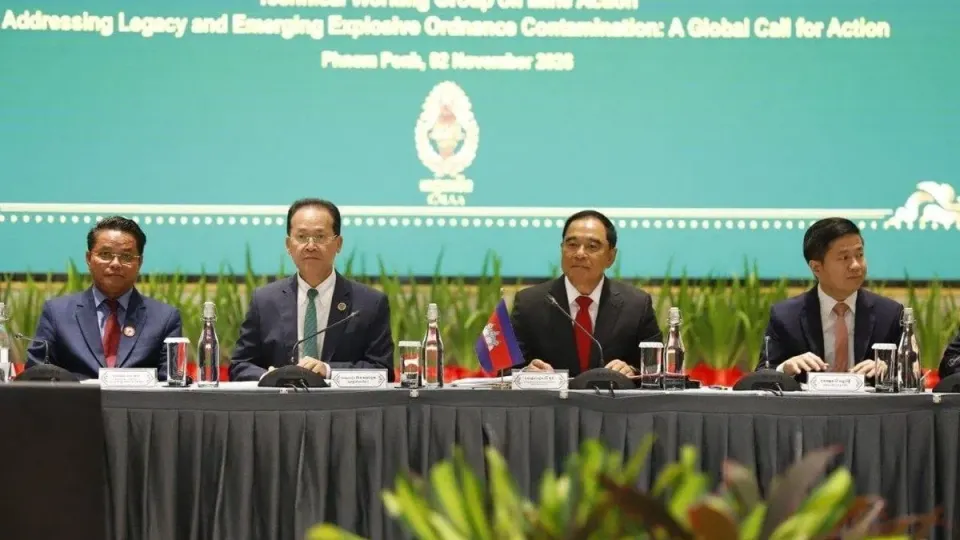
Ly Thuch, first vice-president of the Cambodia Mine Action and Victim Assistance Authority (CMAA), chaired a November 2 meeting of the Technical Working Group on Mine Action (TWG-MA), themed “Addressing Legacy Explosive Ordnance and Emerging Threats Together: A Call for Global Action”.
He called on all relevant government institutions, friendly nations, development partners, donor communities, mine action operators and the private sector to continue working together to address the threat posed by explosive remnants of war.
Thuch noted that Cambodia has released more than 3,600 square kilometres of land from the threat of landmines and explosive remnants of war over the past three decades, with about 75 per cent of the cleared land returned to communities for agricultural use.
However, the 2025 armed conflict between Cambodia and Thailand created new threats from cluster munitions across seven provinces. Preliminary assessments indicate that the newly affected areas are larger than the entire area of legacy contamination remaining from more than 30 years of previous conflicts, he said.
“Cambodia is facing a double burden on the same land: Uncleared explosive remnants from the past and new contamination resulting from armed conflict. Support must therefore continue to address both challenges simultaneously,” Thuch said.
He thanked all supporters for their timely response to the new threats arising from the 2025 conflict.
Thuch outlined three priorities for the Kingdom’s demining partners.
The first is to strengthen surveys and assessments of the newly affected areas to establish the extent and locations of contamination, while expanding risk education in border provinces.
The second is to maintain support for clearing landmines and explosive remnants of past conflicts, with about 1,689 square kilometres still requiring clearance.
The third is to broaden funding sources and encourage greater participation by domestic private-sector businesses to strengthen national ownership and ensure the sustainability of mine action. Cleared land, he noted, provides safe space for agriculture, construction and investment.
Minister of Environment Eang Sophalleth said his ministry was committed to strengthening cooperation with the CMAA by translating an existing memorandum of understanding (MoU) into practical action.
The two institutions will organise joint workshops to identify priorities and develop cooperation plans. Their work will also focus on identifying and prioritising protected areas affected by explosive ordnance, particularly locations where contamination poses risks to conservation officials, local communities and environmental protection activities.
He urged all mine action operators to incorporate environmental safeguards into survey and clearance operations, in accordance with national standards and existing environmental regulations.
“Mine action not only protects people’s lives, but also contributes to the conservation of natural resources and sustainable land management,” he said.
Heng Ratana, director-general of the Cambodian Mine Action Centre (CMAC), outlined both longstanding and emerging challenges, stressing the need to strengthen technical capacity, survey and assessment work, and effective responses to identify contaminated areas, protect communities and support the government’s efforts.
During the meeting, the Kingdom’s demining partners praised Cambodia’s achievements and welcomed the launch of the National Mine Action Policy 2026-2035.
They reaffirmed their commitment to continued support and called for that assistance to be translated into concrete annual targets and implementation plans. Representatives of national ministries and institutions also emphasised the importance of stronger cooperation and attention to emerging threats.
The meeting also presented the 2026-2028 three-year implementation plan for the National Mine Action Policy 2026-2035. The plan sets out specific activities, timelines and indicators to improve the effectiveness and accountability of its implementation.
Reflecting on Cambodia’s clearance efforts, Thuch noted that the kingdom has spent more than 30 years demonstrating that a nation could recover from the tragedy of war. Cambodia remained committed to completing both missions: addressing explosive remnants of past conflicts and responding to new threats, to ensure communities have safe land and a more hopeful future.
“We will complete both missions because our people deserve safe land. We can achieve this sooner and reduce the loss of life if we work together,” he said.