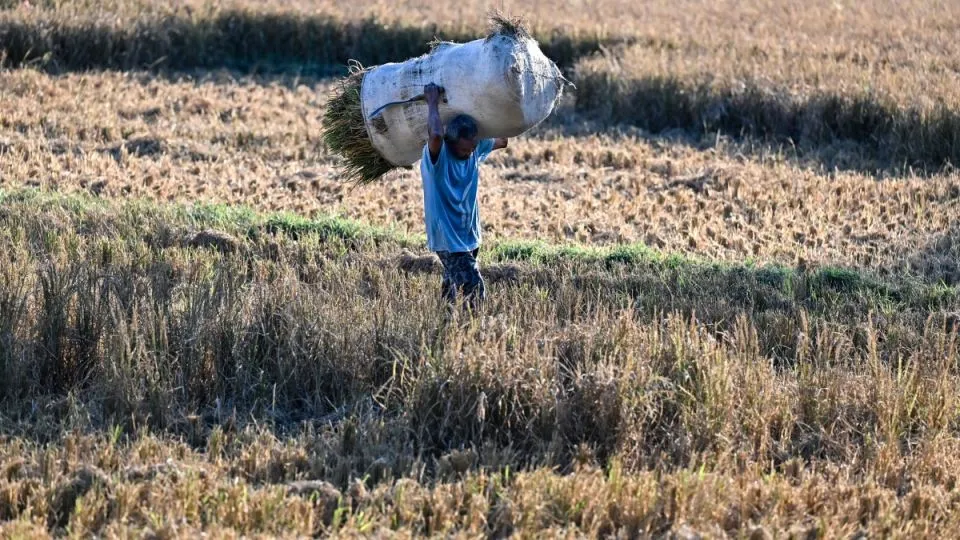
Arya News - October’s volatile food inflation stood at 5.81 percent, continuing an upward trend that began in July.
JAKARTA – Inflation in Indonesia has marginally reduced but is sustained at a relatively high level on account of persistently rising food prices as the weather phenomenon El Niño bites into harvest yields.
Statistics Indonesia (BPS) official Ateng Hartono revealed in a press conference on Monday that the consumer price index (CPI) growth in October touched 3.23 percent year-on-year (yoy), marginally easing down from 3.28 percent in the preceding month.
The reading was still within Bank Indonesia’s (BI) inflation target range of 1.5 to 3.5 percent.
Two of top-three commodity groups that drove the CPI growth the most were transportation, by virtue of price increases in gasoline, airfares and engine oil, and personal care and other services primarily because of gold jewelry, said Ateng.
However, the heaviest hitter was the food, beverages and tobacco group, he revealed, pointing specifically to chilies, fresh fish, rice, cooking oil and broiler chicken meat.
Ateng said red and bird’s eye chili harvests declined in some of the regional production hubs although several others recorded increases.
October’s volatile food inflation, one component that together with core inflation and administered price inflation built up the headline figure, was recorded at 5.81 percent.
Volatile food inflation represents the price growth of food commodities that are particularly susceptible to supply and demand shocks like harvest cycles, weather disruptions and distribution bottlenecks.
It had been consistently climbing since July but was still lower than the same month last year at 6.89 percent, as well as this year’s May at 6.24 percent.
Rice, the main volatile food commodity, always bears a significant weight in inflation calculation given its status as the country’s staple food and it has been climbing constantly since February.
BPS data revealed that the rice price in wholesale markets had climbed by 5.13 percent yoy, and 4.1 percent yoy at the retail level. The price increase was primarily impacted by poorer harvests caused by low rainfall.
The low rainfall was brought about by El Niño, which has caused droughts in certain areas.
The country was overrun by a strong El Niño in 2023, during which volatile food inflation peaked at 7.6 percent in November, although headline inflation was contained at 2.86 percent.
Many experts and meteorological bodies have warned that this year’s El Niño could be the strongest ever, on account of which BPS has projected lower rice harvests throughout September to December than in the past two years.
The Meteorology, Climatology, and Geophysics Agency (BMKG) described September’s national rainfall level as low but defined October as low-to-medium and forecast November to be medium-to-high.
BPS expects this year’s harvest area to decline by some 540,000 hectares and the total production down by 1.59 million tonnes compared with last year.
Ateng did not present the data but his presentation slide contained information that said the agricultural, forestry and fishery sectors heavily impacted inflation at the wholesale level, which in October reached 7 percent.
The wholesale price index (WPI) inflation was sustained at 2 to 3 percent from the start of last year to March this year and started shooting up in April, just weeks after the first missiles were fired in the United States-Israeli war on Iran and global oil prices started rising.
The producer price index (PPI) growth, which measures changes of output prices at the producer level, likewise has been surging since the conflict started, and peaked at 6.94 percent in the third quarter, more than twice as high as the level sustained throughout last year.
Permata Bank economist Faisal Rachman wrote in an analysis on Monday that the “intensifying El Niño effects are expected to keep inflation above 3 percent through at least” the first half of next year.
He said the volatile food inflation was “likely to remain elevated”, partly driven upward by the government’s free nutritious meal program, on top of El Niño’s impact.
“We estimate that, in the absence of government interventions to stabilize food supply and prices, food inflation could increase by 4.38 percentage points under a strong El Niño scenario. […] Accordingly, higher food inflation amid El Niño conditions could contribute approximately 0.27 to 0.88 percentage points to headline inflation,” said Faisal.
He noted that the inflationary impact from elevated global energy prices hinged on the government’s fiscal capacity to absorb external shocks but noted that the surging energy prices, combined with the rupiah depreciation, “could constrain the government’s ability to use fiscal policy as a shock absorber”.
He forecast that BI would hike the rate by 25 basis points (bps) and bring the benchmark rate to 6 percent till the year turns, all to support the rupiah and contain imported inflation.
Bank Danamon chief economist Irman Faiz, meanwhile, forecast that BI would increase the interest rate by 50 bps before the year turns by virtue of rupiah pressures and to maintain inflation expectations.
“If food supply improves and the rupiah stabilizes, the urgency of hiking rates will of course lessen,” Irman told The Jakarta Post on Monday.