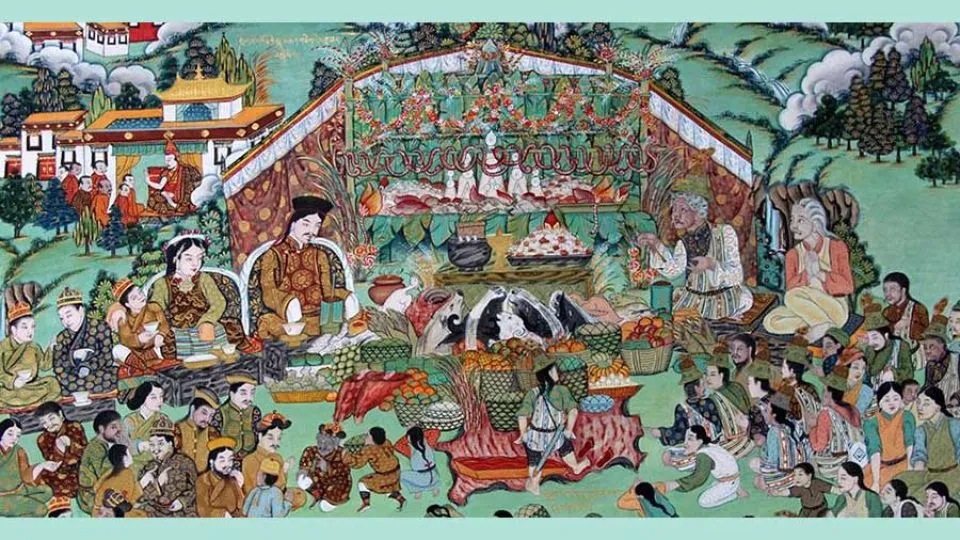
Arya News - The Bhutanese tradition of `Nabhorok`, an oath-bound friendship, was never entered into lightly. Rich in meaning, the word breaks down into na (oath), bho (summon), and rok (charog, or friend) - pointing to a companion who answers the call to help.
THIMPHU – Bhutanese lore warns that every oath you take severs a nerve in your body. That is why Nabhorok: oath-bound friendship was never entered into lightly. Rich in meaning, the word breaks down into na (oath), bho (summon), and rok (charog, or friend), pointing to a companion who answers the call to help.
Bhutanese lore warns that every oath you take severs a nerve in your body. That is why Nabhorok: oath-bound friendship was never entered into lightly. Rich in meaning, the word breaks down into na (oath), bho (summon), and rok (charog, or friend), pointing to a companion who answers the call to help.
Sealing that summon takes a ritual that looks deceptively simple. Two families would sit down for a meal or a drink. Before partaking, they would make offerings. They will invoke a protecting deity like Palden Lhamo, and swear to support each other through all of life’s trials. Should they fail, they also agree that the very food or drink before them would turn to poison.
In the early 1950s, the Nabhorok tradition drew two distant households into a lifelong bond. It united two distinguished families from Bhutan and Sikkim.
On the Bhutanese side was the Sisi Cheum, a noble house that produced Bhutan’s 19th, 21st, and 23rd Druk Desis. They were among the select families granted the title Cheum by Zhabdrung Ngawang Namgyal for supporting him during his early years in Bhutan.
Across the mountain stood the Sikkimese family of Rhenock Athing. Born a Barfungpa, the first Lön of Rhenock was Chagzöd Chogthub who earned his place in history by fighting the invading Gorkha army.
Descendant of Chogthub through his daughter, Sonam Dahdul (1883–1965) became the Chief Officer of the guards and orderlies at the Palace, then Manager of the Chogyal’s private estates and eventually Private Secretary and a member of the State Council. In 1926, he was conferred the title of Rai Sahib on the occasion of King Emperor’s birthday honours.
Linking the two-family circles, Dasho Gaza (1930–2019), a royal servant in the court of the Second King of Bhutan, married Aum Phub Sithub (1929–1954), daughter of Sisi Cheum Choezhi Nado in 1943. He and Aum Phub had two daughters, Singye Dem (b. 1945) and Sangay Dem (1949–1989).
According to Singye Dem, her mother passed away in 1954 after eleven years of marriage. Dasho Gaza, then only 24, completed the funerary rituals in Bhutan before travelling to Lhasa to offer 1,000 butter lamps in his late wife’s memory. While returning from this pilgrimage, Dasho stopped in Sikkim, where he met the Athing’s family, his late wife’s blood relatives.
Singye Dem recounted that her father felt deeply uncomfortable during his visit. His Sikkimese hosts were more sophisticated in their way of life, and Dasho told his daughter he and his party felt embarrassed for being unkempt and not as well dressed. Feeling uneasy, he cut short his stay with the family of Rhenock Athing Rai Sahib Sonam Dahdul and headed back home.
Singye Dem said that a decade later, in 1964, the Sikkim family paid a return visit, spending several days at the Sisi Cheum manor. She remembers that the Sikkimese family carried the same sealed agreement paper her family possessed. She recalls seeing the deed, written on daysho paper and bound in red tora or cloth, in her house in Sisina, though it has since been misplaced.
Five years later, in 1969, Singye Dem visited Sikkim herself. Unlike her father, she was more prepared and confident, staying for five nights. She recalled being hosted in a grand house with peacocks and still remembers the sight of an artificial incubator for hatching chickens.
According to the granddaughter of Yarpa Tse Ten Tashi (1911–1971), Tenzin C. Tashi, who lives in Gangtok confirmed that her grandfather incubated Rhode Island Red chickens. Also, the great-granddaughter of Rhenock Athing, Tenzin noted that Yarpa Tse Ten sold the eggs to the India House, the Palace, and other notable establishments.
13th Century Lhopo–Lepcha Blood Brotherhood Pact
Sworn pacts of kinship in the eastern Himalayas reach back much farther than twentieth century household ties. Recorded by Dr. Anna Balikci in her book, Lamas, Shamans and Ancestors: Village Religion in Sikkim, Tibetan chief Gye Bumsa and Lepcha chief Thekong Tek swore an eternal, hereditary blood brotherhood. Local deities witnessed the oath alongside a graphic ceremony involving raw hides, animal entrails, and feet placed in a vessel of blood, with curses invoked on oath-breakers. Some link this ritual to today’s annual Pang Lhabsol festival held annually on the 15th day of the seventh month of the Tibetan lunar calendar.
Dzom Tashi
According to The Royal History of Sikkim: A Chronicle of the House of the Namgyal, as narrated in Tibetan by the Ninth Chogyal Thutob Namgyal (r.1874-1914) and Gyalmo Yeshe Dolma, Sikkim’s Third Chogyal, Chagdor Namgyal (r.1700–1717), faced a succession threat from his older half-sister, Sem Phande Wangmo, whose mother, Nambi Ongmo was Bhutanese and one of the Queens of Second Chogyal of Sikkim.
While Yugthing Deshey and monk Agyal Pobdig escorted the young Chogyal to safety in Tibet, the Second Chogyal’s natural son Yugthing Arub was kept at Rabtentse Palace in charge of the Lhopos and Lepchas. The Bhutanese militia led by Tasa Ngawang Thinley and Dron Phenlay captured Arub, seized possession of the Palace and occupied it for almost eight years.
Following his capture, Arub was sent to Bhutan. Desi Zhidar initially imprisoned him in anger because Arub had foiled his plot to assassinate the Chogyal. Yet stories of Arub’s extraordinary feats soon circulated. Guards reported seeing him at a spring and in his cell at the same time. Others spoke of him knotting the tips of his guards’ swords and spears. Curious, the Desi decided to see his prisoner for himself.
According to The Royal History of Sikkim, Arub stood before the Desi and pulled a turquoise stone from the hair atop his head. He offered it as a gift. The Desi then placed two swords before him and issued a warning. “You are credited with possessing various magical powers,” the Desi said. “Exhibit them now, or else I shall have you killed.”
The Sikkimese prisoner, Arub calmly knotted both swords. When handed a piece of stone, he shaped it like a ball of dough. Impressed by the feats, the Desi declared, “You are a wizard. We should be friends.”
After winning the Desi’s favour, Arub settled in Dzomthang, present-day Zomlithang in Punakha. There, he fathered a son named Dzom Tashi.
Generations later, a descendant of Dzom Tashi carried that connection forward. It is the same Yarpa Tse Ten Tashi, son of Rhenock Athing, who had previously hosted Singye Dem in his grand house in Gangtok. This time he travelled to Bhutan to meet his Nabhorok. The Yarpa was a pioneering Sikkimese photographer and served as official court photographer to both the Bhutanese and Sikkimese royal courts.
In 1968, Dasho Paljor J. Dorji was serving as Paro Thrimpon. He recalled walking with the Yarpa to Tamchog Goenpa before today’s chain suspension bridge was built. At the goenpa, both families brought out their written oaths and shared a meal. Yab hoped to visit Sisi Chuem further downstream on a later trip, but he passed away shortly after the visit.
From 13th century blood pacts and 17th century royal intrigue to mid 20th century visits across Bhutan and Sikkim, these oaths-bound friendships belong to history. The sealed deeds on daysho paper have been misplaced, and the figures who walked those paths are long gone. Today, Nabhorok survives mostly in memory and these stories remind us of how two distinguished houses from Bhutan and Sikkim once answered the summon of kinship across generations to support each other through all of life’s trials.