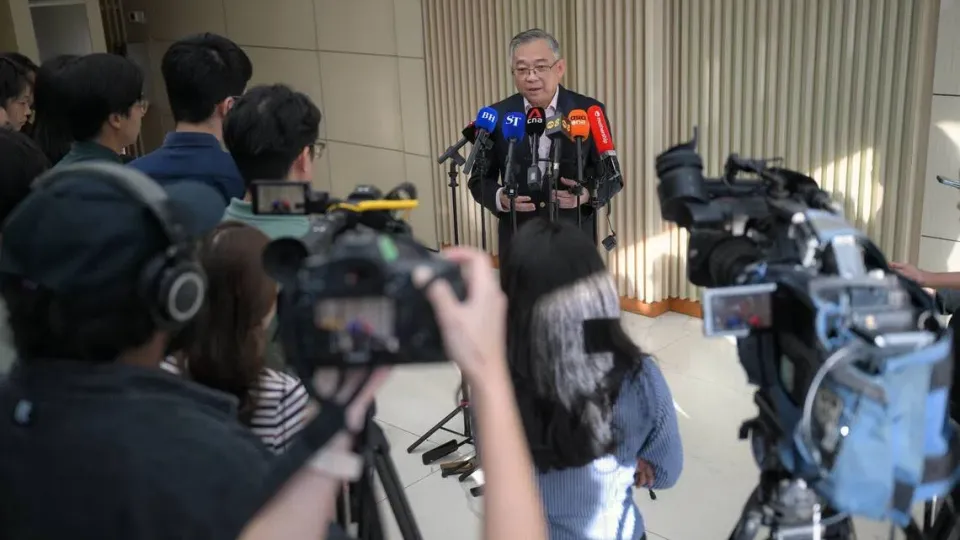
Arya News - The proposed new tariffs of up to 20% would raise the effective tariff rate on Singapore goods from 7.8% to 10.3%, said DPM Gan, who is also Minister of Energy, Trade and Industry (Trade).
SINGAPORE – Singapore will continue to negotiate with the United States on lowering tariffs that threaten to hit about $9.4 billion worth of the Republic’s domestic exports, said Deputy Prime Minister Gan Kim Yong, adding that any deal, however, will require some give and take.
The proposed new tariffs of up to 20% would raise the effective tariff rate on Singapore goods from 7.8% to 10.3%, said DPM Gan, who is also Minister of Energy, Trade and Industry (Trade).
Even so, Singapore will negotiate any trade pact with the country’s interests at the centre of the discussion, he told a media briefing on Nov 26.
“We also have to bear in mind that whatever agreement we arrive (at) and achieve in the US, there will be give and take. There will be compromises. There will be trade-offs that we need to be prepared to accept,” he added.
“So I think, in this process, it’s always important to remember that we will always be visible and always have Singapore’s interests at heart.”
The briefing was held a day after the US Trade Representative (USTR) proposed to impose tariffs of up to 20% on Singapore and 13 other trading partners under Section 301, accusing them of producing more goods than they would under normal, market-oriented conditions.
The duties could take effect in early 2027, though USTR Jamieson Greer offered to consider lowering the proposed rate to 10% if Singapore reaches an Agreement on Reciprocal Trade (ART) with Washington.
While the new tariff will not be stacked upon the previously announced Section 301 tariffs of 12.5% related to forced labour concerns, without an ART the new tariff rate could reach up to 20%.
Gan said the Government is engaging local companies to understand and assess how to assist them.
He said he was surprised by the US trade office’s actions and report, which raised many sticking points with Singapore’s economy.
“I am very surprised that this has happened because this is not something that we expected from an important, major trading partner,” he said.
USTR targets industrial policies and CPF
Apart from the statement that announced the new tariff, the USTR also issued a 168-page investigation report listing and explaining US concerns that follow the investigation the agency started in March.
According to the USTR’s investigation report on Singapore’s industrial policies, the specific acts, policies and practices related to structural excess capacity and production include the Singapore Manufacturing 2030 plan and the Research, Innovation and Enterprise 2030 plan, as well as financial support to the manufacturing sector and firms in the electronics and semiconductors, health and petrochemicals industries.
The report also cited the “encouragement of or failure to address foreign direct investments from non-market economies (NMEs), particularly China, which permits further development of structural excess capacity and production, and encouragement of or failure to address imports from NMEs, which enables Chinese firms to offload excess production”.
Singapore trade deal will involve compromises
Asked what deal can Singapore negotiate given that it already has a free trade agreement (FTA) with the US, Gan said: “It’s an open question because it’s really for us to discuss with the US to see what their concerns are.
“Whether in the process of discussion we will be able to address some of their concerns, and if we are able to do so, we hope we look forward to lower tariffs. It may not be… either 10% or 20%. It may be somewhere in between. And if we are able to arrive (at) some agreeable tariff together with the trade-offs that we have to accept, I think it’s something that will be a subject of negotiation moving forward.”
He said Singapore will be actively engaging the US administration over tariffs over the next couple of months.
Still, he said the high tariff rate and the scrutiny of Singapore’s economic policies in the USTR report were quite disappointing.
“Our bilateral relations are multi-faceted. It’s not just economics, but many other aspects as well. So I think we’ll continue to hope to be able to continue to strengthen our bilateral relationship and look forward to looking for a way to resolve differences in our tariffs and our trade relationship, and to seek better tariff for our exporters.”
The USTR report also targeted Singapore’s Central Provident Fund (CPF), a social security mechanism for retirement savings, saying the Republic uses it to promote savings and depresses consumption to boost its current account surplus.
A current account surplus occurs when a country earns more from international transactions – such as exporting goods and services, collecting investment income abroad, and receiving transfers – than it pays out to the rest of the world over a given period.
Gan said: “It will be important for us to communicate with them to explain our position to them, and we hope that they will understand what CPF is about. It’s not a scheme to suppress consumption.”
The USTR also deemed several financial support schemes for Singapore firms and the agreement with Malaysia on the Johor-Singapore Special Economic Zone as government interventions that promote structural excess capacity and production.
Business community weighs in
The Singapore Business Federation (SBF) is disappointed by the USTR’s determination that Singapore’s policies and practices contribute to structural excess manufacturing capacity and burden US commerce.
“We do not believe the findings accurately reflect Singapore’s market-driven economy, our role as a global trading and logistics hub, or the mutually beneficial nature of US-Singapore economic relations,” said the country’s top trade body.
SBF said the impact of the new tariff on Singapore businesses will depend on the final US action, including the products covered, tariff rates, implementation timeline, and how any new tariffs interact with existing measures.
SBF chief executive officer Kok Ping Soon said the immediate priority is to help businesses navigate these uncertainties and remain competitive.
“SBF will work closely with the business community and the Government to understand the implications and shape the necessary support,” he said.
Singapore and the US inked an FTA in 2003. In 2024, the US’ overall trade surplus with the Republic amounted to US$27 billion (S$34.8 billion). In 2025, this trade surplus with Singapore grew to US$33 billion.
However, the USTR report states: “Although Singapore has run a sizeable bilateral goods trade deficit with the United States for nearly all of the past decade, this does not outweigh the negative effects of Singapore’s outsized manufacturing sector and comparatively low consumption.”
Deborah Elms, head of trade policy at Singapore-based independent think-tank Hinrich Foundation, said if the two sides enter talks for a new deal, the US will likely demand three things: substantial new investments in the US; commitments to curb the flow of “non-market economy” (the US’ code for China) involvement in Singapore-to-US trade; and digital trade commitments that keep Singapore aligned with the US and American companies and platforms.
“Singapore will have to decide if these new commitments are worthwhile,” Elms added.
Singapore, despite its small size, is the third-largest Asian investor in the US, behind Japan and South Korea. Bilateral trade and Singapore investments in the US support some 350,000 American jobs.
About 6,600 US companies are based in Singapore, while more than 250 Singapore companies operate across 45 US states, in sectors from logistics and agribusiness to aerospace and shipbuilding.
The USTR investigation into structural excess industrial capacity that is flooding world markets with cheap exports was conducted against a total of 16 US trading partners, including Washington’s close allies Japan, the European Union (EU) and South Korea.
The USTR has not proposed tariffs on goods from Mexico and Norway at the moment.
The affected trading partners other than Singapore are China, Bangladesh, Cambodia, the EU, India, Indonesia, Japan, South Korea, Malaysia, Switzerland, Taiwan, Thailand and Vietnam.
Some Singapore exports are also subject to US sectoral tariffs – with rates ranging from 25% to 50% – on steel, aluminium, copper and automotive parts.
Read More:
US leaves door open to lower Singapore tariff deal even as it proposes 20% levy