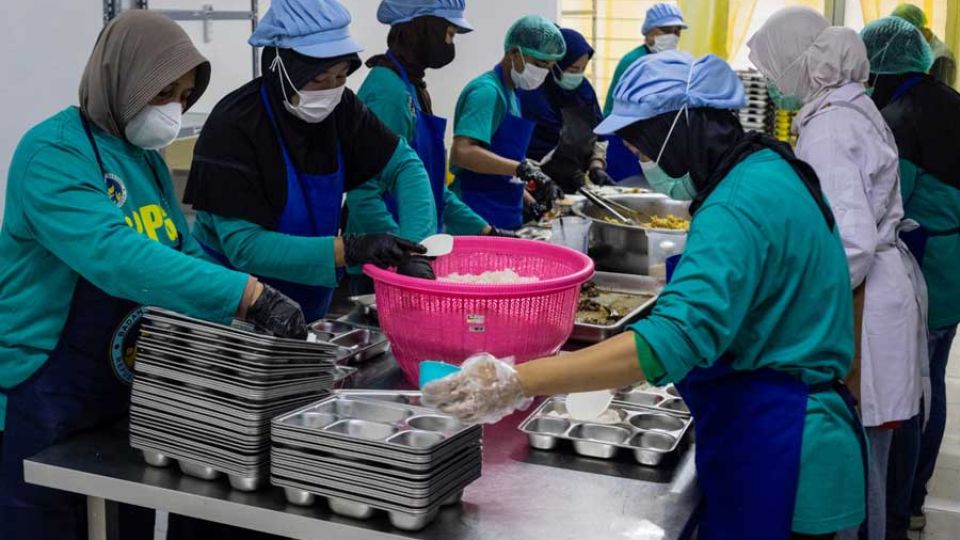
Arya News - The National Nutrition Agency (BGN) has shut nearly 900 kitchens for the free nutritious meals program and dismissed hundreds of employees in its first sweeping governance overhaul under newly appointed agency head Sudaryono, amid declining public confidence in the program.
JAKARTA – The National Nutrition Agency (BGN) has shut nearly 900 kitchens for the free nutritious meal program and dismissed hundreds of employees in its first sweeping governance overhaul under newly appointed agency head Sudaryono, amid declining public confidence in the program.
Sudaryono, a politician from President Prabowo Subianto’s Gerindra Party, cited violations ranging from poor hygiene and failure to comply with operational standards to inadequate wastewater treatment facilities as reasons behind the “permanent” closure of the total of 883 kitchens, out of more than 28,000 nationwide.
The closures affected 98 kitchens in Sumatra, 311 across Java and Madura and 474 throughout Kalimantan, Sulawesi, Bali, West and East Nusa Tenggara, Maluku and Papua.
Sudaryono said the agency would not tolerate kitchen heads who solicited kickbacks from partners or suppliers, warning that the BGN would take action against those procuring food ingredients at inflated prices.
“Anyone found committing such violations will be dealt with firmly. If the allegations are proven, we will dismiss them and suspend or shut down their kitchen,” he told reporters on Monday.
The measures came less than a week after Sudaryono was appointed to lead the agency following the resignation of his predecessor, Nanik Sudaryati Deyang, due to health reasons after less than two months in office.
The agency has faced mounting scrutiny since its rollout in early 2025 over mass food poisoning cases and governance problems, culminating in the arrest of former BGN head Dadan Hindayana and two of his deputies in a corruption investigation linked to the multitrillion-rupiah program.
Under Sudaryono, the agency has dismissed 261 of its own employees, comprising 224 non-civil servant workers and 37 experts, over alleged disciplinary violations ranging from online gambling and misconduct to suspected acceptance of gratuities.
“Those who have acted improperly must be punished, especially those who tarnish the reputation of others who have worked diligently and with integrity,” Sudaryono said.
On Wednesday, Sudaryono held a meeting with ministers overseeing food, health and education and promised that his agency would work to improve transparency and build a system to allow parents to check on the menus.
Despite the changes, Iman Zanatul Haeri of the Association for Education and Teachers (P2G) insisted that the free meals program be suspended at least until the Constitutional Court issues its ruling on the government’s decision to finance the initiative through the national education budget.
“The budget should have been refocused [from the program] toward more substantive education needs, including school operational costs and education funding from elementary to higher education,” Iman said at a separate event on Monday.
Public satisfaction with the costly program has also taken a turn for the worse. A survey released on Tuesday by pollster Saiful Mujani Research and Consulting (SMRC) found 61.6 percent of respondents were dissatisfied with how the government ran the program, while only 33.8 percent were satisfied.
The level of public satisfaction with the program fell from 53.1 percent in March of this year and 62.5 percent in November 2025.
“The results may reflect a series of incidents surrounding the program, from the arrest of the former BGN leaders over alleged graft to other governance problems, including the food poisoning cases,” SMRC executive director Deni Irvani said.
SMRC interviewed 749 respondents of voting age nationwide from July 5 to 19, and the survey had a 3.7 percent margin of error.
Government Communications Agency (Bakom) head Muhammad Qodari noted earlier this week that the free meals program would remain one of the national priorities of Prabowo’s administration despite its current shortcomings.
“The program will continue to be our best investment toward achieving the vision of Golden Indonesia 2045,” Qodari said on Monday.