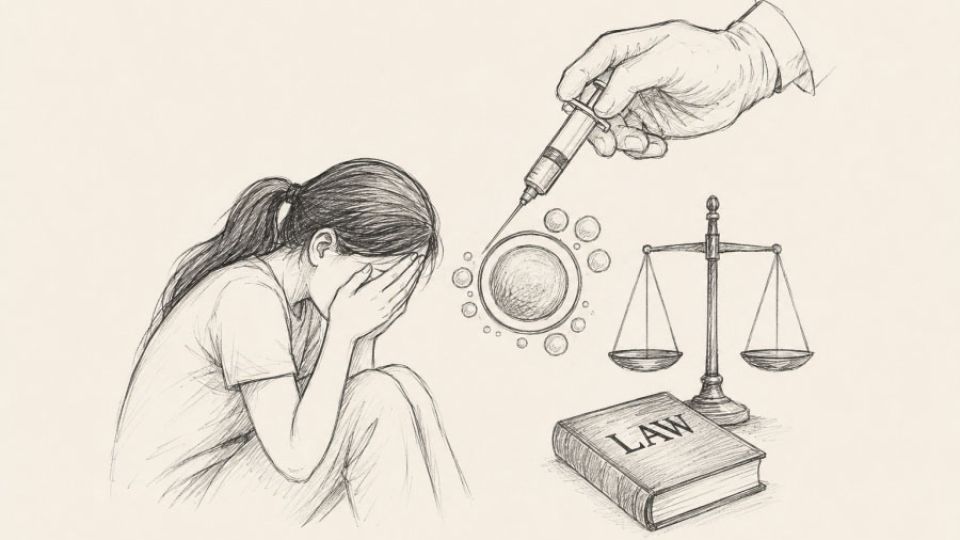
Arya News - Police traced a financial deal between Dr Nutan Sharma and the intermediary after the extraction, but the investigation did not proceed against suspects.
KATHMANDU – A month ago, a 17-year-old girl from Lalitpur suddenly fell seriously ill. Persistent vomiting, intense abdominal pain, and repeated fainting spells forced her family to seek urgent medical care. Initial clinical assessments suggested a urinary tract infection, and treatment began accordingly.
However, as her abdomen began to swell visibly, doctors suspected roundworms. When her condition failed to improve, tests were conducted for tuberculosis.
“We paid for very expensive medical examinations, but initially, nobody could diagnose what was wrong,” said the victim’s mother. “When nothing became clear, doctors decided to perform a video X-ray.” According to her, the ultrasound revealed a swelling of her ovaries. Doctors warned that the severe inflammation was impacting her lungs and that a ruptured egg sac could prove fatal.
Recognising the gravity of the situation, the girl’s family immediately rushed her to the Tribhuvan University Teaching Hospital in Maharajgunj.
At Teaching Hospital, doctors asked the 17-year-old whether she had ever undergone an egg donation procedure. She initially denied it. Her mother, hearing about egg donation for the first time, was entirely bewildered by the question. As doctors prepared for emergency surgery, the mother briefly left the ward to buy prescribed medicines. In her mother’s absence, the girl confided in the medical team. “I was afraid to speak earlier, but I donated my eggs at a clinic in Lalitpur,” she admitted.
When the mother returned, doctors informed her of the revelation. “Only then did I understand what had happened to my daughter,” said her mother. According to the girl, an acquaintance had persuaded her, claiming that egg donation was a simple, harmless procedure with no health risks, and promised her a payment of Rs30,000.
Believing the acquaintance, the teenager visited the In Vitro Fertilisation (IVF) centre at B&B Hospital in Gwarko, Lalitpur. Medical staff administered injections and instructed her to return a week later. On June 28, doctors extracted her eggs.
Despite undergoing intensive medical treatment, the girl’s health remains fragile. “Doctors told us that if her body recovered with medication, surgery might not be needed. Fortunately, the drugs worked, and her condition stabilised,” said her mother, informing that she began eating again and was discharged after a week.
Before leaving, hospital staff advised the family that harvesting eggs from a minor was a serious crime and suggested contacting police. Police officers stationed at the hospital listened to the account and directed the family to file a formal complaint with the District Police Range in Jawalakhel, Lalitpur.
“The family approached us as soon as they learned about the illegal egg extraction,” said Superintendent of Police Gautam Mishra of the District Police Range, Lalitpur. “We registered a case under human organ trafficking laws and initiated an investigation.”
However, the victim’s family alleged that police initially hesitated to take the complaint. Due to a general lack of clarity regarding laws on human egg trade, family members had to repeatedly urge officials to act. Assistance was eventually provided after discussions with the Women and Children Cell of the police.
On July 17, police arrested Radhika Gotame, aged 21, an intermediary from Lamjung currently residing in Lalitpur. Yet, shortly after her arrest, the District Attorney’s Office in Lalitpur ordered Gotame’s release on personal recognisance.
“She was released on own recognisance after the prosecutors had recorded her statement, but our investigation remains ongoing,” said Mishra. “We are probing the broader network involved in this racket.”
Assistant District Attorney Bharat Mainali defended the decision, stating that the district court had granted remand for only two days. “Her role was primarily that of an accomplice, and her interrogation was complete,” said Mainali. “Hence, the decision was made to continue investigating while keeping her out of detention.”
Police sources said that Gotame was released largely because the court refused to issue arrest warrants for Dr Nutan Sharma, a senior consultant obstetrician and gynaecologist at B&B Hospital, and another individual who introduced the teenager to Gotame.
Investigating officers recovered financial evidence, including WhatsApp messages between Dr Sharma and Gotame. Screenshots showed Dr Sharma explaining a temporary issue with her Siddhartha Bank account before confirming a transfer of Rs50,000 to Gotame. Investigators found evidence of two such transactions, including one on June 28. Gotame subsequently paid Rs30,000 to the minor.
Despite this documentary evidence, the court declined to issue arrest warrants under the Human Trafficking and Transportation (Control) Act 2007. Section 4 of the Act defines human trafficking as buying or selling human beings, forcing individuals into prostitution, or illegally removing human organs. Police framed their investigation around human organ trafficking, but SP Mishra admitted that specific statutory provisions addressing reproductive tissue trade are lacking.
“We attempted to arrest Dr Sharma and another suspect, but the court did not grant permission,” said an investigating officer. “Without warrants under the Human Trafficking Act, holding the intermediary in custody became legally problematic.”
The victim’s family expressed deep anger over the court’s stance. “My child is struggling between life and death. How can the court let them off simply by claiming there is no specific law?” her mother asked. “Does a lack of clear legislation give anyone the right to endanger a minor’s life? Doctors have warned that she may face lifelong infertility. Who will take responsibility for her ruined health?”
Legal experts have strongly criticised the authorities’ approach. Advocate Shashi Basnet, a member of the Supreme Court Bar Association, stressed that invasive reproductive procedures performed on a minor without parental consent constitute severe child abuse.
“State prosecutors previously declined to prosecute similar cases citing statutory gaps, and courts are following the same flawed reasoning,” said Basnet. “Indirectly, this is clear exploitation of a child. Charges could easily be framed under the Act Relating to Children 2018 to prosecute child abuse and bodily harm.”
Commercial egg harvesting and unregulated IVF practices have triggered legal battles in Nepal before. On August 17, 2025, advocates Nirab Gyawali, Dhruba Bhandari, and Ankita Tripathi filed a writ petition in the Supreme Court demanding strict regulation of commercial egg collection. On August 19, 2025, the court issued an interim order directing the government to immediately halt unregulated egg extraction and storage and establish effective monitoring mechanisms.
“The recurrence of such incidents directly defies the Supreme Court’s order,” said Basnet, adding, “Authorities cannot hide behind the excuse of non-existent laws. Because victims almost always come from economically vulnerable families, these rackets operate with impunity. The state must treat this with utmost gravity.”
This is not the first time law enforcement has uncovered commercial egg harvesting rings targeting young women. In July 2025, the Central Investigation Bureau (CIB) of Nepal Police conducted a major operation into illegal egg trading involving Hope Fertility and Diagnostic Clinic in Babarmahal, Kathmandu.
CIB investigations revealed that clinics extracted eggs from young women to supply childless couples, charging couples up to Rs1.8 million while paying donors as little as Rs10,000. The CIB recommended prosecuting a group led by Dr Swasti Sharma.
Although CIB initially sought to press charges under organised crime laws, consultations with government attorneys led to charges being framed under the Children’s Act 2018. However, the case sparked fierce public controversy after Attorney General Sabita Bhandari, appointed by the Sushila Karki government formed after the Gen Z protest, decided not to proceed with prosecution.
Critics pointed out a conflict of interest, as Bhandari was a relative of the accused doctor and held financial investments in Hope Fertility. The prosecution waiver claimed that the minors had filled out consent forms listing their age as over 18 and that there was no evidence of forced sexual abuse or physical coercion.
Following widespread outcry, the Ministry of Health and Population formulated the Assisted Reproductive Technology and IVF Operational Guidelines 2025. The guidelines stipulate that egg donors must be between 20 and 35 years old, may donate a maximum of six times in their lifetime, and must provide fully informed consent after being briefed on medical risks. The standards strictly prohibit monetary inducements.
Despite these guidelines, the lack of primary legislation continues to leave room for exploitation, leaving vulnerable young girls at risk and health professionals shielded from prosecution.
Prashant Subedi, the operator of Vatsalya IVF, says that 30 to 40 percent of people seeking IVF treatment require egg or sperm donation, and argues that the practice should be regulated through a legal framework.
“Laws regarding this issue vary from country to country. Some Islamic countries have even banned it. However, if Nepal imposes a complete ban, people will simply travel to India for treatment,” he told Kantipur. “Instead, it would be more appropriate to introduce legislation that permits donation within specified age limits and under clearly defined protocols within Nepal.”
Noting that India introduced legislation on the matter only after extensive deliberation, Subedi said, “At present, the law there allows a married woman who has already given birth to one child to donate eggs once, and those eggs must be stored in designated egg banks.”