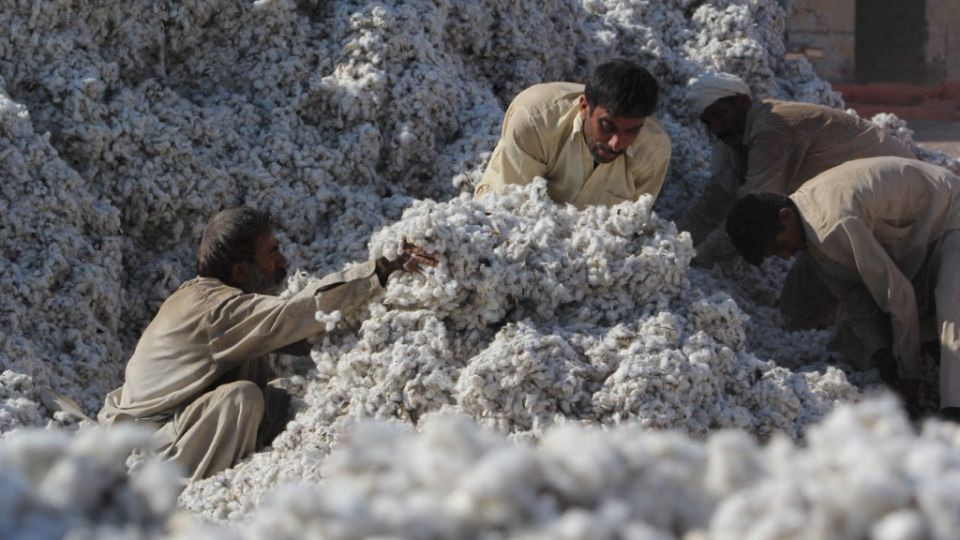
Arya News - A surge in cotton production in Sindh during the ongoing season has brought relief to seed cotton producers and ginners amid several challenges that continue to affect the cotton sector as a whole.
HYDERABAD – A surge in cotton production in Sindh during the ongoing season has brought relief to seed cotton producers and ginners amid several challenges that continue to affect the cotton sector as a whole.
The Aug 31 fortnight cotton bales arrival report issued by Pakistan Cotton Ginners Association (PCGA) has put cotton bale production at countrywide ginning factories at 16,96,451 bales compared with last year’s 13,35,632 in the corresponding period.
Of the nationwide cotton production, Sindh has taken the lead. Its cotton production was reported at 11,39,354 against last year’s 870,062 bales in the same period. When compared with Punjab, the largest province, PCGA reported its cotton production at 557,097 bales against 405,570 in the corresponding period last year. Percentage-wise, Sindh production is 31pc up from last year.
Cotton is grown mainly in left-bank districts of Sindh province in the kharif season. Sanghar district is considered the hub of seed cotton cultivation, contributing 757,845 bales to Pakistan’s total production.
Despite persistent challenges, province takes lead with 1,139,354 bales this year
The year on year basis increase in seed cotton could be attributed to various factors at a time when its fundamental challenges remain intact.
Syed Nadeem Shah, who grows cotton in Matiari and Tando Allahyar districts, described weather as a major factor behind the surge in cotton production. “Rains remain moderate for the crop; otherwise, heavy spells of rainfall damage cotton, which is a sensitive crop in terms of vulnerability to weather patterns”, he argued.
Initially, he explained, a rate of Rs11,000 to Rs12,000 was offered to cotton producers in June and farmers were now getting a rate of 9,500 to Rs10,000 in the August-September period. Similarly, he said, cotton sown in March led to a 28-30 maunds per acre yield. “Cotton sown in April is giving 17-18 maunds per acre yield”, he said. He noted that cotton in the past used to give three to four pickings but with a change of seeds by farmers, they get two to three maunds of produce every seven to eight days.
Sindh Abadgar Board (SAB) president Mahmood Nawaz Shah opined that cotton production has declined in Sindh in recent past. “Punjab has lost its considerable cotton acreage to corn and paddy which is a choice for farmers. Farmers in Sindh grow cotton as a last option as they can’t switch over to other crops”, he said.
So, he said, the recent increase in cotton production in Sindh is a positive sign. “With the commencement of the cotton season we had assessed that cotton production figures would show a declining trend after initial arrivals but the Aug 31 report reflects seed cotton reaching ginners in August in large numbers”, he said. PCGA’s October report would make the scenario clearer as it would cover arrivals until September.
However, he said that challenges to cotton were not over yet. “Cotton faces climate change and weather patterns that often prove detrimental to it. Pest attacks are also continuing because it is a sensitive plant. We have reports of pink bollworm attacks on the crop. This compromises production”, he remarked.
PCGA chairman Sham Lal said that this year’s increase in production in Sindh indicated that early sowing of cotton was reported on considerable acreage.
He said that cotton growers have received an adequate price of Rs9,000 to Rs9,500 per 37.324kg of seed cotton (raw cotton). “This price trend is encouraging for farmers and this might force them to continue the crop until December by adding some input of fertiliser and pesticides to save the crop and get more pickings”, he said.
He urged the government to withdraw 18pc tax on oilseed (binola recovered from seed cotton as a byproduct that produces oil) production and 10pc on oilcake production by ginners. “Oilcake production is also subjected to an additional four per cent on its non-filer buyers. So, it is 14pc tax cumulatively levied on oilcake. Either we underreport lint cotton or pay a lesser rate to cotton producers to adjust tax on the part of non-filers”, he said.
He said the government last year subjected imported cotton to a levy to make domestic cotton competitive. “But we demand that this tax should be withdrawn”, he said. The duty on imported cotton was levied under the Export Facilitation Scheme (EFS), he confirmed.
Oilcake is mostly used by cattle and buffalo pen owners, who are mostly non-filers. Due to this levy, said another ex-PCGA chairman, most ginners don’t reflect their actual bale production to avoid tax. “Such lint cotton production goes undocumented and is known as ‘goal maal’. This quantum is not reflected in the actual PCGA’s report”, he said.
Tariq Shah Jamote, chairman of the National Assembly’s Standing Committee on Food Security, told Dawn on Saturday that the Standing Committee had persuaded to remove imported cotton from EFS list in a bid to bring imported cotton at par with domestically produced cotton which is subjected to 18pc GST.
The PCGA report had last year put Pakistan production of cotton at 5.607m bales during the 2025-26 season against the 10.2m bales target, set by the Federal Committee on Agriculture (FCA) — a 1.5pc increase over last year (2024-25). It was, however, 45pc short of the official target. As per the breakup, Punjab produced 2.693m bales while Sindh and Balochistan contributed 2.915m bales although 37pc short of the target.