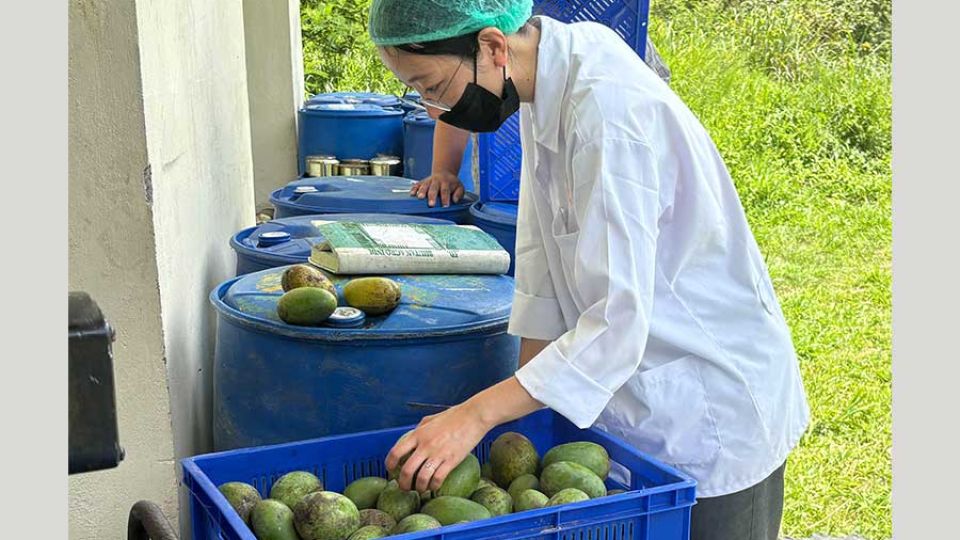
Arya News - Bhutan Agro currently supports more than 3,000 farmers across the country, purchasing a diverse range of fruits and vegetables, including apples, mangoes, mandarins, passion fruit, pineapples, strawberries and carrots among others.
MONGAR – Bhutan Agro Industries Limited (BAIL) has recorded significant growth in procurement at its Lingmethang processing plant, with volumes surging from 43.43 metric tonnes in 2020 to 174.93 metric tonnes in 2025.
Bhutan Agro currently supports more than 3,000 farmers across the country, purchasing a diverse range of fruits and vegetables, including apples, mangoes, mandarins, passion fruit, pineapples, strawberries and carrots among others.
Through formal contract agreements, Bhutan Agro has partnered with 260 farming households in eastern Bhutan, while reaching an additional 300 regional farmers annually through open procurement.
These locally sourced raw materials are processed into value-added products, including premium pickles, canned juices, jams and other fruit-based products.
According to Bhutan Agro, the growth in procurement has been driven by the introduction of contract farming in 2021, which has strengthened linkages with farmers and created assured market access for locally produced fruits.
Bhutan Agro’s pineapple procurement increased from 1.2 metric tonnes in 2020 to 108.5 metric tonnes in 2025, while passion fruit procurement increased from 0.2 metric tonnes in 2019 to 7.25 metric tonnes in 2025. Similarly, strawberry procurement increased from 0.12 metric tonnes in 2019 to 2.35 metric tonnes in 2025.
“The company’s procurement provides farmers with financial incentives to scale up production,” said an official. “Technical guidance from government agencies under market-led production programmes has simultaneously boosted overall yields and crop quality.”
Lhawang Norbu, 77, a mango grower from Khalangzi, said that although a hailstorm damaged a significant portion of his crop this year, he was still able to sell around 1,460 kg of mangoes, down from nearly 2,000 kg last year. He fetches around Nu 100 per kg in the local market, while Bhutan Agro pays a bulk rate of Nu 52 per kg.
Selling around one tonne of mangoes earned him about Nu 52,000. His main challenge, however, is finding enough farm labourers to manage his three-acre mango orchard.
Selling in bulk to Bhutan Agro also helps farmers prevent spoilage, whereas selling in local markets carries a greater risk of fruit rotting because of the lower volume of buyers.
To further benefit growers, BAIL sets base procurement prices between 7 and 147 percent above estimated production costs. It also offers cash incentives, including an additional Nu 5 per kg for produce delivered directly to the factory gate and a Nu 2.50 per kg premium for certified organic or Good Agricultural Practices (GAP) crops.
In Yangbari, pineapple growers are seeing similar gains.
Rinchen Jamtsho, 46, a member of the Yangbari Pineapple Growers, said the 58-member group sold around 34 tonnes of pineapple last year. Encouraged by growing demand, production increased to 60 tonnes this year. The group expanded after adding eight new members last year and three more this year.
On his own farm, Rinchen earned a profit of Nu 30,000 last year from a 60-decimal plot. After expanding his farm to more than three acres this year, his earnings rose to Nu 55,000.
“Having Bhutan Agro as a guaranteed market has greatly benefited local farmers, saving them from having to undercut their prices to compete with imported Indian pineapples in the local market,” said Rinchen Jamtsho.
Each member household earns between Nu 50,000 and Nu 100,000 annually, depending on the size of their land and their yield.
Tashi Dorji, 44, another member of the group, said that selling to Bhutan Agro allows farmers to sell large volumes at once, which is difficult to achieve in local retail markets.
Sonam Loday, a fruit farmer from Tsakaling Gewog, earned around Nu 70,000 last year by selling more than 500 kg of passion fruit from his two-acre farm to Bhutan Agro.
With the current harvest season still ongoing, he has already sold around 400 kg and earned Nu 15,000.
While the local market offers Nu 100 per kg compared with Bhutan Agro’s bulk rate of Nu 38 per kg, Sonam said he follows a clear strategy: he sells in bulk to Bhutan Agro during peak production periods and shifts to the local market when yields are lower.
To support rural livelihoods by building a reliable agricultural value chain for local farmers and protecting growers of perishable crops from market volatility and post-harvest losses, the company guarantees stable procurement prices and processes payments within four days of delivery.
Bhutan Agro plans to deepen its engagement with farming communities across the country through partnerships built around clear market opportunities, the official added.
“We believe farmers can invest, produce and grow with greater confidence when there is greater visibility on where their produce will go and how it can be transformed into value-added products.”