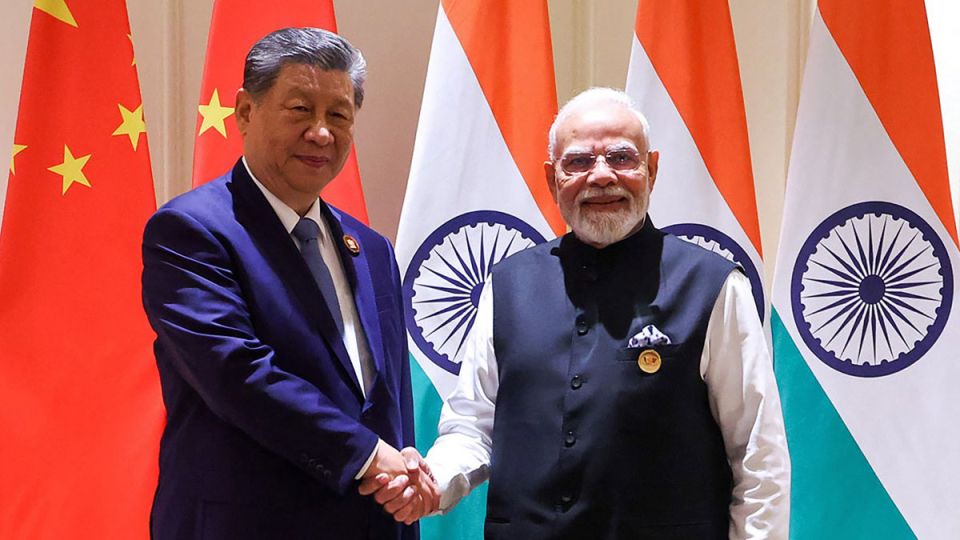
Arya News - Both leaders shook each other’s right hands and smiled as they spoke via interpreters, a rare sign of warmth in an otherwise frosty bilateral relationship.
NEW DELHI – How long did their handshake last? It is one of the several offbeat headlines to emerge from the BRICS summit that ended in New Delhi on Sept 13. The 20-second-long notable handclasp that caught public attention in this case was one between Indian Prime Minister Narendra Modi and Chinese President Xi Jinping.
Both leaders shook each other’s right hands and smiled as they spoke via interpreters, a rare sign of warmth in an otherwise frosty bilateral relationship.
Xi’s presence on Indian soil – his first in nearly seven years, together with a bilateral meeting between him and Modi on Sept 12 – has renewed hopes for an optimistic phase in India-China ties that have long been bedevilled not just by their border dispute but also wider geopolitical and economic rivalry between the two Asian neighbours.
Public readouts of the Modi-Xi bilateral meeting have struck a note of cautious optimism. India’s Ministry of External Affairs said both countries should take “a strategic and long-term perspective of their ties”. It is a sentiment the Chinese Ministry of Foreign Affairs echoed, with Xi noting that the ongoing detente between New Delhi and Beijing “needs to be cherished”.
Both countries have launched a series of efforts since 2024 to put their relationship back on track after a fatal border clash along their Himalayan frontier in June 2020 sent ties into a deep freeze.
Border talks have resumed, as have some direct flights rebuilding people-to-people links. India has also eased some of the restrictions on Chinese investment that it had imposed following the 2020 clash.
But this effort at a relationship reset has been fraught with challenges, amid a deep sense of mistrust between Beijing and New Delhi that has lingered stubbornly since the brief 1962 Indo-China war.
According to Reuters, India recently declined to approve a proposal by Alipay, a platform related to China’s Ant Group, to be linked to India’s instant digital payments system, citing national security concerns.
And The Independent, a British news portal, reported on Sept 12 – the day when Modi and Xi met each other – that satellite images had shown China was advancing into “contested India border territory” in Arunachal Pradesh.
Despite these persistent irritants, experts note it is important that top leaders from both countries keep talking to ensure the relationship does not flare up again, and delivers mutual benefits, including potentially for the wider developing world.
“It is the leadership at the top that sets the political perspective and the commitment to carry this relationship forward, which would be beneficial for both,” said Alka Acharya, director of the Institute of Chinese Studies, a Delhi-based research institution. “And it is the two leaders who clearly convey down the line that this is a relationship which is important to both,” she told The Straits Times.
The Indian statement emphasised that “peace and tranquility in the border areas remains an essential basis for the continued development of bilateral relations”. Other focus areas in their statements were on addressing “each other’s economic and trade concerns in a balanced way” and further boosting people-to-people connectivity.
Dylan Loh, associate professor in public policy and global affairs at Nanyang Technological University in Singapore, characterised the Modi-Xi bilateral meeting as “a further step in pragmatic stability”, noting that “building proper strategic trust” remains difficult. The key, he added, would be to sustain communication and follow up from this meeting. “High-level summits set the tone, but without routine follow-up mechanisms, military-to-military dialogue on the ground and functional working groups, agreements quickly degrade, so these should be institutionalised. The political message, from the top leaders, to working level groups must be crystal clear as well,” Loh told ST.
China, for many in India, fundamentally remains an expansionist power that seeks to limit India’s growth and influence, despite periodic bursts of optical public bonhomie between its leaders such as what was on display on the margins of the BRICS summit. “The Chinese long-term view of India is that it is a rival that needs to be managed,” said Jabin T. Jacob, director of the Centre of Excellence for Himalayan Studies at Shiv Nadar University in Greater Noida in Uttar Pradesh. “The world (for them) is only big enough for the US and China. It is one, whether they state it or not, a G-2 world where the US keeps to its corner and China keeps to its corner for now.” Eventually, the Chinese, Jacob added, “will want to topple the US from anywhere and everywhere”. “But for now, given the difference in capacity and capabilities, the Chinese are trying to divvy up the world. So, it is ‘Asia for Asians’ for now, and ‘Asia for Asians’ means an Asia led by China. It is as simple as that.”
Similarly, many in China view India as a “cat’s paw ally” of the US against China, a perception that is reinforced by India’s membership of the Quad, a grouping that includes the US, Japan, Australia and India with the goal of “fostering a free and open Indo-Pacific”. Many, however, see it as an euphemism to limit Chinese influence in the region.
Lin Minwang, professor at the Center for South Asian Studies at Fudan University, noted India’s distrust and suspicion towards China stands out when compared to other countries in China’s neighbourhood. “So, when facing many specific issues, suspicion, doubt and even hostility often become the mainstream thinking in how India approaches its China policy,” he noted. “And this, in turn, tends to amplify all the more concrete problems – be it the border issue, trade frictions or even the Pakistan question.”
Besides the border dispute and trade imbalance, China’s strategic military support for Pakistan, especially during the four–day conflict with India in May 2025, has not helped dispel Indian suspicions vis-a-vis the Chinese.
Yet, despite differences and Indian attempts to decouple from China, the country overtook the US to emerge as India’s largest trading partner in the financial year that ended March 2026. Bilateral trade reached US$151.1 billion (S$191.5 billion), even though the country’s trade deficit with Beijing widened to US$112.16 billion during the same period.
Moreover, with ongoing trade-related tensions with the US and President Donald Trump’s “America First” approach that has accelerated US diplomatic isolation and weakened traditional alliances, many see an opportunity for India and China to work together.
Many analysts have pitched China as a potential source for capital and technical know-how for India as it seeks to boost its manufacturing capability, even though there are questions how far China is willing to transfer certain cutting-edge technologies.
“It is absolutely a wrong presumption to think that the Chinese are just waiting to enter the Indian market,” Jacob said. He argued it is the Chinese who have blocked capital and technology from coming into India, adding that India’s differences with the US offer an “opportunity that the Chinese would want to exploit”.
“They realise that if the Indians are on the mat, they are going to push for maximum advantage and leverage if they can,” he told ST.
“And they realise that they need to do it because, otherwise, India then builds and does the same thing that China did in the 80s and 90s – have good relations as long as the money flows in and once you build your capacity, turn nasty, which is exactly what the Chinese did to the Japanese.”
But despite such concerns, Acharya noted that New Delhi needs to strive to expand its strategic options beyond the US and Europe, focusing particularly on China and the wider Eurasian region that has seen rapid economic development amid a pushback against “neoliberal policies that are trying to stifle their growth and cut off opportunities”.
“The India-China border dispute is not going to be solved overnight, but it also cannot hold the whole relationship hostage,” she told ST, especially when Indian manufacturers depend on Chinese imports to grow their production and export capabilities, while also looking to partner with Chinese companies in newer emerging technologies.
“I am not implying that we revive the brotherhood and bonhomie of the 1950s – that is obviously not going to happen,” Acharya said. “While we have to keep addressing the dispute, we also must start thinking afresh about the larger framework of cooperation with China and push for more cooperative restructuring of the existing regional and global institutions.”
Read More:
India’s Modi and China’s Xi push business links, border peace as ties revive