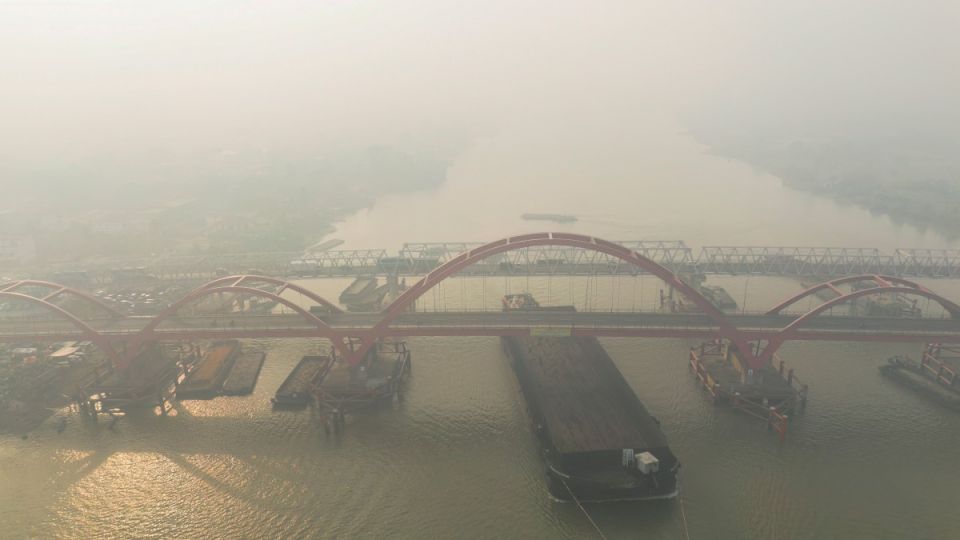
Arya News - Children accounted for around 20 percent of all wildfire-related respiratory illnesses as 12.5 million people in seven provinces were affected by the widespread forest and land fire, according to the Health Ministry.
JAKARTA – Spreading forest and peatland fires in Indonesia have caused people to fall sick, as haze from hundreds of thousands of burned lands across the country worsen air quality in many regions and trigger respiratory infections among people.
Three regencies in Central Kalimantan recorded the worst air quality, according to data from Environment Ministry’s air quality monitoring platform as of Friday at 7 p.m.
East Kotawaringin, Katingan and Gunung Mas regencies scored 750, 629 and 394, respectively, in the ministry’s Air Pollutant Standard Index (ISPU), which determines the air quality in a location and its impact to human health. Under the classification, readings above 300 are considered hazardous, with pollutants posing severe health risks to humans and other creatures.
Central Kalimantan is among the worst hit regions in this year’s wildfire season, which is supercharged by drier air caused by the El Niño climate phenomenon over the Pacific Ocean. Around 68,300 hectares of land in the province, the same size as one Jakarta, were burned from January to August, according to data from independent forest monitoring platform Nusantara Atlas.
Overall, the platform found around 895,657 ha of land across the country had been burned between January and the end of August, 34 percent higher than the figure in the same period in 2019, when the country was also impacted by El Niño.
With haze blanketing more parts of the country, more people are falling sick with acute respiratory infections.
The Health Ministry’s data per Sept. 9 showed 113,336 cases recorded in seven fire-affected regions, including Central Kalimantan, West Kalimantan, Jambi and South Sumatra. The figure doubled from 50,891 recorded on Sept. 1.
Children younger than 5 accounted for 26,545 cases, or more than 20 percent of all acute respiratory infection recorded patients, according to Health Ministry spokesperson Widyawati in a press briefing on Thursday.
Around 12.5 million people were affected by the wildfire, according to the Health Ministry’s data.
The ministry has placed 1,691 community health centers (Puskesmas) and 360 referral hospitals on standby to anticipate a surge in patients affected by the haze, while also mobilizing more than 19,000 health workers across the affected provinces.
The ministry has also distributed masks, oxygen concentrators and cylinders, gloves and purifiers as part of prevention measures against respiratory illnesses.
Widyawati urges people living in wildfire-affected areas to “stay vigilant, wear masks while outdoors, watch the air quality index, rehydrate regularly and visit the health centers if they experience difficulty breathing”.
The West Kalimantan administration extended the province’s state of emergency on Thursday until Sept. 20, which gives the provincial authorities greater leeway to mobilize funds, personnel and heavy equipment to put out the widespread forest and land fires.
Firefighting continues across the regions, as 532,152 hot spots were detected on Friday, increasing from 488,170 detected the day before, according to data accumulated by Nusantara Atlas.
Forest and land fires have long been a recurring problem in Indonesia, fueled by the draining of peatland ecosystems and use of fire to clear land mostly for agricultural purposes.
The widespread wildfire has triggered haze that has again crossed country borders. Cities in Sarawak on the Malaysian side of Borneo Island recorded air pollution readings of 200 on Friday, putting it in the “unhealthy” category according to air quality monitoring firm IQAir.
Singapore, which has also been hit by haze in the past weeks, saw its air quality improved to 122 over the same period, although it was still considered “unhealthy for sensitive groups” under IQAir’s classification.
On Thursday, Vice President Gibran Rakabuming Raka visited a wildfire emergency mitigation post in Banjarbaru in South Kalimantan. He instructed the National Disaster Mitigation Agency (BNPB) to prioritize extinguishing fires in areas around schools and protecting vulnerable groups, while maximizing cloud seeding operations to induce rainfall.
The disaster agency had deployed nearly 44,000 joint personnel and 45 aircrafts to conduct patrols and waterbombing missions in wildfire-hit areas, said BNPB spokesperson Berton Panjaitan at Thursday’s press briefing.
Also on Thursday, Japan Maritime Self-Defense Force (JMSDF) vessel JS Kunisaki landed in Mempawah, West Kalimantan to assist local authorities in firefighting missions. Carrying three heavy transport helicopters and up to 300 personnel, the Japanese force was slated to join the waterbombing missions on Friday and Saturday in the region.