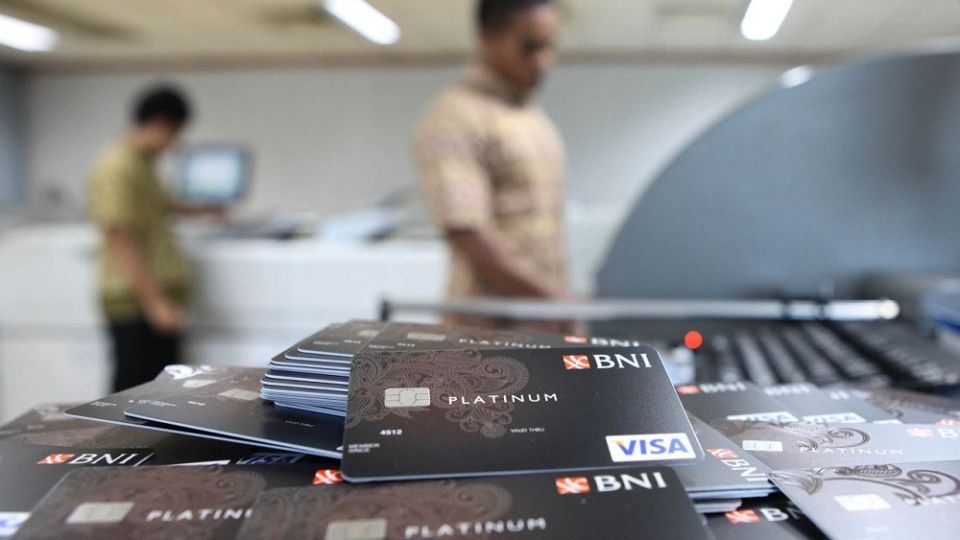
Arya News - Reducing reliance on western credit card providers was the main reason behind the establishment of the Indonesian Credit Card (KKI), so the country has a system to rise to the task when worst comes to worst.
JAKARTA – The denizens of Jakarta have given a tepid reception to the launch of the Indonesian Credit Card (KKI) after discovering its limitation and reviewing necessities but stated willingness to change heart if consumer stimulus is introduced.
Bank Indonesia (BI) launched the credit card for retail customers on Independence Day after years of running the system for limited use.
Asked whether the goal was to ultimately integrate the system with international payment networks, interim BI governor Destry Damayanti told The Jakarta Post on Thursday: “[There is] no such plan because it’s only for domestic [use]”.
Kaleb Sihombing, a civil servant in Jakarta, said that limitation would become an impasse in deciding whether to get the KKI since the need to make overseas transactions was the chief factor behind obtaining his first credit card.
“I only use [my credit card] when I’m abroad or when there’s a domestic discount. I don’t need it for daily use because there are many other more convenient payment systems,” Kaleb told the Post on Friday.
The international credit card system and infrastructure have always been overwhelmingly dominated by American companies like Visa and Mastercard, both of which have deep reach in the Indonesian credit card ecosystem.
The systems employed by both companies have for decades been convenient, proven and well connected until the Ukraine war began in 2022, which brought the United States to impose economic sanctions on Russia, intended to isolate the invader from the international economy.
The sanctions largely blocked Russian customers from making international transactions using Visa and Mastercard, an act that many perceived as weaponization of payment systems by the US.
After the sanctions were imposed, then president Joko “Jokowi” Widodo said, “Visa and Mastercard could be a problem”, stressing the need for independent and sovereign financial transactions.
Reducing reliance on western credit card providers was the main notion behind the establishment of the KKI so Indonesia has a system to rise to the task when worst comes to worst.
The system itself has been online since April 2023, but its usage was limited only to accommodate government transactions, which in the second quarter reached a total of Rp 147.8 billion (US$8.35 million), according to BI.
Independence Day launch marked its expansion to the retail segment and BI deputy governor Filianingsih Hendarta said on Wednesday that some banks had become eligible issuers with more to follow.
The deputy governor said the credit card would connect with the Quick Response Indonesia Standard (QRIS), a unified QR payment network widely used in the country that is connected with all payment systems.
When implemented fully, customers will be able to scan the merchant’s QR code for payment and choose whether to transact using the balance of their bank accounts, electronic money or the credit card.
Kaleb sees this as a potential swing factor because if the card cannot accommodate international transactions, it had to at least offer “ease or new ways to simplify daily domestic transactions”.
The civil servant went on to say that he might be interested in getting the KKI if the annual fee was zero and if its usage offers discounts. If discounts on consumptive purchases are not possible, he is hoping for tax deductions, which he said “could make us more interested” in getting the card.
Permata Bank chief economist Josua Pardede told the Post on Friday that “strong incentives” were recommended to attract the flock but advised that they should be temporary and limited.
“The incentives should be meant to shift the initial payment behavior, then be gradually reduced when the number of users and transactions have reached the economy of scale,” the economist said.
He went on to say that neither BI nor the state budget should bear the incentive burden; it should instead be shouldered by the issuer banks, who receive the “economic benefit” from increasing customers, transaction volumes, financing revenue and long-term relationships with users.
Josua is overall for the domestic credit card system since it reduces dependency on the international system and can press processing cost, not to mention less security concerns.
Nevertheless, he said giving consumers a strong enough reason to shift and use it routinely is a big hurdle, pointing out that demand for credit cards at the start of the second quarter was still growing, but was slowing down.
Credit card weighted net balance, which depicts customers’ perception of the product, was only 30 percent, which Josua said was far lower than vehicle and housing loans, meaning “customers don’t automatically need one additional credit card”.
Pulina Nitya, a private sector worker in Jakarta, told the Post on Friday that she does not own a credit card and so far has no intention of getting one “because I haven’t had any real necessity that presses me to use a credit card”.
“In terms of my financial profile, I’m really avoiding having credit, consumption credit. […] Having a credit card is not my priority right now,” Pulina said.
When the time to get a credit card comes, Pulina firmly said she is “not interested” in obtaining the Indonesian Credit Card as she will likely prefer one that accommodates overseas transactions.