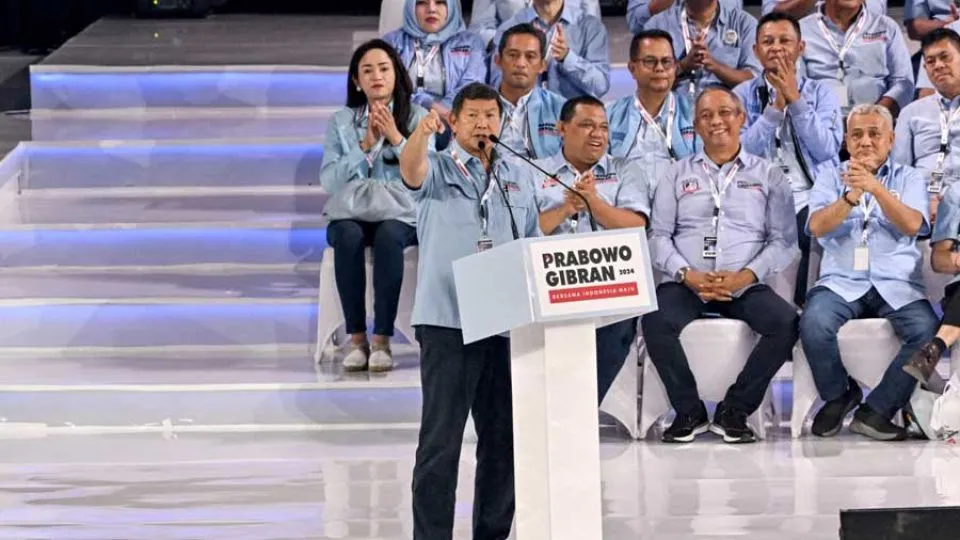
Arya News - PT Nations Petroleum, an oil and gas company under the Arsari Group, owned by Hashim Djojohadikusumo, the younger brother of President Prabowo Subianto, secured the Natuna D-Alpha working area through the direct offer mechanism.
JAKARTA – The Energy and Mineral Resources Ministry has named the winners of six oil and gas working areas under Phase I of the 2026 tender.
The awards, issued under Energy Ministerial Decree No. 108.K/MG.4/DJM/2026 on Sept. 17, form part of the government’s broader push to accelerate exploration and unlock new fossil energy reserves beneath Indonesian soil.
“The addition of these reserves is expected to support the sustainability of oil and gas production and meet future national energy needs,” the ministry said in a statement on Friday.
The six blocks were awarded through two mechanisms. Two areas, Sapukala and Natuna D-Alpha, were secured via direct offer. Four others: Bengara II, Pesut Mahakam, Puri and Rupat, were awarded through a regular tender based on 2025 ABT study areas.
The most politically notable winner is PT Nations Petroleum, an oil and gas company under the Arsari Group, owned by Hashim Djojohadikusumo, the younger brother of President Prabowo Subianto. The firm secured the Natuna D-Alpha working area through the direct offer mechanism.
The firm has committed to a signature bonus of US$200,000 (Rp 3.5 billion) to be paid to the government and a total commitment of $103.309 million for the initial three-year exploration period.
PT Nations Petroleum’s commitment comprises three geological and geophysical study packages, 3D seismic data acquisition and processing covering 591 square kilometers, one pilot unit design and engineering project, three CO2 integrated study packages, one manufacturing, procurement, and construction (MPC) project, two EPC design cost packages, one appraisal well, one exploration well and one package for operations, multi-mode testing and monitoring.
The Natuna D-Alpha Block is a working area located off Natuna Island in the Riau Islands. The block holds gas potential of up to 222 trillion cubic feet (TCF), touted as one of the largest reserves in the world.
However, the gas-rich field contains high levels of carbon dioxide (CO2), meaning the exploitable gas volume is likely only around 46 TCF.
Separately, the Energy Ministry estimates Natuna D-Alpha’s oil potential at about 2,865 million barrels (MMBO).
The government said adding these reserves is expected to support sustainable oil and gas production and meet future national energy needs.
“The government expects the winners to fulfill and realize all established commitments, particularly regarding the execution of exploration activities, in accordance with applicable regulations,” the ministry stated.
Chinese energy giant Sinopec International Energy Investment Holdings Limited also emerged as a winner, taking the Bengara II block. Hong Kong-based Cinda Energy Limited, meanwhile, won the Rupat block.
In total, the firm commitment value for the six working areas reached $141.51 million, with an accumulated signature bonus of $1.6 million.
Despite that, three oil and gas working areas, Rombebai, Maratua II and Jayapura, remain without a winner.
The ministry said these areas are now being offered as “Available Working Areas” under applicable rules, opening opportunities for business entities and permanent establishments to participate again through the Direct Offer mechanism.
Offers may be submitted with or without a joint study. The Direct Offer auction process without a joint study runs for 30 calendar days, while proposals may be submitted to the Director General of Oil and Gas within a maximum of six months after the determination of the offer results.
Business entities may also propose their own preferred terms and conditions.
“These three Available Working Areas offer exploration opportunities with characteristics and key Cooperation Contract terms tailored to the specific conditions of each working area,” the ministry emphasized.
Read More:
Indonesia’s President Prabowo’s latest swipe at experts draws backlash
Recentralisation concerns in fiscal, education policies heighten in Indonesia