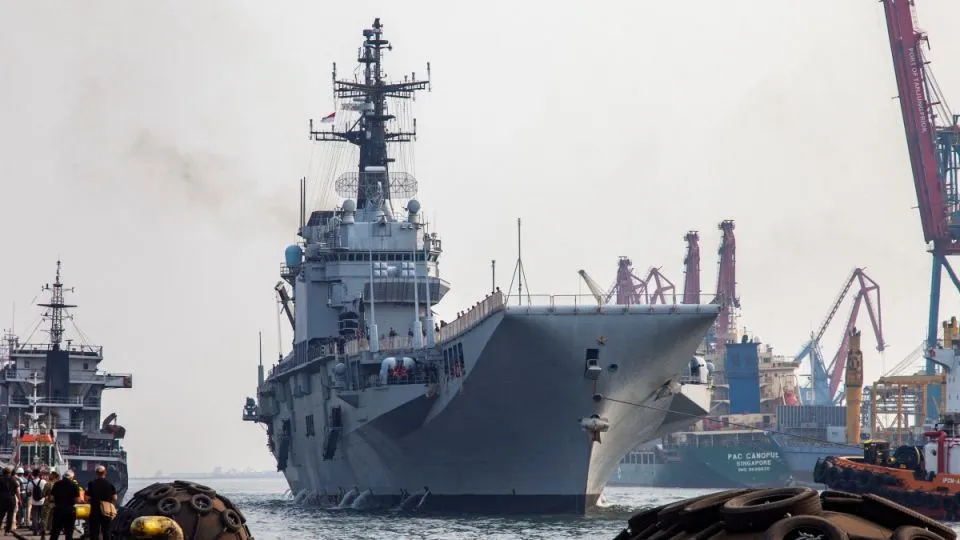
Arya News - Officials have touted the light aircraft carrier’s use in humanitarian assistance and disaster relief (HADR) missions, such as to fight forest fires or providing relief in response to various natural disasters.
JAKARTA – The arrival of decommissioned Marina Militare (Italian Navy) light aircraft carrier ITS Giuseppe Garibaldi at Tanjung Priok Port in North Jakarta on Friday marked a new era for the Indonesian Navy as it exerts more assertive and outgoing naval power.
Scheduled for official transfer on Sept. 24, and to be renamed KRI Sriwijaya, the vessel will make Indonesia the second country in Southeast Asia to operate an aircraft carrier after Thailand with its HTMS Chakri Naruebet. Thailand has operated the 11,000-tonne aircraft carrier since 1997.
Indonesian Navy chief of staff Adm. Muhammad Ali has repeatedly stated that the vessel, officially an aircraft-carrying cruiser, would be mostly used in military operations other than war (MOOTW), especially in humanitarian assistance and disaster relief (HADR) missions.
Meanwhile, President Prabowo Subianto said on Sept. 7 that the aircraft carrier would be used as a helicopter carrier to extinguish fires.
“[The aircraft carrier] will be refurbished, we will turn it into a helicopter carrier and also for drones,” Prabowo told a disaster mitigation meeting on Sept. 7, as reported by Kompas.com.
“It has the capabilities to house 10 medium-class helicopters.”
Prabowo said the capacity to base helicopters closer to fire hot spots will assist disaster response.
He also asked more aircraft to be on standby to conduct water bombings and weather medication operations.
Prabowo’s administration has been highly criticized for its tardiness in handling forest fires and various other natural disasters due to a budgetary focus on the ill-managed free nutritious meal program.
The 14,000-tonne ITS Giuseppe Garibaldi was launched on June 11, 1983, and underwent various trials before being commissioned on Sept. 30, 1985. The light aircraft carrier, officially an aircraft-carrying cruiser, was decommissioned on Oct. 1, 2024, after 39 years of service.
The carrier flattop can accommodate up to six helicopters simultaneously while 12 helicopters can be stored in the hanger under the deck.
This means a huge increase when compared with existing Indonesian landing platform docks (LPDs), which can carry only two to three helicopters, thus increasing the speed and amount of relief goods being delivered to disaster locations.
The Indonesian Navy has sent 100 personnel to Italy for training. These personnel also manned the aircraft carrier under the supervision of Marina Militare as part of their training regime.
In total, the aircraft needed some 500 crew, about 200 air wing personnel and 100 command and control staff, for a total of some 800 personnel during its Italian service.
Indonesian Navy chief spokesman Cdre. Tunggul said the additional personnel were being trained, both for ship crew and air wing personnel.
“Currently, all personnel are being trained under the auspice of Training Command of the First Fleet Command (Koarmada),” he told The Jakarta Post on Sunday.
“The Navy has also conducted shipboard familiarization training at the Naval Aviation Center’s [Puspenerbal] Second Air Wing and on board KRI Makassar-590.”
The Navy built a mock-up of ITS Giuseppe Garibaldi’s landing deck at Juanda Naval Air Base in Sidoarjo, East Java, for training purposes.
KRI Makassar has two landing spots for helicopters and can carry three helicopters inside its hangar.
Tunggul said the training also involved helicopters from the Indonesian Army and Indonesian Air Force in a tri-service training ahead of a Naval Parade scheduled on Oct. 4.
HADR missions
Tangguh Chairil, an international relations lecturer from Binus University, said that the Navy must ensure the aircraft carrier’s capacity to conduct HADR missions, including supporting assets and infrastructures.
“For example, for forest fires, we must determine which helicopters can be used for water bombing missions and which helicopters can be carrier-borne,” he told the Post on Sunday.
“Unfortunately, as an aircraft carrier, Giuseppe Garibaldi does not have a well deck, like amphibious assault vessels, which can carry landing crafts for HADR missions.”
While most aircraft carriers do not have well decks, landing helicopter docks (LHDs) do have them, such as Mistral-class from France and the singular Trieste from Italy.
As Italy has stripped all weapon systems, Indonesia must fork over more money to rearm the aircraft carrier, with such arms as naval guns, heavy machine guns, air-to-air and antiship missiles as well as antisubmarine torpedoes and depth charges.
Indonesia may also have to modernize various sensors and systems, including combat management system (CMS).
“In term of weapons, navigational system, radar, sensor and CMS, we have to study it further and the matter will be decided at the Defense Ministry level,” Tunggul said.
As for which assets are to be deployed, he said that the aircraft carrier would become a base for drones and helicopters, as directed by the president.
Indonesia has bought a large number of Turkish UAVs, consisting of 12 units of Turkish Aerospace Industries’ Anka and 60 units of Bayraktar TB-3.
The Turkish Navy has constructed the 24,000-tonne TCG Anadolu as the world’s first dedicated UAV carrier with a TB-3 performing a first flight from the UAV carrier on Feb. 18.
The Defense Ministry has also signed a Letter of Intent (LoI) with Italian aircraft maker Leonardo and weapons broker PT ESystem Solution to supply the Indonesian Navy with AW149 medium multipurpose helicopters.
As the LoI has not been taken into force with an effective contract, it is not clear when the helicopters will be delivered to Indonesia. Typically, a defense contract takes two to three years to be fulfilled.